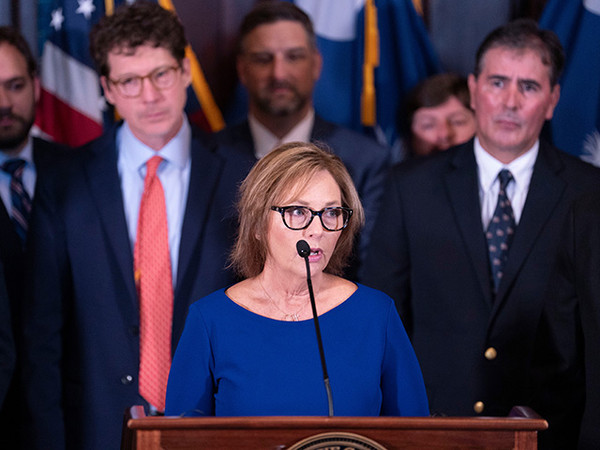

For reasons that are completely obscure to us, upon the death of Senator Lindsey Graham, President Donald Trump immediately threw his support behind the appointment of the late Senator’s sister, Darline Graham Nordone, to temporarily represent South Carolina in the U.S. Senate, a recommendation that Gov. Henry McMaster ultimately accepted Monday.
Before the announcement, President Trump vigorously urged McMaster to select Nordone.
“I recommended, to Governor Henry McMaster, Lindsey Graham’s wonderful sister, Darline, to serve as interim Senator from the Great State of South Carolina,” Trump wrote on Truth Social. “This would be a fabulous tribute to Lindsey, who loved her dearly!”
South Carolina Sen. Tim Scott also endorsed the decision before McMaster’s announcement, saying there was “no one better” to temporarily carry out Graham’s duties.
The late Senator had just secured renomination in last month’s GOP primary and was preparing for a general election campaign this fall before his unexpected death.
Under South Carolina law, a special election will determine who serves the remainder of Graham’s Senate term, while Nordone will serve on an interim basis until voters choose a permanent successor. Republican candidates are expected to compete for the party’s nomination before facing Democrat Annie Andrews in the general election.
Ms. Nordone is expected to be sworn in today. So far it is unclear if Ms. Nordone will run to become her brother’s permanent replacement.
The bond between Darline and Lindsey Graham has long been an important part of Senator Graham’s biography.
Nordone and Graham grew up in Central, South Carolina, where their parents, Millie and F.J. Graham, operated the Sanitary Cafe, a combination restaurant, bar and pool hall. The family lived modestly, at one point residing in a room behind the business, Newsweek reported.
When their mother died of Hodgkin's lymphoma in 1976, the Post and Courier reported and their father died just 15 months later, Lindsey Graham, then a college student in his early 20s, took responsibility for his teenage sister.
According to the Post and Courier, Graham later adopted Nordone after joining the Air Force so she could receive military benefits. He became her legal guardian and helped raise her into adulthood.
Ms. Nordone has worked as an optician and held positions at several South Carolina state agencies, including the Commission for the Blind and the Department of Employment and Workforce. A resident of Lexington, she graduated from the College of Charleston and earned a master's degree in rehabilitation counseling.
Senator Graham, who never married, relied on his sister to fill the political role normally occupied by a spouse and Darline remained a constant presence throughout her brother's political career, appearing at campaign events and in several of his advertisements. Nordone stood alongside him when he filed for reelection earlier this year, joined by her children and grandchildren.
While some observers have privately argued that the leap from political prop to Senator is a long one, no one that we could find would go on the record with criticism of the appointment.
Senator Graham’s sudden death has left the South Carolina GOP with a big hole to fill, but no shortage of potential candidates weighing their options.
Representative Joe Wilson and South Carolina native Treasury Secretary Scott Bessent have already taken themselves out of the race. However, Representative Ralph Norman is allegedly considering a run. Speculation has also centered on former South Carolina Governor, U.N. Ambassador and GOP presidential hopeful Nikki Haley, Rep. Nancy Mace and Lieutenant Governor Pam Evette as potential candidates in the special GOP primary.
Russell Fry, businessman Mark Lynch, whom Graham defeated in last month's Republican primary, and former Governor Mark Sanford, who served two separate stints in the U.S. House, are also alleged to be considering a run in the special primary.
Under South Carolina law, the filing period for a special primary election opens on the second Tuesday following a candidate’s death, which in this case would be July 21, and lasts one week.
The special primary would then be held on August 11, the second Tuesday after the filing period closes. If no candidate secures a majority, a runoff election would follow on August 25. The eventual nominee would then have a little more than two months to campaign ahead of the November 3 general election.
The conventional wisdom from the political class is that Governor McMaster and President Trump should have chosen as a temporary replacement someone who would run, and be a strong candidate, to be the permanent replacement for the late Senator.
That did not happen, apparently for reasons of sentiment that defy political logic. However, there may be a silver lining in what appears to be an illogical appointment. The final decision on who will replace one of the Senate’s most high-profile members now rests, as it should, with South Carolina’s grassroots Republican voters. And the millionaires club of the U.S. Senate now has a new voice drawn from the American middle class, who is intimately familiar with its struggles, and will, we hope, bring a dose of reality to that often out-of-touch legislative body.