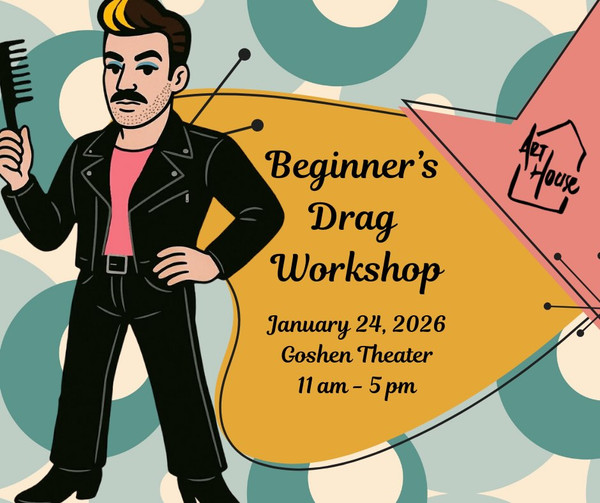

If you thought that the depravity of drag shows and other public displays of sexual deviance is limited to our rotting coastal cities, such as San Francisco and New York, think again, because it is now creeping into the small towns of America’s heartland, like Goshen, Indiana.
Goshen, the county seat of Elkhart County and home to Goshen Collage, a well-respected college affiliated with the Mennonite Church, boasts a downtown of nicely preserved 19th and early 20th century store fronts, with the Goshen Theater standing as the anchor of downtown preservation efforts.
The theater, renovated and restored through a $5.2 million renovation project funded through grants and an extensive public fundraising campaign is the jewel of the city’s Main Street.
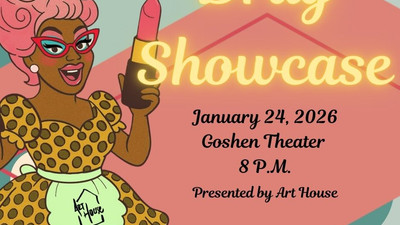
And on Saturday, January 24, 2026 the theater, which was restored and reopened through the donations of Goshen’s most prominent citizens and community organizations, and is now operated by a board of directors, will host a “Beginner's Drag Workshop” and “Drag Showcase” in the same space used later for the Elkhart County Boys and Girls Club art show.
There are no age limitations or parental warnings on these shows, so no doubt children would be welcome, especially to the “Beginner's Drag Workshop.”
While it is impossible to understand why community leaders and donors have seemingly remained silent as the depravity of these public displays of sexual deviance take place on the Main Street of their town, it is easy to understand why the promotors of these shows want to host them in small towns like Goshen, Indiana – their intention is to normalize their deviance.
And they are not shy about saying so.
The drag queen might appear as a comic figure, but he carries an utterly serious message: the deconstruction of sex, the reconstruction of child sexuality, and the subversion of middle-class family life.
The ideology that drives this movement was born in the sex dungeons of San Francisco and incubated in the academy. It is now being transmitted, with official state support, in a number of public libraries and schools across the United States. By excavating the foundations of this ideology and sifting through the literature of its activists, conservative cultural commentator Christopher Rufo says parents and citizens can finally understand the new sexual politics and formulate a strategy for resisting it.
Start with queer theory, the academic discipline born in 1984 with the publication of Gayle S. Rubin’s essay “Thinking Sex: Notes for a Radical Theory of the Politics of Sexuality.” Beginning in the late 1970s, Rubin, a lesbian writer and activist, had immersed herself in the subcultures of leather, bondage, orgies, fisting, and sado-masochism in San Francisco, migrating through an ephemeral network of BDSM (bondage, domination, sadomasochism) clubs, literary societies, and New Age spiritualist gatherings.
In “Thinking Sex,” Rubin sought to reconcile her experiences in the sexual underworld with the broader forces of American society. Following the work of the French theorist Michel Foucault, Rubin sought to expose the power dynamics that shaped and repressed human sexual experience.
“Modern Western societies appraise sex acts according to a hierarchical system of sexual value,” Rubin wrote. “Marital, reproductive heterosexuals are alone at the top erotic pyramid. Clamouring below are unmarried monogamous heterosexuals in couples, followed by most other heterosexuals. . . . Stable, long-term lesbian and gay male couples are verging on respectability, but bar dykes and promiscuous gay men are hovering just above the groups at the very bottom of the pyramid. The most despised sexual castes currently include transsexuals, transvestites, fetishists, sadomasochists, sex workers such as prostitutes and porn models, and the lowliest of all, those whose eroticism transgresses generational boundaries.”
Pay attention to the phrase “eroticism transgresses generational boundaries” that’s your cue the real targets of these workshops and performances are your children. And it is also worth noting that the figure chosen to represent the “Beginner's Drag Workshop” is not the comical drag queen, but a leather-clad “leather daddy,” a figure associated with Bondage/Discipline, Dominance/Submission, Sadism/Masochism in San Francisco’s South of Market Street sex dungeon culture.
Gayle S. Rubin’s project—and, by extension, that of queer theory—was to interrogate, deconstruct, and subvert this sexual hierarchy and usher in a world beyond limits, much like the one she had experienced in San Francisco. The key mechanism for achieving this turn was the thesis of social construction.
“The new scholarship on sexual behaviour has given sex a history and created a constructivist alternative to” the view that sex is a natural and pre-political phenomenon, Rubin wrote.
“Underlying this body of work is an assumption that sexuality is constituted in society and history, not biologically ordained. This does not mean the biological capacities are not prerequisites for human sexuality. It does mean that human sexuality is not comprehensible in purely biological terms.”
In other words, traditional conceptions of sex, regarding it as a natural behavior that reflects an unchanging order, are pure mythology, designed to rationalize and justify systems of oppression.
For Rubin and later queer theorists, sex and gender were infinitely malleable. There was nothing permanent about human sexuality, which was, after all, “political.” Through a revolution of values, they believed, the sexual hierarchy could be torn down and rebuilt in their image.
“There [are] historical periods in which sexuality is more sharply contested and more overtly politicized,” Rubin wrote. “In such periods, the domain of erotic life is, in effect, renegotiated.”
And, following the practice of any good negotiator, they laid out their theory of the case and their maximum demands. As Rubin explained: “A radical theory of sex must identify, describe, explain, and denounce erotic injustice and sexual oppression. Such a theory needs refined conceptual tools which can grasp the subject and hold it in view. It must build rich descriptions of sexuality as it exists in society and history. It requires a convincing critical language that can convey the barbarity of sexual persecution.” Once the ground is softened and the conventions are demystified, the sexual revolutionaries could do the work of rehabilitating the figures at the bottom of the hierarchy—“transsexuals, transvestites, fetishists, sadomasochists, sex workers.”
Where does this process end?
At its logical conclusion: the abolition of restrictions on the behavior at the bottom end of the moral spectrum—pedophilia. Though she uses euphemisms such as “boylovers” and “men who love underaged youth,” Rubin makes her case clearly and emphatically.
In long passages throughout “Thinking Sex,” Rubin denounces fears of child sex abuse as “erotic hysteria,” rails against anti–child pornography laws, and argues for legalizing and normalizing the behavior of “those whose eroticism transgresses generational boundaries.” These men are not deviants, but victims, in Rubin’s telling.
“Like communists and homosexuals in the 1950s, boylovers are so stigmatized that it is difficult to find defenders for their civil liberties, let alone for their erotic orientation,” she explains. “Consequently, the police have feasted on them. Local police, the FBI, and watchdog postal inspectors have joined to build a huge apparatus whose sole aim is to wipe out the community of men who love underaged youth. In twenty years or so, when some of the smoke has cleared, it will be much easier to show that these men have been the victims of a savage and undeserved witch hunt.” Rubin wrote fondly of those primitive hunter-gatherer tribes in New Guinea in which “boy-love” was practiced freely.
Such positions are hardly idiosyncratic within the discipline of queer theory.
Longtime Rubin collaborator Pat Califia, who would later become a transgender man, claimed that American society had turned pedophiles into “the new communists, the new niggers, the new witches.” For Califia, age-of-consent laws, religious sexual mores, and families who police the sexuality of their children represented a thousand-pound bulwark against sexual freedom.
“You can’t liberate children and adolescents without disrupting the entire hierarchy of adult power and coercion and challenging the hegemony of antisex fundamentalist religious values,” she lamented. All of it—the family, the law, the religion, the culture—was a vector of oppression, and all of it had to go.
After a lengthy examination of the historical and philosophical underpinnings of how drag fits into modern sexual politics, Mr. Rufo explains the final turn in the story of drag is, in some ways, the most surprising.
As the dark side of drag pushed transgression to the limits, another faction began moving from the margins to the mainstream. Some drag queens—most notably, the drag performer RuPaul—toned down the routines, pushed the ideology deep into the background, and presented drag as good old-fashioned, glamorous American fun. Television producers packaged this new form of drag as reality programming, softening the image of the drag queen and assimilating the genre into mass media and consumer culture.
This provided an opportunity for what’s going on in Goshen, Indiana this Saturday.
As the queer theorists’ vanguard intellectual project was running aground on incest and bestiality fantasies, the most enterprising among them took a different tack: using the commercialization of drag and the goodwill associated with the gay and lesbian rights movement as a means of transforming drag performances into “family-friendly” events that could transmit a simplified version of queer theory to children.
The key figure in this transition was a “genderqueer” college professor and drag queen named Harris Kornstein—stage name Lil Miss Hot Mess—who hosted some of the original readings in public libraries and wrote the children’s book The Hips on the Drag Queen Go Swish, Swish, Swish. Kornstein sits on the board of Drag Queen Story Hour, the nonprofit organization that was founded by Michelle Tea in 2015 to promote “family-friendly” drag performances and has since expanded to 40 local chapters that have organized hundreds of performances across the United States.
Kornstein also published the manifesto for the movement, “Drag Pedagogy: The Playful Practice of Queer Imagination in Early Childhood,” with coauthor Harper Keenan, a female-to-male transgender queer theorist at the University of British Columbia. With citations to Foucault and Butler, the essay begins by applying queer theory’s basic premise of social constructivism and heteronormativity to the education system.
“The professional vision of educators is often shaped to reproduce the state’s normative vision of its ideal citizenry. In effect, schooling functions as a way to straighten the child into a kind of captive alignment with the current parameters of that vision,” Kornstein and Keenan write. “To state it plainly, within the historical context of the USA and Western Europe, the institutional management of gender has been used as a way of maintaining racist and capitalist modes of (re)production.”
To disrupt this dynamic, the authors propose a new teaching method, “drag pedagogy,” as a way of stimulating the “queer imagination,” teaching kids “how to live queerly,” and “bringing queer ways of knowing and being into the education of young children.”
As Kornstein and Keenan explain, this is an intellectual and political project that requires drag queens and activists to work toward undermining traditional notions of sexuality, replacing the biological family with the ideological family, and arousing transgressive sexual desires in young children.
For the drag pedagogists, the traditional life path—growing up, getting married, working 40 hours a week, and raising a family—is an oppressive bourgeois norm that must be deconstructed and subverted.
As the drag queens take the stage in their sexually suggestive costumes, Kornstein and Keenan argue, their task is to disrupt the “binary between womanhood and manhood,” seed the room with “gender-transgressive themes,” and break the “reproductive futurity” of the “nuclear family” and the “sexually monogamous marriage”—all of which are considered mechanisms of heterosexual, capitalist oppression. The books selected in many Drag Queen Story Hour performances—Cinderelliot, If You’re a Drag Queen and You Know It, The Gender Wheel, Bye Bye, Binary, and They, She, He, Easy as ABC—promote this basic narrative.
Though events are often billed as “family-friendly,” Kornstein and Keenan explain that this is a form of code: “It may be that DQSH is ‘family friendly,’ in the sense that it is accessible and inviting to families with children, but it is less a sanitizing force than it is a preparatory introduction to alternate modes of kinship. Here, DQSH is ‘family friendly’ in the sense of ‘family’ as an old-school queer code to identify and connect with other queers on the street.” That is, the goal is not to reinforce the biological family but to facilitate the child’s transition into the ideological family.
Editor’s Note: This is the same method used by communists, NAZIs and other totalitarian ideologies – think of the “Beginner's Drag Workshop” as the precursor to your child leaving your biological family and your parental guidance to join the ideological family of the Hitler Youth or the Communist Party’s Young Pioneers.
When Goshen, Indiana’s parents, voters, and political leaders understand the true nature of “Beginner's Drag Workshop,” the inevitable follow-up of Drag Queen Story Hour at the library, and the ideology that drives them, we would hope they would work quickly to restore the limits that have been temporarily—and recklessly—abandoned by the Goshen Theater, its management and donors and board.
But so far no one has stepped-up to publicly oppose normalizing this degeneracy, not a minister, not an elected official, not a donor, not a board member.
If you agree that it is time to draw a bright line between adult sexuality and childhood innocence, and send the perversions of “genderfuck,” “primitivism,” and the degeneracy of Beginner's Drag Workshop, back to the margins, where they belong, we urge you to show up at the Goshen Theater on January 24, 2026, from 11:30 a.m. to 8:00 p.m. to protest these events. The theater address is 216 South Main Street, Goshen, Indiana, the telephone number is 574-213-0322.
CHQ Editor George Rasley is a member of Faith Leaders for America. His family were Goshen and Elkhart County, Indiana pioneers. He was ordained an Elder of the First Presbyterian Church of Goshen, Indiana, served as Councilman at Large on the Goshen City Council and as a member of the Board of Directors of Goshen Hospital. The views presented here are his own and are not claimed to represent the position of any church or institution with which he has been associated. Mr. Rasley now commutes between his home and business in Florida and Washington, DC.