
FLASH UPDATE: At 2:58 a.m. this morning on Truth Social President Trump posted: "If Iran shots [sic] and violently kills peaceful protesters, which is their custom, the United States of America will come to their rescue. We are locked and loaded and ready to go."
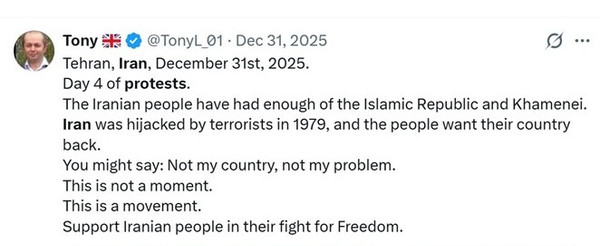
Massive nationwide protests calling for regime change erupted across Iran over the weekend. The protests were prompted by Iran’s failing economy and the relentless authoritarianism of Iran’s theocratic regime. However, instead of siding with the protestors, the Trump administration, like the Obama administration before it, stopped far short of offering them assistance in overthrowing the oppressive Islamist regime of Ayatollah Ali Khamenei.
Speaking on Monday in Florida President Trump said Iranian authorities routinely open fire on demonstrators. “They kill people,” Trump said at Mar-a-Lago. “Every time they have a riot, or somebody forms a group, little or big, they start shooting people.”
“I’m not going to talk about overthrow of a regime,” Trump said, adding that Iran’s leadership already faces severe internal pressure.
While we generally support President Trump’s foreign policy, we find his remarks virtually indistinguishable from what former Presidents Barack Obama and Joe Biden said when faced with a similar opportunity to foment internal opposition to the failing leadership of our mortal Islamist enemy.
Back in 2009 during similar protests Obama said he was watching the news from Iran. It is “up to Iranians to make decisions about who Iran’s leaders will be,” he said, adding that “we respect Iranian sovereignty and want to avoid the United States being the issue inside of Iran.”
Everyone understands that Obama, who was raised as a Marxist and a Muslim, was in the tank for the Ayatollahs; he sent them billions of dollars in cash and negotiated the “Obamabomb Treaty” that eliminated sanctions and put their nuclear weapons program miles ahead of where it would have been had sanctions stayed in place.
However, President Trump knows better, or at least he should, because at the same time he was saying he wasn’t going to talk about regime change he threatened to “quickly eradicate” and “knock down” any attempts by Iran’s Ayatollahs to rebuild their nuclear program.
Let’s say, giving the President the benefit of the doubt, that he is being coy about what the United States may or may not do regarding regime change in Iran. Everyone who is realistic about the now 47-year-old war Iran’s theocratic regime declared on America knows that regime change is the only way to permanently stop Iran’s drive to acquire nuclear weapons.
Now it is clear that the totalitarian system of Sharia-supremacism and “Absolute Wilayat al-Faqih” (Guardianship of the Jurist) has steadily lost whatever popular support it had at the beginning of the Khomeinist revolution.
Much of this erosion of support can also be attributed to the effects of the economic warfare we have conducted through various sanctions the United States imposed upon Iran and its leaders.
The problem is that the sanctions and other intelligence operations the United States have conducted against Iran have lacked a consistent strategic vision behind them, or to the extent there has been a strategic vision it has been strictly defensive in nature.
The bottom line is that previously when the Iranian people have protested the failures of Khomeinism and Absolute Wilayat al-Faqih the United States did little or nothing concrete to use that popular discontent to undermine the regime, instead substituting holding worthless real estate in the Middle East and killing a few thousand ignorant jihadis for fighting and winning the real war – which is the defeat of Sharia-supremacism and Iranian Absolute Wilayat al-Faqih.
Now is the time to turn popular dissent into regime change in Iran.
Unfortunately, none of the generals who have been tasked with fighting and winning the wars in Syria, Afghanistan and Iraq, and certainly none of the politicians who have advocated United States involvement in them, have been willing to accept and confront the truth that to end the war Iran has declared on us we have to defeat the ideology of Wilayat al-Faqih.
How would we go about that given American weariness with war in the Middle East and President Trump’s often stated opposition to American “boots on the ground” in Iran?
As our late friend Michael Ledeen made clear in countless articles and two books, there are alternatives to an all-out shooting war, however, “Fighting back against Iran is difficult and costly. No American president from Carter to Obama has been willing to take it on.”
As an alternative to what Mr. Ledeen called “an all-out shooting war” President Trump could start by updating to the 21st century the tools President Ronald Reagan used to defeat Communism in Eastern Europe in the 1980s.
Here are four simple steps that we could take almost immediately to help bring about regime change in Iran:
The weakness of Iran’s system of Wilayat al-Faqih has never been more obvious and the opportunity to undermine it from within rarely greater. As James Phillips, a senior research fellow for Middle Eastern affairs at The Heritage Foundation said in a 2019 article, the harder Iran’s dictatorship struggles to oppose reforms that threaten its power, the sooner young Iranians and Arabs forced to live under Tehran’s thumb will reach the conclusion that Iran’s Islamist model is bankrupt economically, politically, and morally.
George Rasley is editor of Richard Viguerie's ConservativeHQ.com and is a veteran of over 300 political campaigns. A member of American MENSA, he served on the staff of Vice President Dan Quayle, as Director of Policy and Communication for former Congressman Adam Putnam (FL-12) then Vice Chairman of the Oversight and Government Reform Committee's Subcommittee on National Security and Foreign Affairs, and as spokesman for retired Rep. Mac Thornberry formerly a member of the House Intelligence Committee and Chairman of the House Armed Services Committee.
Massive nationwide protests calling for regime change erupted across Iran over the weekend. The protests were prompted by Iran’s failing economy and the relentless authoritarianism of Iran’s theocratic regime. However, instead of siding with the protestors, the Trump administration, like the Obama administration before it, stopped far short of offering them assistance in overthrowing the oppressive Islamist regime of Ayatollah Ali Khamenei.
Speaking on Monday in Florida President Trump said Iranian authorities routinely open fire on demonstrators. “They kill people,” Trump said at Mar-a-Lago. “Every time they have a riot, or somebody forms a group, little or big, they start shooting people.”
“I’m not going to talk about overthrow of a regime,” Trump said, adding that Iran’s leadership already faces severe internal pressure.
While we generally support President Trump’s foreign policy, we find his remarks virtually indistinguishable from what former Presidents Barack Obama and Joe Biden said when faced with a similar opportunity to foment internal opposition to the failing leadership of our mortal Islamist enemy.
Back in 2009 during similar protests Obama said he was watching the news from Iran. It is “up to Iranians to make decisions about who Iran’s leaders will be,” he said, adding that “we respect Iranian sovereignty and want to avoid the United States being the issue inside of Iran.”
Everyone understands that Obama, who was raised as a Marxist and a Muslim, was in the tank for the Ayatollahs; he sent them billions of dollars in cash and negotiated the “Obamabomb Treaty” that eliminated sanctions and put their nuclear weapons program miles ahead of where it would have been had sanctions stayed in place.
However, President Trump knows better, or at least he should, because at the same time he was saying he wasn’t going to talk about regime change he threatened to “quickly eradicate” and “knock down” any attempts by Iran’s Ayatollahs to rebuild their nuclear program.
Let’s say, giving the President the benefit of the doubt, that he is being coy about what the United States may or may not do regarding regime change in Iran. Everyone who is realistic about the now 47-year-old war Iran’s theocratic regime declared on America knows that regime change is the only way to permanently stop Iran’s drive to acquire nuclear weapons.
Now it is clear that the totalitarian system of Sharia-supremacism and “Absolute Wilayat al-Faqih” (Guardianship of the Jurist) has steadily lost whatever popular support it had at the beginning of the Khomeinist revolution.
Much of this erosion of support can also be attributed to the effects of the economic warfare we have conducted through various sanctions the United States imposed upon Iran and its leaders.
The problem is that the sanctions and other intelligence operations the United States have conducted against Iran have lacked a consistent strategic vision behind them, or to the extent there has been a strategic vision it has been strictly defensive in nature.
The bottom line is that previously when the Iranian people have protested the failures of Khomeinism and Absolute Wilayat al-Faqih the United States did little or nothing concrete to use that popular discontent to undermine the regime, instead substituting holding worthless real estate in the Middle East and killing a few thousand ignorant jihadis for fighting and winning the real war – which is the defeat of Sharia-supremacism and Iranian Absolute Wilayat al-Faqih.
Now is the time to turn popular dissent into regime change in Iran.
Unfortunately, none of the generals who have been tasked with fighting and winning the wars in Syria, Afghanistan and Iraq, and certainly none of the politicians who have advocated United States involvement in them, have been willing to accept and confront the truth that to end the war Iran has declared on us we have to defeat the ideology of Wilayat al-Faqih.
How would we go about that given American weariness with war in the Middle East and President Trump’s often stated opposition to American “boots on the ground” in Iran?
As our late friend Michael Ledeen made clear in countless articles and two books, there are alternatives to an all-out shooting war, however, “Fighting back against Iran is difficult and costly. No American president from Carter to Obama has been willing to take it on.”
As an alternative to what Mr. Ledeen called “an all-out shooting war” President Trump could start by updating to the 21st century the tools President Ronald Reagan used to defeat Communism in Eastern Europe in the 1980s.
Here are four simple steps that we could take almost immediately to help bring about regime change in Iran:
Pump-up the power and content of Farsi language programing through radio and TV, especially satellite TV, making it clear that we stand with the people of Iran in their quest for liberty.
Pump-up the power and content of our Farsi language social media communications with the people of Iran and integrate them with radio and TV messages proposed above.
Use clandestine means to deliver cellphones, satellite phones, radios and laptops to Iranian dissidents to that they can communicate with each other outside of government channels.
Create online and on-air communications channels that dissidents can access to communicate outside of the Iranian government channels, for example digital radio channels could provide Iranians with news, entertainment and information on protest locations.
Pump-up the power and content of our Farsi language social media communications with the people of Iran and integrate them with radio and TV messages proposed above.
Use clandestine means to deliver cellphones, satellite phones, radios and laptops to Iranian dissidents to that they can communicate with each other outside of government channels.
Create online and on-air communications channels that dissidents can access to communicate outside of the Iranian government channels, for example digital radio channels could provide Iranians with news, entertainment and information on protest locations.
The weakness of Iran’s system of Wilayat al-Faqih has never been more obvious and the opportunity to undermine it from within rarely greater. As James Phillips, a senior research fellow for Middle Eastern affairs at The Heritage Foundation said in a 2019 article, the harder Iran’s dictatorship struggles to oppose reforms that threaten its power, the sooner young Iranians and Arabs forced to live under Tehran’s thumb will reach the conclusion that Iran’s Islamist model is bankrupt economically, politically, and morally.
George Rasley is editor of Richard Viguerie's ConservativeHQ.com and is a veteran of over 300 political campaigns. A member of American MENSA, he served on the staff of Vice President Dan Quayle, as Director of Policy and Communication for former Congressman Adam Putnam (FL-12) then Vice Chairman of the Oversight and Government Reform Committee's Subcommittee on National Security and Foreign Affairs, and as spokesman for retired Rep. Mac Thornberry formerly a member of the House Intelligence Committee and Chairman of the House Armed Services Committee.