
Leave it to Democrats, and a few Republicans who view the Constitution as a suicide pact, to claim President Trump exceeded his authority when he ordered the military to attack Venezuelan drug-running boats. Not only are Trump’s critics wrong on the policy, as we explain with the help of our friend Rod D. Martin, they are wrong on the Constitution and history as well.
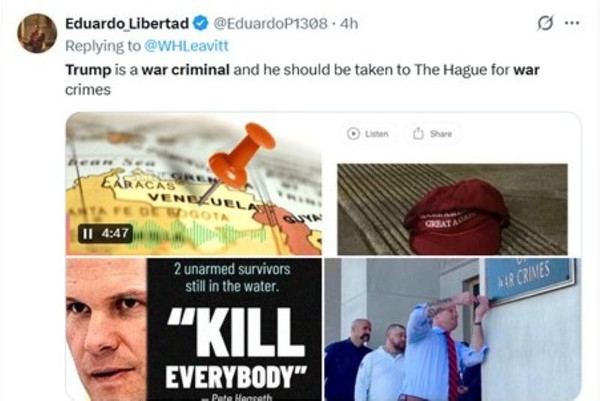
After the Washington Post reported Defense Secretary Pete Hegseth issued a verbal order for all crew members to be killed as part of a Sept. 2 attack on Venezuelan drug boats Democrat Senator Tim Kaine of Virginia said, “This rises to the level of a war crime if it’s true.” And Republican Representative Mike Turner (OH-10) said, “Obviously, if that occurred, that would be very serious and I agree that that would be an illegal act.”
We think Turner and Kaine are wrong and need to read up on the Constitution, the Maritime Drug Law Enforcement Act (MDLEA), and Supreme Court case law going back to 1820 before accusing anyone of war crimes.
Ultimately, wrote Clifford Angell Bates, Jr. for the November 4, 2025 issue of the Rod Martin report, the debate is not about executive tyranny but constitutional interpretation: whether the architecture of separated powers was designed to restrain decisive action or to enable it when the Republic’s security and laws are at stake. In an era of transnational criminal networks and asymmetric warfare, the old quarrel over presidential power is anything but academic — it defines the frontier between legality, necessity, and survival.
First, let’s dispense with the claim that drug runners operating stateless vessels in international waters are due American constitutional protections, such as due process.
As Mr. Bates explained, the legal concept of hostis humani generis comes from United States v. Smith (18 U.S. 153, 1820). Pirates, the Court explained, are “enemies of all mankind.” This principle allows universal jurisdiction over pirates. Any nation may apprehend and punish them, regardless of nationality or location.
The framers incorporated this principle into the Define and Punish Clause. Borders do not limit felonies on the high seas. Congress can legislate broadly. The executive can enforce.
Modern narco-terrorists fit the same model. Cartels that traffic drugs with violence, coercion, and cross-border operations pose threats comparable to piracy. They endanger commerce, security, and human life globally. Like pirates, they act beyond any one nation’s control.
Pirates were routinely executed on the high seas, indeed, in the battle with the pirate Blackbeard off Ocracoke Island in 1719, “Pirates who lost their nerve and jumped overboard, rather than fight to the end, were shot in the water as they tried to escape. None of them survived, and one corpse was found in the reeds days later, with buzzards circling overhead.”
What’s more, as Andrew Kent of Fordham Law School explained in Piracy and Due Process for the Michigan Journal of International Law:
Since the mid-twentieth century, U.S. Supreme Court case law and government practice have coalesced around the view that U.S. citizens carry their constitutional rights with them globally.7 But with regard to noncitizens, the law and practice are very different. The Supreme Court did not start opining on this issue until the latter part of the nineteenth century, but once it did, the Court repeatedly stated that noncitizens abroad were outside the protection of the Constitution.8
Before the late nineteenth century, direct statements about whether nonU.S. citizens possessed constitutional rights extraterritorially were few. Still, they pointed the same way—against extraterritorial rights for noncitizens.9
After an extensive review of cases and history Mr. Kent concluded that claims about due process and piracy suppression are incorrect. Both Parliament and the U.S. Congress; both the Crown and its counselors and U.S Presidents and their advisers; both the Royal Navy and the U.S. Navy; and commentators both English and American believed that (1) pirates on the high seas could lawfully be subject to extrajudicial killing, but that (2) the criminal justice system was usually the preferred approach to dealing with pirates, and when tried for their crimes in English or American territory respectively, accused pirates were entitled to due process of law.
Narco-terrorists who use violence violate the law of nations. Universal jurisdiction applies and there is no requirement they be apprehended when operating in international waters.
Congress codified this authority in the Maritime Drug Law Enforcement Act of 1986 (46 U.S.C. §§ 70501–70507), explained Mr. Bates. The MDLEA criminalizes drug manufacture, distribution, and possession on vessels subject to U.S. jurisdiction on the high seas. Penalties include life imprisonment. Jurisdiction applies automatically to U.S.-flagged vessels, universally to stateless ships, and to foreign-flagged vessels with flag-state consent. Over thirty countries, including Colombia and Mexico, have agreements with the U.S. No direct U.S. nexus is required for stateless vessels.
The Coast Guard may board, search, and seize vessels and arrest suspects without warrants under 14 U.S.C. § 89. Courts have upheld these actions as consistent with the Constitution and statutory authority. United States v. Villamonte-Marquez (462 U.S. 579, 1983) confirmed that mobility and border-search exigencies justify warrantless boardings. United States v. Suerte (291 F.3d 366, 5th Cir. 2002) held that drug trafficking on the high seas falls within the scope of high-seas felonies.
The president’s authority derives from the Constitution and congressional statutes. Article II makes the president Commander in Chief. Section 3 mandates that the president “take Care that the Laws be faithfully executed.” These clauses empower interdiction, seizure, arrest, and, in extreme circumstances, the use of lethal force.
Historical precedent supports decisive executive action. Revenue cutters in 1790 patrolled the high seas. In 1973, over a ton of marijuana was seized from the Big L (a 42-foot sport fisherman boat) in the Florida Straits. Today, interdictions cover six million square miles of ocean.
Deadly force is lawful under limited circumstances. Graham v. Connor (490 U.S. 386, 1989) establishes the standard of objective reasonableness. It applies when traffickers violently resist, threaten officers, or risk scuttling vessels. Coast Guard rules of engagement require proportionality. Executive Order 12333 prohibits assassination. MDLEA enforcement provides the legal authority to use lethal force when necessary and reasonable.
A classified Justice Department opinion in October 2025 explicitly authorized lethal strikes on cartel leaders and vessels. It framed narco-trafficking as an ongoing armed attack under international law. Article 51 of the UN Charter recognizes the right of the U.S. to self-defense in such circumstances. No territorial invasion or new congressional declaration is required.
In January 2025, the Trump administration designated groups such as Cartel de los Soles and Tren de Aragua as Foreign Terrorist Organizations. That allows operations to shift from law enforcement to counterterrorism. The president may act under Article II self-defense powers. Notification to Congress is given under the War Powers Resolution (50 U.S.C. §§ 1541–1548).
More importantly, wrote Mr. Bates, these operations fall within the 2001 Authorization for Use of Military Force (AUMF). The AUMF permits force against those who planned, authorized, or aided terrorist attacks or harbored such organizations. Modern narco-terrorists who threaten U.S. security clearly fit this category.
The president’s authority is inherent as Commander-in-Chief. Courts and the executive branch have repeatedly affirmed this power to repel attacks. Having designated groups such as Cartel de los Soles and Tren de Aragua as Foreign Terrorist Organizations the AUMF does not require the President to offer such terrorists surrender and arrest on the high seas as a battlefield option.
For the complete article by Clifford Angell Bates, Jr. examining this important issue click the link, and for more of this insightful commentary from Rod D. Martin and others we invite CHQ readers to subscribe to the Rod Martin Report at https://www.rodmartin.org/
After the Washington Post reported Defense Secretary Pete Hegseth issued a verbal order for all crew members to be killed as part of a Sept. 2 attack on Venezuelan drug boats Democrat Senator Tim Kaine of Virginia said, “This rises to the level of a war crime if it’s true.” And Republican Representative Mike Turner (OH-10) said, “Obviously, if that occurred, that would be very serious and I agree that that would be an illegal act.”
We think Turner and Kaine are wrong and need to read up on the Constitution, the Maritime Drug Law Enforcement Act (MDLEA), and Supreme Court case law going back to 1820 before accusing anyone of war crimes.
Ultimately, wrote Clifford Angell Bates, Jr. for the November 4, 2025 issue of the Rod Martin report, the debate is not about executive tyranny but constitutional interpretation: whether the architecture of separated powers was designed to restrain decisive action or to enable it when the Republic’s security and laws are at stake. In an era of transnational criminal networks and asymmetric warfare, the old quarrel over presidential power is anything but academic — it defines the frontier between legality, necessity, and survival.
First, let’s dispense with the claim that drug runners operating stateless vessels in international waters are due American constitutional protections, such as due process.
As Mr. Bates explained, the legal concept of hostis humani generis comes from United States v. Smith (18 U.S. 153, 1820). Pirates, the Court explained, are “enemies of all mankind.” This principle allows universal jurisdiction over pirates. Any nation may apprehend and punish them, regardless of nationality or location.
The framers incorporated this principle into the Define and Punish Clause. Borders do not limit felonies on the high seas. Congress can legislate broadly. The executive can enforce.
Modern narco-terrorists fit the same model. Cartels that traffic drugs with violence, coercion, and cross-border operations pose threats comparable to piracy. They endanger commerce, security, and human life globally. Like pirates, they act beyond any one nation’s control.
Pirates were routinely executed on the high seas, indeed, in the battle with the pirate Blackbeard off Ocracoke Island in 1719, “Pirates who lost their nerve and jumped overboard, rather than fight to the end, were shot in the water as they tried to escape. None of them survived, and one corpse was found in the reeds days later, with buzzards circling overhead.”
What’s more, as Andrew Kent of Fordham Law School explained in Piracy and Due Process for the Michigan Journal of International Law:
Since the mid-twentieth century, U.S. Supreme Court case law and government practice have coalesced around the view that U.S. citizens carry their constitutional rights with them globally.7 But with regard to noncitizens, the law and practice are very different. The Supreme Court did not start opining on this issue until the latter part of the nineteenth century, but once it did, the Court repeatedly stated that noncitizens abroad were outside the protection of the Constitution.8
Before the late nineteenth century, direct statements about whether nonU.S. citizens possessed constitutional rights extraterritorially were few. Still, they pointed the same way—against extraterritorial rights for noncitizens.9
After an extensive review of cases and history Mr. Kent concluded that claims about due process and piracy suppression are incorrect. Both Parliament and the U.S. Congress; both the Crown and its counselors and U.S Presidents and their advisers; both the Royal Navy and the U.S. Navy; and commentators both English and American believed that (1) pirates on the high seas could lawfully be subject to extrajudicial killing, but that (2) the criminal justice system was usually the preferred approach to dealing with pirates, and when tried for their crimes in English or American territory respectively, accused pirates were entitled to due process of law.
Narco-terrorists who use violence violate the law of nations. Universal jurisdiction applies and there is no requirement they be apprehended when operating in international waters.
Congress codified this authority in the Maritime Drug Law Enforcement Act of 1986 (46 U.S.C. §§ 70501–70507), explained Mr. Bates. The MDLEA criminalizes drug manufacture, distribution, and possession on vessels subject to U.S. jurisdiction on the high seas. Penalties include life imprisonment. Jurisdiction applies automatically to U.S.-flagged vessels, universally to stateless ships, and to foreign-flagged vessels with flag-state consent. Over thirty countries, including Colombia and Mexico, have agreements with the U.S. No direct U.S. nexus is required for stateless vessels.
The Coast Guard may board, search, and seize vessels and arrest suspects without warrants under 14 U.S.C. § 89. Courts have upheld these actions as consistent with the Constitution and statutory authority. United States v. Villamonte-Marquez (462 U.S. 579, 1983) confirmed that mobility and border-search exigencies justify warrantless boardings. United States v. Suerte (291 F.3d 366, 5th Cir. 2002) held that drug trafficking on the high seas falls within the scope of high-seas felonies.
The president’s authority derives from the Constitution and congressional statutes. Article II makes the president Commander in Chief. Section 3 mandates that the president “take Care that the Laws be faithfully executed.” These clauses empower interdiction, seizure, arrest, and, in extreme circumstances, the use of lethal force.
Historical precedent supports decisive executive action. Revenue cutters in 1790 patrolled the high seas. In 1973, over a ton of marijuana was seized from the Big L (a 42-foot sport fisherman boat) in the Florida Straits. Today, interdictions cover six million square miles of ocean.
Deadly force is lawful under limited circumstances. Graham v. Connor (490 U.S. 386, 1989) establishes the standard of objective reasonableness. It applies when traffickers violently resist, threaten officers, or risk scuttling vessels. Coast Guard rules of engagement require proportionality. Executive Order 12333 prohibits assassination. MDLEA enforcement provides the legal authority to use lethal force when necessary and reasonable.
A classified Justice Department opinion in October 2025 explicitly authorized lethal strikes on cartel leaders and vessels. It framed narco-trafficking as an ongoing armed attack under international law. Article 51 of the UN Charter recognizes the right of the U.S. to self-defense in such circumstances. No territorial invasion or new congressional declaration is required.
In January 2025, the Trump administration designated groups such as Cartel de los Soles and Tren de Aragua as Foreign Terrorist Organizations. That allows operations to shift from law enforcement to counterterrorism. The president may act under Article II self-defense powers. Notification to Congress is given under the War Powers Resolution (50 U.S.C. §§ 1541–1548).
More importantly, wrote Mr. Bates, these operations fall within the 2001 Authorization for Use of Military Force (AUMF). The AUMF permits force against those who planned, authorized, or aided terrorist attacks or harbored such organizations. Modern narco-terrorists who threaten U.S. security clearly fit this category.
The president’s authority is inherent as Commander-in-Chief. Courts and the executive branch have repeatedly affirmed this power to repel attacks. Having designated groups such as Cartel de los Soles and Tren de Aragua as Foreign Terrorist Organizations the AUMF does not require the President to offer such terrorists surrender and arrest on the high seas as a battlefield option.
For the complete article by Clifford Angell Bates, Jr. examining this important issue click the link, and for more of this insightful commentary from Rod D. Martin and others we invite CHQ readers to subscribe to the Rod Martin Report at https://www.rodmartin.org/