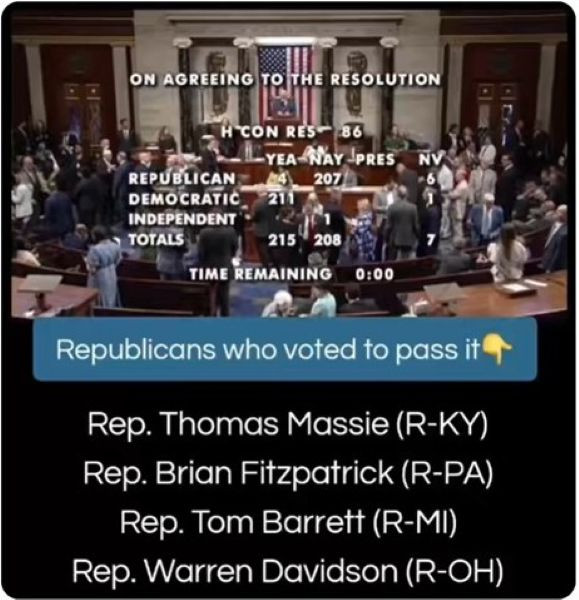

In an act of supreme folly and betrayal, the U.S. House of Representatives, on June 3, passed a resolution to withdraw U.S. troops from armed hostilities with Iran.
Lawmakers voted 215–208 for the Democrat-led measure. Four Republicans voted with Democrats in support of the resolution.
The four alleged Republicans who betrayed our constitutional republic, largely out of personal animus to President Donald Trump, were Reps. Tom Barrett (R-Mich.), Warren Davidson (R-Ohio), Brian Fitzpatrick (R-Pa.), and Thomas Massie (R-Ky).
The measure invokes the 1973 War Powers Resolution to halt the Iran conflict or otherwise force U.S. President Donald Trump to obtain congressional approval to continue the military operations against Iran that began on Feb. 28.
The 1973 War Powers Resolution states that a president must remove U.S. forces from any hostilities lacking congressional authorization within 60 days. However, a president may extend that timeline by 30 days to enable a safe troop withdrawal.
The Senate would still need to pass this latest measure for it to have a chance of becoming law, and Trump could still issue a veto, noted the writers at the Epoch Times.
A previous resolution to halt the Iran conflict failed in the House on May 14 in a 212–212 tie vote. Democrats had set a follow-up attempt in motion, with a vote scheduled on May 21, but Republican leaders in the House were able to cancel the vote at the last minute, amid growing signs it could pass.
House Speaker Mike Johnson (R-La.) said the timing of the Democrat-led resolution could interfere with Trump’s efforts to negotiate a lasting peace agreement with Tehran.
“The president is now in the process of concluding a peace agreement, and we have to allow him the latency to do that,” Johnson told The Epoch Times ahead of the scheduled vote. “And I think a war powers resolution right now is very untimely and a very negative and dangerous thing in the country.”
Speaker Johnson is right, the passage of the Resolution is not only a personal betrayal of President Trump, it also undercuts his negotiating position and emboldens the Islamic Republic of Iran to continue their stalling tactics.
The Iranians understand us and our politics much better than the Trump team understands them, and they have obviously concluded, no doubt with encouragement from their allies in the Democratic Party, that pushing the President up against the midterm congressional elections bolsters their position.
Apropos that strategy, Tehran and Washington recently issued contradictory messages over the status of ceasefire discussions. President Donald Trump insisted Wednesday a firm deal could precipitate “this weekend,” but Iran’s Foreign Minister Abbas Araghchi said there has been no “significant process.”
“Fake news reports that the Islamic Republic of Iran, and the U.S.A., stopped speaking a few days ago are false and erroneous,” the President insisted Tuesday afternoon. “The conversations between us have been going on continuously.” The President did, however, indicate that time is running out for Tehran to make a decision.
“As I told Iran, ‘It’s time, one way or another, for you to make a deal. You’ve been doing this for 47 years, and it cannot be allowed to go on any longer,’” he said, referencing the Islamic regime’s rule.
Citing progress in the negotiations Secretary of State Marco Rubio when testifying before Congress on Tuesday said that Iran had “agreed” to negotiate certain aspects of the nuclear program.
"They have agreed to negotiate aspects of their nuclear program that just a month ago, just a year ago, they were refusing to even mention," he said.
Washington and Tehran officially reached a ceasefire on April 7, but Trump subsequently implemented an armed blockade of Iranian ports and trade, and U.S. and Iranian forces have exchanged fire on several occasions, and the Iranians have launched attacks against the regional countries they perceive as helping the United States.
While we laud President Trump’s search for a negotiated end to hostilities, we doubt very much that it will succeed, especially with the Islamic Republic of Iran’s allies in Congress undercutting the President’s negotiating position.
From our perspective of 50-years of studying Iran’s Shia Twelver revolutionary government and working on national security matters one thing is quite clear to us; no Iranian Twelver is ever going to surrender on our terms.
To do so would involve not only violating the Islamic Republic’s political values, as expressed in their constitution and the governing principles of Khomeinism, or “Absolute Wilayat al-Faqih” (Guardianship of the Jurist), it would also violate the core religious principles of Shia Islam, namely that by spreading war and chaos the return of the hidden Twelfth Imam will be hastened and an Armageddon-like conflict will bring about the worldwide rule of Shia Islam.
Killing General Qasem Soleimani, Supreme Leader Ayatollah Ali Khamenei, secretary of the Supreme National Security Council Ali Larijani, Defense Minister Aziz Nasirzadeh, Army Chief of Staff Abdul Rahim Mousavi, Intelligence Minister Esmail Khatib, commander of Iran's Basij paramilitary force Gholamreza Soleimani, and others, does not defeat the Islamic Republic of Iran’s ideology of Wilayat al-Faqih.
This ideology, based on Shia “Twelver” Islam, is the motivating force behind Iran’s drive to acquire a nuclear weapon and to sow terror and chaos across the world. Killing Iran’s leaders does not defeat this ideology because another adherent of Wilayat al-Faqih will step up to take their place.
It is obvious to us, but apparently not to the Trump team, that in the near term the Ayatollahs will give up only the minimum necessary for the regime to survive, in the long term, they have every intention of continuing their war against the United States and Israel, because it is the entire reason for the existence of the Islamic Republic.
So, we can kill Iranian leaders down to the point that sergeants are running the army and the clerks are running the government and they are not going to change their goal of acquiring nuclear weapons and their stated policy of death to the two Satans, the United States and Israel, and the House passage of the recent war powers resolution only emboldens them to continue to stall through the midterm elections.
Defeating and replacing the ideology of Wilayat al-Faqih is a necessary condition of “winning” the war and achieving a lasting peace with a new Iran. Until a truly secular government made up of Wester-oriented Iranians committed to peace is in place the war the Islamic Republic declared 47 years ago on America and the West will continue with the encouragement of Democrats and feckless Republicans, such as Reps. Tom Barrett, Warren Davidson, Brian Fitzpatrick, and Thomas Massie.
George Rasley is editor of Richard Viguerie's ConservativeHQ.com. A veteran of over 300 political campaigns, he served as a staff member, consultant or advance representative for some of America’s most recognized conservative political figures, including President Ronald Reagan, Senator Jesse Helms, Governor Sarah Palin and Representative Jack Kemp. A member of American MENSA, he served on the House and Senate staff and on the staff of Vice President Dan Quayle. Rasley is a graduate of Hanover College and studied international affairs at Oxford University's Worcester College. Rasley has lived, worked and travelled extensively in the Muslim world, including staffing Vice President Quayle on official visits to Saudi Arabia and Indonesia.
Lawmakers voted 215–208 for the Democrat-led measure. Four Republicans voted with Democrats in support of the resolution.
The four alleged Republicans who betrayed our constitutional republic, largely out of personal animus to President Donald Trump, were Reps. Tom Barrett (R-Mich.), Warren Davidson (R-Ohio), Brian Fitzpatrick (R-Pa.), and Thomas Massie (R-Ky).
The measure invokes the 1973 War Powers Resolution to halt the Iran conflict or otherwise force U.S. President Donald Trump to obtain congressional approval to continue the military operations against Iran that began on Feb. 28.
The 1973 War Powers Resolution states that a president must remove U.S. forces from any hostilities lacking congressional authorization within 60 days. However, a president may extend that timeline by 30 days to enable a safe troop withdrawal.
The Senate would still need to pass this latest measure for it to have a chance of becoming law, and Trump could still issue a veto, noted the writers at the Epoch Times.
A previous resolution to halt the Iran conflict failed in the House on May 14 in a 212–212 tie vote. Democrats had set a follow-up attempt in motion, with a vote scheduled on May 21, but Republican leaders in the House were able to cancel the vote at the last minute, amid growing signs it could pass.
House Speaker Mike Johnson (R-La.) said the timing of the Democrat-led resolution could interfere with Trump’s efforts to negotiate a lasting peace agreement with Tehran.
“The president is now in the process of concluding a peace agreement, and we have to allow him the latency to do that,” Johnson told The Epoch Times ahead of the scheduled vote. “And I think a war powers resolution right now is very untimely and a very negative and dangerous thing in the country.”
Speaker Johnson is right, the passage of the Resolution is not only a personal betrayal of President Trump, it also undercuts his negotiating position and emboldens the Islamic Republic of Iran to continue their stalling tactics.
The Iranians understand us and our politics much better than the Trump team understands them, and they have obviously concluded, no doubt with encouragement from their allies in the Democratic Party, that pushing the President up against the midterm congressional elections bolsters their position.
Apropos that strategy, Tehran and Washington recently issued contradictory messages over the status of ceasefire discussions. President Donald Trump insisted Wednesday a firm deal could precipitate “this weekend,” but Iran’s Foreign Minister Abbas Araghchi said there has been no “significant process.”
“Fake news reports that the Islamic Republic of Iran, and the U.S.A., stopped speaking a few days ago are false and erroneous,” the President insisted Tuesday afternoon. “The conversations between us have been going on continuously.” The President did, however, indicate that time is running out for Tehran to make a decision.
“As I told Iran, ‘It’s time, one way or another, for you to make a deal. You’ve been doing this for 47 years, and it cannot be allowed to go on any longer,’” he said, referencing the Islamic regime’s rule.
Citing progress in the negotiations Secretary of State Marco Rubio when testifying before Congress on Tuesday said that Iran had “agreed” to negotiate certain aspects of the nuclear program.
"They have agreed to negotiate aspects of their nuclear program that just a month ago, just a year ago, they were refusing to even mention," he said.
Washington and Tehran officially reached a ceasefire on April 7, but Trump subsequently implemented an armed blockade of Iranian ports and trade, and U.S. and Iranian forces have exchanged fire on several occasions, and the Iranians have launched attacks against the regional countries they perceive as helping the United States.
While we laud President Trump’s search for a negotiated end to hostilities, we doubt very much that it will succeed, especially with the Islamic Republic of Iran’s allies in Congress undercutting the President’s negotiating position.
From our perspective of 50-years of studying Iran’s Shia Twelver revolutionary government and working on national security matters one thing is quite clear to us; no Iranian Twelver is ever going to surrender on our terms.
To do so would involve not only violating the Islamic Republic’s political values, as expressed in their constitution and the governing principles of Khomeinism, or “Absolute Wilayat al-Faqih” (Guardianship of the Jurist), it would also violate the core religious principles of Shia Islam, namely that by spreading war and chaos the return of the hidden Twelfth Imam will be hastened and an Armageddon-like conflict will bring about the worldwide rule of Shia Islam.
Killing General Qasem Soleimani, Supreme Leader Ayatollah Ali Khamenei, secretary of the Supreme National Security Council Ali Larijani, Defense Minister Aziz Nasirzadeh, Army Chief of Staff Abdul Rahim Mousavi, Intelligence Minister Esmail Khatib, commander of Iran's Basij paramilitary force Gholamreza Soleimani, and others, does not defeat the Islamic Republic of Iran’s ideology of Wilayat al-Faqih.
This ideology, based on Shia “Twelver” Islam, is the motivating force behind Iran’s drive to acquire a nuclear weapon and to sow terror and chaos across the world. Killing Iran’s leaders does not defeat this ideology because another adherent of Wilayat al-Faqih will step up to take their place.
It is obvious to us, but apparently not to the Trump team, that in the near term the Ayatollahs will give up only the minimum necessary for the regime to survive, in the long term, they have every intention of continuing their war against the United States and Israel, because it is the entire reason for the existence of the Islamic Republic.
So, we can kill Iranian leaders down to the point that sergeants are running the army and the clerks are running the government and they are not going to change their goal of acquiring nuclear weapons and their stated policy of death to the two Satans, the United States and Israel, and the House passage of the recent war powers resolution only emboldens them to continue to stall through the midterm elections.
Defeating and replacing the ideology of Wilayat al-Faqih is a necessary condition of “winning” the war and achieving a lasting peace with a new Iran. Until a truly secular government made up of Wester-oriented Iranians committed to peace is in place the war the Islamic Republic declared 47 years ago on America and the West will continue with the encouragement of Democrats and feckless Republicans, such as Reps. Tom Barrett, Warren Davidson, Brian Fitzpatrick, and Thomas Massie.
George Rasley is editor of Richard Viguerie's ConservativeHQ.com. A veteran of over 300 political campaigns, he served as a staff member, consultant or advance representative for some of America’s most recognized conservative political figures, including President Ronald Reagan, Senator Jesse Helms, Governor Sarah Palin and Representative Jack Kemp. A member of American MENSA, he served on the House and Senate staff and on the staff of Vice President Dan Quayle. Rasley is a graduate of Hanover College and studied international affairs at Oxford University's Worcester College. Rasley has lived, worked and travelled extensively in the Muslim world, including staffing Vice President Quayle on official visits to Saudi Arabia and Indonesia.