
Yesterday, the U.S. Department of the Treasury’s Office of Foreign Assets Control (OFAC) took action against Iran’s so-called Persian Gulf Strait Authority, a new attempt by Iran’s Islamic Revolutionary Guard Corps (IRGC) to monetize its campaign of state-sponsored terror by extorting vessels transiting the Strait of Hormuz. This entity spearheads an Iranian-controlled scheme that flagrantly violates international law and U.S. sanctions. Anyone cooperating with the so-called strait authority may be providing support to and receiving services from the IRGC, which ultimately benefits from this attempted extortion, and may therefore be exposed to sanctions risk.
“The Iranian military’s latest attempt to extort global maritime trade is proof that Economic Fury has left the regime desperate for cash,” said Secretary of the Treasury Scott Bessent. “Through Economic Fury, the United States has imposed a financial stranglehold on the world’s leading state sponsor of terrorism. Treasury has deprived the Iranian regime of revenue for their weapons programs, terrorist proxies, and nuclear ambitions. Under President Trump’s leadership, we will remain relentless in our pursuit to constrict the network of vessels, intermediaries, and buyers through which Iran exports both its oil and malevolence.”
Yesterday’s action builds on recent guidance warning of the sanctions risk for complying with Iranian demands for passage through the Strait of Hormuz such as “toll” payments, including payments made via fiat currency, digital assets, offsets, informal swaps, or other in-kind payments such as nominally charitable donations, and providing sensitive vessel information.
Yesterday’s action is being taken pursuant to the counterterrorism authority, Executive Order (E.O.) 13224, as amended. It continues the robust sanctions campaign targeting Iranian oil sales in support of Economic Fury and the President’s National Security Presidential Memorandum 2 (NSPM-2), instituting a campaign of maximum economic pressure on Iran.
ECONOMIC FURY DELIVERS MAXIMUM PRESSURE ON IRAN
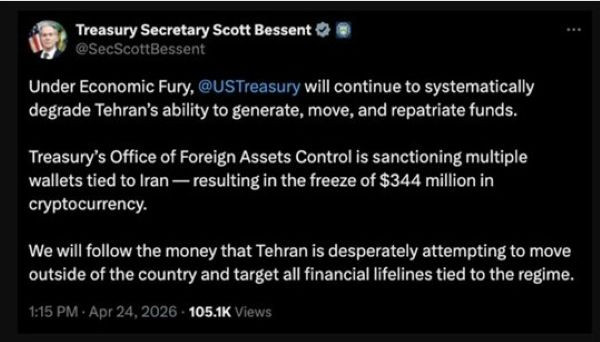
The Treasury Department is maintaining maximum pressure on Iran and targeting the regime’s ability to generate, move, and repatriate funds. Treasury is aggressively advancing Economic Fury and has disrupted tens of billions of dollars’ worth of revenue from being otherwise accessible to the Iranian regime and its proxies. This includes actions that have led to the freezing of nearly half a billion dollars in regime-linked cryptocurrency. In addition, Treasury has cracked down on Tehran’s global shadow banking networks; designated networks supplying weapons and other military components to Iran; sanctioned a corrupt Iraqi official who has facilitated the sale of oil along with Iran-backed militias operating in Iraq; taken numerous actions against Iran’s terrorist proxies; and targeted shadow fleet vessels, companies, and other entities that sustain Iran’s illicit oil industry.
Through the blockade, the Trump Administration is directly targeting the regime’s primary revenue stream. Any person or vessel facilitating the illicit trade of oil or other commodities, through covert trade or financial channels, risks exposure to U.S. sanctions.
Treasury will continue to vigorously target both traditional sanctions evasion schemes and the exploitation of digital assets while continuing to freeze funds stolen from the Iranian people. Treasury is also prepared to take action against any foreign company supporting illicit Iranian commerce, including airlines, and, as necessary, may impose secondary sanctions on foreign financial institutions that facilitate Iran’s activities.
PROTECTING FREEDOM OF NAVIGATION IN THE STRAIT OF HORMUZ
Starved of revenue and severely weakened by Operation Epic Fury, Iran’s IRGC extorts vessels transiting the Strait of Hormuz through the so-called Persian Gulf Strait Authority (PGSA), a government agency aimed at imposing illegitimate tolls on commercial traffic and forcing vessels to follow Iranian direction in return for safe passage. Vessels must submit requested information to receive “permission” from the PGSA to transit through the Strait of Hormuz. The PGSA works with the IRGC and IRGC Navy to coordinate traffic through the Strait of Hormuz, including requiring vessels to follow IRGC instructions to navigate an Iranian-designated route near Iran’s coast, while charging fees for passage. The funds from these illegitimate tolls are funneled to the IRGC, a designated Foreign Terrorist Organization.
The Persian Gulf Strait Authority is being designated pursuant to E.O. 13224, as amended, for having materially assisted, sponsored, or provided financial, material, or technological support for, or goods or services to or in support of, the IRGC.
SANCTIONS IMPLICATIONS
As a result of yesterday’s action, all property and interests in property of the designated or blocked person described above that are in the United States or in the possession or control of U.S. persons are blocked and must be reported to OFAC. In addition, any entities that are owned, directly or indirectly, individually or in the aggregate, 50 percent or more by one or more blocked persons are also blocked. Unless authorized by a general or specific license issued by OFAC, or exempt, OFAC’s regulations generally prohibit all transactions by U.S. persons or within (or transiting) the United States that involve any property or interests in property of blocked persons.
“The Iranian military’s latest attempt to extort global maritime trade is proof that Economic Fury has left the regime desperate for cash,” said Secretary of the Treasury Scott Bessent. “Through Economic Fury, the United States has imposed a financial stranglehold on the world’s leading state sponsor of terrorism. Treasury has deprived the Iranian regime of revenue for their weapons programs, terrorist proxies, and nuclear ambitions. Under President Trump’s leadership, we will remain relentless in our pursuit to constrict the network of vessels, intermediaries, and buyers through which Iran exports both its oil and malevolence.”
Yesterday’s action builds on recent guidance warning of the sanctions risk for complying with Iranian demands for passage through the Strait of Hormuz such as “toll” payments, including payments made via fiat currency, digital assets, offsets, informal swaps, or other in-kind payments such as nominally charitable donations, and providing sensitive vessel information.
Yesterday’s action is being taken pursuant to the counterterrorism authority, Executive Order (E.O.) 13224, as amended. It continues the robust sanctions campaign targeting Iranian oil sales in support of Economic Fury and the President’s National Security Presidential Memorandum 2 (NSPM-2), instituting a campaign of maximum economic pressure on Iran.
ECONOMIC FURY DELIVERS MAXIMUM PRESSURE ON IRAN
The Treasury Department is maintaining maximum pressure on Iran and targeting the regime’s ability to generate, move, and repatriate funds. Treasury is aggressively advancing Economic Fury and has disrupted tens of billions of dollars’ worth of revenue from being otherwise accessible to the Iranian regime and its proxies. This includes actions that have led to the freezing of nearly half a billion dollars in regime-linked cryptocurrency. In addition, Treasury has cracked down on Tehran’s global shadow banking networks; designated networks supplying weapons and other military components to Iran; sanctioned a corrupt Iraqi official who has facilitated the sale of oil along with Iran-backed militias operating in Iraq; taken numerous actions against Iran’s terrorist proxies; and targeted shadow fleet vessels, companies, and other entities that sustain Iran’s illicit oil industry.
Through the blockade, the Trump Administration is directly targeting the regime’s primary revenue stream. Any person or vessel facilitating the illicit trade of oil or other commodities, through covert trade or financial channels, risks exposure to U.S. sanctions.
Treasury will continue to vigorously target both traditional sanctions evasion schemes and the exploitation of digital assets while continuing to freeze funds stolen from the Iranian people. Treasury is also prepared to take action against any foreign company supporting illicit Iranian commerce, including airlines, and, as necessary, may impose secondary sanctions on foreign financial institutions that facilitate Iran’s activities.
PROTECTING FREEDOM OF NAVIGATION IN THE STRAIT OF HORMUZ
Starved of revenue and severely weakened by Operation Epic Fury, Iran’s IRGC extorts vessels transiting the Strait of Hormuz through the so-called Persian Gulf Strait Authority (PGSA), a government agency aimed at imposing illegitimate tolls on commercial traffic and forcing vessels to follow Iranian direction in return for safe passage. Vessels must submit requested information to receive “permission” from the PGSA to transit through the Strait of Hormuz. The PGSA works with the IRGC and IRGC Navy to coordinate traffic through the Strait of Hormuz, including requiring vessels to follow IRGC instructions to navigate an Iranian-designated route near Iran’s coast, while charging fees for passage. The funds from these illegitimate tolls are funneled to the IRGC, a designated Foreign Terrorist Organization.
The Persian Gulf Strait Authority is being designated pursuant to E.O. 13224, as amended, for having materially assisted, sponsored, or provided financial, material, or technological support for, or goods or services to or in support of, the IRGC.
SANCTIONS IMPLICATIONS
As a result of yesterday’s action, all property and interests in property of the designated or blocked person described above that are in the United States or in the possession or control of U.S. persons are blocked and must be reported to OFAC. In addition, any entities that are owned, directly or indirectly, individually or in the aggregate, 50 percent or more by one or more blocked persons are also blocked. Unless authorized by a general or specific license issued by OFAC, or exempt, OFAC’s regulations generally prohibit all transactions by U.S. persons or within (or transiting) the United States that involve any property or interests in property of blocked persons.