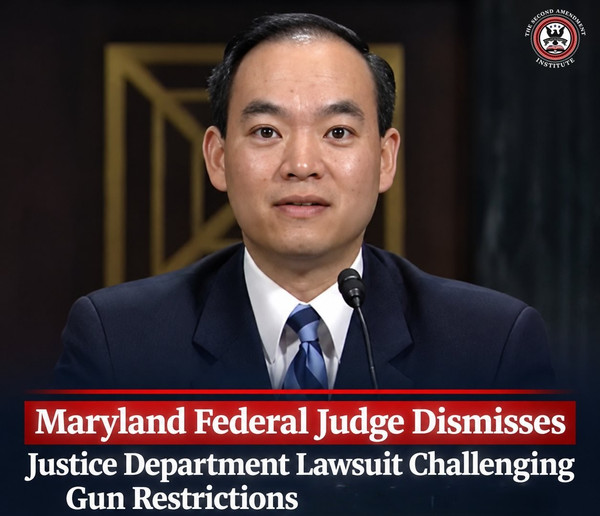

In one of the most blatantly hypocritical rulings issued by a Democrat federal judge during President Donald Trump’s second term, U.S. District Judge Theodore Chuang, a Barack Obama appointee, ruled that the federal government lacks the authority to protect your civil rights – if the rights being protected are the rights guaranteed by the Second Amendment.
Judge Chuang has a lengthy record of politicized rulings against the Trump administration, including decisions trying to undue the DOGE cuts to USAID, “barring” Jeremy Lewin, a former DOGE team member, from becoming Deputy Administrator of USAID, and blocking U.S. Immigration and Customs Enforcement on Monday from arresting illegal aliens.
The Montgomery County, Maryland, law at the center of the case prohibits the possession, transport, sale or transfer of a firearm “in or within 100 yards of a place of public assembly,” which includes a publicly or privately owned: park, place of worship, school, library, recreational facility, multipurpose exhibition facility (ex. fairgrounds or conference center); any government building open to the public for the business of government or community use, polling place, courthouse, and legislative assembly. Any parking area, grounds or similar associated property are automatically included as part of any “place of public assembly.”
Lengthy written testimony by state gun-rights group Maryland Shall Issue, Inc., in opposition to the passage of Bill 23-26E was very clear that the law’s designated “places of public assembly” encompassed thousands of locations in the County: 1,262 public bikeways, 605 houses of worship, 693 public parks (not including four federal parks and any privately owned “parks”), 258 private schools, 137 public elementary schools, 40 middle schools, 25 high schools, 42 public recreation centers, 10 colleges and universities, 29 municipalities, 45 post offices, 38 fire stations, 15 public swimming pools, and 23 public transit/metro /MARC commuter train stations.
As our friends at the NRA explained, this would make it virtually impossible to exercise the rights guaranteed by Second Amendment within Montgomery County, Maryland – and the Trump Department of Justice agreed.
In a press release announcing the federal lawsuit, the Trump Department of Justice charged that the breadth of Bill 23-26’s prohibition, including the 100-yard exclusion zone, makes it practically impossible for individuals in the County to go about their daily business while lawfully carrying a firearm.
Therefore, said the Trump DOJ, the ordinance violates the Supreme Court’s recent decision in Wolford v. Lopez, where the Court held a law that bans citizens from carrying firearms into, “places that people routinely visit in the course of their daily routines . . . hobbles what the Second Amendment protects: the right of Americans to carry arms for self-defense as they go about their daily lives.”
The DOJ alleged that this gun-free zones law violated the rights of County citizens and visitors under the Second Amendment and sought a preliminary injunction and declaratory relief to bar the expected enforcement of Bill 23-26E.
As the DOJ press release explains, the complaint stated, “have engaged in, and, on information and belief, will continue to engage in, a pattern or practice of conduct by law enforcement officers that deprives persons” of constitutional rights.
The federal law underpinning the lawsuit, 34 U.S.C. § 12601, declares it to be unlawful for “any governmental authority, or any agent thereof, or any person acting on behalf of a governmental authority, to engage in a pattern or practice of conduct by law enforcement officers … that deprives persons of rights, privileges, or immunities secured or protected by the Constitution or laws of the United States.”
The statute directs the Attorney General, for or in the name of the United States, to seek “appropriate equitable and declaratory relief to eliminate the pattern or practice” in a civil lawsuit, whenever “the Attorney General has reasonable cause to believe that a violation has occurred.”
On November 9, U.S. District Judge Theodore Chuang, a Barack Obama appointee, granted the defendants’ motion to dismiss the federal suit without any examination of whether the challenged law violated the Second Amendment or was supportable under the Bruen standard.
In a nutshell, reported the NRA, he concluded that the Government’s claim, asserted pursuant to the civil enforcement authority in 34 U.S.C. § 12601, failed because that statute requires a “pattern or practice of conduct by law enforcement officers” that deprives persons of constitutional rights, and arguments of facial invalidity and the “expected enforcement” did not rise to this standard. Section 12601 “generally does not authorize a civil enforcement action based only on an allegedly unconstitutional statute or ordinance” and, even to the extent that the law could be construed to permit a civil enforcement action based on an allegedly unconstitutional policy, it must be one that specifically addresses “conduct by law enforcement officers.” According to the judge, because there was “no claim or record of actual enforcement actions taken” by the police in relation to Bill 23-26E, the Justice Department was barred from relying on the authority of § 12601.
As an additional factor, the judge rejected any broader interpretation of § 12601 “because it would effect a breathtakingly broad expansion of federal power in advancing civil enforcement actions by the federal government against state and local governments.” Even the existence of an unconstitutional law should not suffice, as this would enable the government to “file suit against a state or local law enforcement agency any time it believes that a state or local government has enacted a law that could violate an individual’s constitutional rights, so long as there is some potential for that agency to be called upon to enforce the law.”
The defendants had asked the judge to dismiss the federal lawsuit in its entirety with prejudice, meaning the suit could not be reinstated even when the “pattern or practice of conduct by law enforcement officers” in enforcing the County law is shown.
Whether the order included a with-prejudice dismissal isn’t clear from the memorandum opinion, although it has been reported that the dismissal was, in fact, made on this basis.
The NRA reported noted the federal government became empowered to enforce the rights of U.S. citizens against state abuses as a result of the Civil War and the post-war amendments to the U.S. Constitution.
It is a curious legal proposition, to say the least, to assert that DOJ is powerless in the face of an obviously unconstitutional law like Montgomery County’s or that a law specifically threatening criminal penalties for those who engage in constitutionally protected behavior somehow doesn’t apply to a “practice” of the police.
It is even more curious when one considers DOJ’s involvement in cases that concerned the enforcement of school districts’ same sex bathroom rules or prison inmate grooming standards, up to and including at the U.S. Supreme Court. Would Congress really give the Department that authority but deprive it of the ability to enforce an affirmative provision of the Bill of Rights itself?
Imagine if this same logic were to be applied to other civil rights, such as freedom of the press or the right to vote, that were chilled by a blatantly unconstitutional local law that had been passed but not enforced often enough to establish a pattern or practice. We think most would agree that would never happen and the law would be quickly found to be unconstitutional.
At this point it is unclear if the Trump Department of Justice will appeal the ruling. However, given the broad implications of Judge Chuang’s decision we conclude that the Trump administration must appeal to preserve the federal government’s authority to defend not just the rights guaranteed by the Second Amendment, but all constitutional rights.