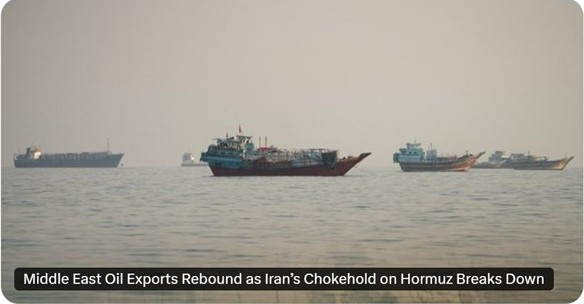

Oil tanker traffic through the Strait of Hormuz reached a seven-day average of 13.5 million barrels per day, levels not seen since before the March 1 attack by the U.S. and Israel on Iran, and comes amid the continued U.S. naval blockade of Iranian ports, according to global trade analytics firm Kpler. And overall Persian Gulf exports reached 23.3 million barrels a day the week prior, according to a Sept. 29 estimate by Goldman Sachs.
“We estimate that the global oil market is roughly balanced in September,” the Goldman note said, adding, “We note a divergence between the fall of Iranian exports and the rise of exports of other Gulf producers… Saudi estimated exports more than doubled in September and rose above their 2025 average.”
That would be a dramatic turnaround from August, as our friend Robert Romano, Executive Director of Americans for Limited Government, noted in a recent post to their must-read newsletter The Daily Torch, data published by OPEC, showing that as of Sept. 10, last month in August, Saudi Arabia oil production was only at 66 percent of its 2025 levels at 6.2 million barrels a day compared to 9.4 million in 2025.
Further improvement in September as alternative routes including pipelines and different ports are utilized and as Strait of Hormuz traffic is restored demonstrate a turning point in the war.
It basically means the U.S. has secured control of the Strait. That, in spite of repeated proclamations by Iran that the Strait was “closed”. Right now, the only one who can’t use the Strait is Iran. So much for that.
And yet Congress might expect another War Powers Resolution declaration on top of the March 2, June 12, June 29 and July 10 declarations already set forth by President Donald Trump, who has promised that after the Congressional elections in November, the war would end “one way or another.”
The news come as oil prices have been easing, with West Texas Intermediate (WTI) crude oil falling to about $90 a barrel as of this writing from a prior high of about $100 a barrel on Sept. 15, and from its April 6 high of $112 a barrel, about a 19.6 percent drop from the height of the war.
As a result, assuming that new level holds or falls even further, gasoline prices might be expected to fall over the next few weeks. If oil were to crash down to around $80 a barrel by the end of October, that might take gas prices back down to about $4 a gallon from its current $4.46 a gallon.
As it stands, oil futures contracts, again as of this writing, definitely show signs of easing, with November 2026 at $90, December 2026 at $88.13, January 2027 at $86.52 and so forth. Markets believe the war is winding down again.
Ironically, moving oil through the Strait of Hormuz was once the subject of the memorandum of understanding — now disregarded by both the U.S. and Iran. The U.S. Navy is doing what it does best, and has effectively changed the situation in the Middle East. President Trump is likely to keep rotating the fleet but it appears a strong naval presence will remain until the conclusion of the war.
On one hand, Iran might wish to continue negotiating but it could be futile. Treasury Secretary Scott Bessent’s devastating economic D-Day continues as the Iranian rial has depreciated to record lows.
Otherwise, Iran’s own oil exports are down more than 80 percent.
A lingering question remaining for President Trump might be what to do with anything that remains of Iran’s nuclear program. Maybe he’s going to bomb the craters.
Ultimately, the question in part will revolve around depriving Iran of any future ability to project power in the region and securing global energy supply lines, and degrading its tendency to be a disruptive influence.
And then, there is always what the President said on March 6 on Truth Social: “There will be no deal with Iran except UNCONDITIONAL SURRENDER!” That could be what it really comes down to in the end. We’ll see.
Otherwise, the only leverage Iran had left was the Strait. Without it, and as new pipelines and port capacity are built up beyond the Strait, Iran may never again be able to strangle global energy supplies or threaten international security with a nuclear weapon. Even if voters in November’s midterms cannot fully appreciate it yet, future generations can thank President Trump later.