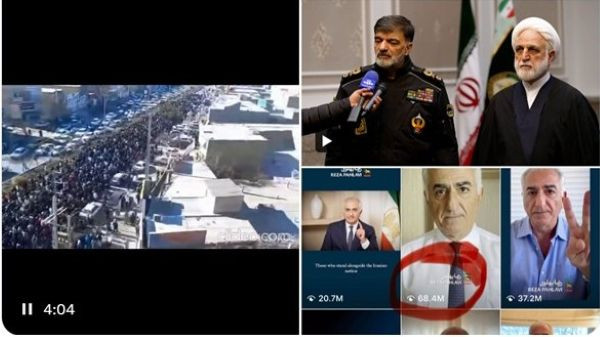

There is a moment in revolutions – a precise and historically recognizable sweet spot – when an old, brutal, and hardened regime, like the Islamic Republic of Iran, still deploys its forces, yet something breaks in its resolve. You can sense it, and then the public senses it: fear has shifted sides, and the revolutionaries are winning.
How do we know that, as Nadav Eyal put it, “fear has shifted sides” in Iran?
One strong indicator is that regime leaders and their families are fleeing Iran.
Lebanese media report Iranian Foreign Minister Abbas Araghchi’s visit to Beirut was not merely ceremonial, as he arrived accompanied by his family. Those traveling with him included his wife Arezoo Ahmadfand, his daughter Sadat, and his sons Seyed Hossein and Seyed Reza. According to the reports, Araghchi and his family are expected to remain in residences designated for Iranian diplomats in Lebanon for an “unspecified period.”
Another strong indicator is that last night the regime attempted to cut off the internet and international phone service, yet they failed to use the communications blackout to fully deploy their usual tools of repression, shooting into crowds and other forms of mass violence, to end the demonstrations that brought millions of Iranians from all walks of life into the streets.
A third strong indicator is that the regime’s geographic, demographic and ideological base is fracturing. In Mashad, Iran’s second city and the birthplace of Ayatollah Khomeini, the founder of the Islamic Republic, people are chanting the name of Prince Reza Pahlavi together.
And Shia clerics, who previously supported the Islamic Republic of Iran, are now showing support for the anti-regime protests. In this video, a Shia cleric calls on people to rise up and fight against the Islamic regime, openly supporting the protests and stating that Khomeini—the dictator—was the root cause of all these problems.
So, what does “doing Iran” look like?
As our late friend Michael Ledeen made clear in countless articles and two books, there are alternatives to an all-out shooting war, however, “Fighting back against Iran is difficult and costly. No American president from Carter to Obama has been willing to take it on.”
As an alternative to what Mr. Ledeen called “an all-out shooting war” President Trump could start by updating to the 21st century the tools President Ronald Reagan used to defeat Communism in Eastern Europe in the 1980s.
Here are four simple steps that we could take almost immediately to help bring about regime change in Iran:
Everyone who is realistic about the now 47-year-old war Iran’s theocratic regime declared on America knows that regime change is the only way to permanently stop Iran’s drive to acquire nuclear weapons.
The weakness of Iran’s system of Wilayat al-Faqih has never been more obvious and the opportunity to undermine it from within rarely greater. As James Phillips, a senior research fellow for Middle Eastern affairs at The Heritage Foundation said in a 2019 article, the harder Iran’s dictatorship struggles to oppose reforms that threaten its power, the sooner young Iranians and Arabs forced to live under Tehran’s thumb will reach the conclusion that Iran’s Islamist model is bankrupt economically, politically, and morally.
George Rasley is editor of Richard Viguerie's ConservativeHQ.com and is a veteran of over 300 political campaigns. A member of American MENSA, he served on the staff of Vice President Dan Quayle, as Director of Policy and Communication for former Congressman Adam Putnam (FL-12) then Vice Chairman of the Oversight and Government Reform Committee's Subcommittee on National Security and Foreign Affairs, and as spokesman for retired Rep. Mac Thornberry formerly a member of the House Intelligence Committee and Chairman of the House Armed Services Committee.
How do we know that, as Nadav Eyal put it, “fear has shifted sides” in Iran?
One strong indicator is that regime leaders and their families are fleeing Iran.
Lebanese media report Iranian Foreign Minister Abbas Araghchi’s visit to Beirut was not merely ceremonial, as he arrived accompanied by his family. Those traveling with him included his wife Arezoo Ahmadfand, his daughter Sadat, and his sons Seyed Hossein and Seyed Reza. According to the reports, Araghchi and his family are expected to remain in residences designated for Iranian diplomats in Lebanon for an “unspecified period.”
Another strong indicator is that last night the regime attempted to cut off the internet and international phone service, yet they failed to use the communications blackout to fully deploy their usual tools of repression, shooting into crowds and other forms of mass violence, to end the demonstrations that brought millions of Iranians from all walks of life into the streets.
A third strong indicator is that the regime’s geographic, demographic and ideological base is fracturing. In Mashad, Iran’s second city and the birthplace of Ayatollah Khomeini, the founder of the Islamic Republic, people are chanting the name of Prince Reza Pahlavi together.
And Shia clerics, who previously supported the Islamic Republic of Iran, are now showing support for the anti-regime protests. In this video, a Shia cleric calls on people to rise up and fight against the Islamic regime, openly supporting the protests and stating that Khomeini—the dictator—was the root cause of all these problems.
So, what does “doing Iran” look like?
As our late friend Michael Ledeen made clear in countless articles and two books, there are alternatives to an all-out shooting war, however, “Fighting back against Iran is difficult and costly. No American president from Carter to Obama has been willing to take it on.”
As an alternative to what Mr. Ledeen called “an all-out shooting war” President Trump could start by updating to the 21st century the tools President Ronald Reagan used to defeat Communism in Eastern Europe in the 1980s.
Here are four simple steps that we could take almost immediately to help bring about regime change in Iran:
Pump-up the power and content of Farsi language programing through radio and TV, especially satellite TV, making it clear that we stand with the people of Iran in their quest for liberty.
Pump-up the power and content of our Farsi language social media communications with the people of Iran and integrate them with radio and TV messages proposed above.
Use clandestine means to deliver cellphones, satellite phones, radios and laptops to Iranian dissidents to that they can communicate with each other outside of government channels. Editor’s Note: Elon Musk has allegedly made Starlink available to the Iranian revolutionaries.
Create online and on-air communications channels that dissidents can access to communicate outside of the Iranian government channels, for example digital radio channels could provide Iranians with news, entertainment and information on protest locations.
Pump-up the power and content of our Farsi language social media communications with the people of Iran and integrate them with radio and TV messages proposed above.
Use clandestine means to deliver cellphones, satellite phones, radios and laptops to Iranian dissidents to that they can communicate with each other outside of government channels. Editor’s Note: Elon Musk has allegedly made Starlink available to the Iranian revolutionaries.
Create online and on-air communications channels that dissidents can access to communicate outside of the Iranian government channels, for example digital radio channels could provide Iranians with news, entertainment and information on protest locations.
Everyone who is realistic about the now 47-year-old war Iran’s theocratic regime declared on America knows that regime change is the only way to permanently stop Iran’s drive to acquire nuclear weapons.
The weakness of Iran’s system of Wilayat al-Faqih has never been more obvious and the opportunity to undermine it from within rarely greater. As James Phillips, a senior research fellow for Middle Eastern affairs at The Heritage Foundation said in a 2019 article, the harder Iran’s dictatorship struggles to oppose reforms that threaten its power, the sooner young Iranians and Arabs forced to live under Tehran’s thumb will reach the conclusion that Iran’s Islamist model is bankrupt economically, politically, and morally.
George Rasley is editor of Richard Viguerie's ConservativeHQ.com and is a veteran of over 300 political campaigns. A member of American MENSA, he served on the staff of Vice President Dan Quayle, as Director of Policy and Communication for former Congressman Adam Putnam (FL-12) then Vice Chairman of the Oversight and Government Reform Committee's Subcommittee on National Security and Foreign Affairs, and as spokesman for retired Rep. Mac Thornberry formerly a member of the House Intelligence Committee and Chairman of the House Armed Services Committee.