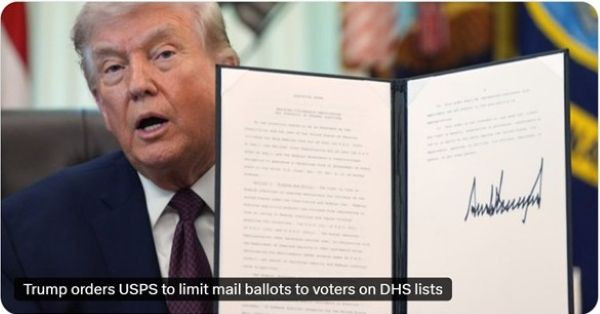

President Donald Trump yesterday signed an executive order to create a nationwide list of verified eligible voters, a move that is sure to draw legal challenges as the president continues to work to ensure election integrity and only citizens vote ahead of this year's midterm elections.
The order calls on the Department of Homeland Security, working in conjunction with the Social Security Administration, to make the list of eligible voters in each state, according to the White House. It also seeks to bar the U.S. Postal Service from sending absentee ballots to those not on each state's approved list, although Trump critics and those opposed to election integrity claim the president lacks the power to mandate what the Postal Service does.
The Justice Department for months has been demanding detailed voter registration lists from states in what it has described as an effort to ensure the security of elections, and has sued when state officials have refused to hand them over.
The FBI in January seized ballots from the election office of a Georgia county that has been central to evidence of fraud in President Trump's 2020 election loss. And Attorney General Pam Bondi recently named Daniel Bishop, the top federal prosecutor for the Middle District of North Carolina, as a "special attorney" with the power to investigate and prosecute cases across the country "relating to the integrity of federal elections," according to a copy of the order.
As NPR observed, elections in the U.S. are unique because they are not centralized. Rather than being run by the federal government, they're conducted by election officials and volunteers in thousands of jurisdictions across the country, from tiny townships to sprawling urban counties with more voters than some states have people. The Constitution's so-called "Elections Clause" gives Congress the power to "make or alter" election regulations, at least for federal office, but it doesn't mention any presidential authority over election administration, meaning Democrats and their allies who have long opposed election integrity efforts will head straight to the Court House in some friendly Democrat jurisdiction.
Indeed, attorney Mark Elias, one of the central figures in Democrat efforts to undermine election integrity efforts has already threatened to sue.
"If Trump signs an unconstitutional Executive Order to take over voting, we will sue," Marc Elias, a voting rights litigator and founder of Democracy Docket, said in a social media post. "I don't bluff and I usually win."
In a post to his website Elias claimed the order is unconstitutional because it “blatantly threatens criminal prosecution against state and local election workers who ‘issue Federal ballots to individuals not eligible to vote in a Federal election.’ This part of the Order is clearly intended to intimidate election workers into relying on the federal government’s list of eligible voters, despite the possession of local knowledge and voter registration forms asserting eligibility under penalty of perjury.”
Elias further claimed “the Order requires the United States Postal Service to promulgate rules requiring that all mail ballots sent through USPS only be sent to: (i) a list of voters provided by each state in advance; and (ii) in an envelope with a unique, trackable barcode on the ballot envelope. The USPS procedures, again, are clearly designed to force compliance with the federal citizenship list by denying states the ability to use USPS to transmit ballots to voters not on the federal list.”
Oddly enough, Elias also criticizes the order because the tracking code would provide the federal government with a way to identify ballots sent to individuals it believes to be non-citizens.
However, election integrity advocates applauded the move as a much needed corrective to abuses revealed in recent elections.
To facilitate much of the tracking envisioned in Trump’s new order, it mandates that all mail ballots use official election envelopes with Postal Service intelligent mail barcodes, whose design would have to be approved by the Postal Service.
VoteBeat, an allegedly nonpartisan source of local reporting on elections and voting, reported Tammy Patrick, chief programs officer at The Election Center, a nonprofit association of election officials, noted the order draws on a ballot-tracking barcode system she helped develop with the Postal Service. She said barcodes and official election mail logos are legitimate best practices — but that the executive order misapplies them without providing funding or a path to implementation.
The system was designed to help the Postal Service identify and prioritize ballots, not to serve as a universal mandate — and many local election offices lack the capacity to implement it, she said.
We applaud President Trump’s bold action, but we have to ask, why is it that President Trump was forced to issue an Executive Order because a 52-member Republican majority in the Senate floundered around for a year failing to pass the SAVE America Act? We aren’t counting Mike Lee because he is the ONLY Republican standing up for, and fighting to protect our elections via the SAVE America Act.
The order calls on the Department of Homeland Security, working in conjunction with the Social Security Administration, to make the list of eligible voters in each state, according to the White House. It also seeks to bar the U.S. Postal Service from sending absentee ballots to those not on each state's approved list, although Trump critics and those opposed to election integrity claim the president lacks the power to mandate what the Postal Service does.
The Justice Department for months has been demanding detailed voter registration lists from states in what it has described as an effort to ensure the security of elections, and has sued when state officials have refused to hand them over.
The FBI in January seized ballots from the election office of a Georgia county that has been central to evidence of fraud in President Trump's 2020 election loss. And Attorney General Pam Bondi recently named Daniel Bishop, the top federal prosecutor for the Middle District of North Carolina, as a "special attorney" with the power to investigate and prosecute cases across the country "relating to the integrity of federal elections," according to a copy of the order.
As NPR observed, elections in the U.S. are unique because they are not centralized. Rather than being run by the federal government, they're conducted by election officials and volunteers in thousands of jurisdictions across the country, from tiny townships to sprawling urban counties with more voters than some states have people. The Constitution's so-called "Elections Clause" gives Congress the power to "make or alter" election regulations, at least for federal office, but it doesn't mention any presidential authority over election administration, meaning Democrats and their allies who have long opposed election integrity efforts will head straight to the Court House in some friendly Democrat jurisdiction.
Indeed, attorney Mark Elias, one of the central figures in Democrat efforts to undermine election integrity efforts has already threatened to sue.
"If Trump signs an unconstitutional Executive Order to take over voting, we will sue," Marc Elias, a voting rights litigator and founder of Democracy Docket, said in a social media post. "I don't bluff and I usually win."
In a post to his website Elias claimed the order is unconstitutional because it “blatantly threatens criminal prosecution against state and local election workers who ‘issue Federal ballots to individuals not eligible to vote in a Federal election.’ This part of the Order is clearly intended to intimidate election workers into relying on the federal government’s list of eligible voters, despite the possession of local knowledge and voter registration forms asserting eligibility under penalty of perjury.”
Elias further claimed “the Order requires the United States Postal Service to promulgate rules requiring that all mail ballots sent through USPS only be sent to: (i) a list of voters provided by each state in advance; and (ii) in an envelope with a unique, trackable barcode on the ballot envelope. The USPS procedures, again, are clearly designed to force compliance with the federal citizenship list by denying states the ability to use USPS to transmit ballots to voters not on the federal list.”
Oddly enough, Elias also criticizes the order because the tracking code would provide the federal government with a way to identify ballots sent to individuals it believes to be non-citizens.
However, election integrity advocates applauded the move as a much needed corrective to abuses revealed in recent elections.
To facilitate much of the tracking envisioned in Trump’s new order, it mandates that all mail ballots use official election envelopes with Postal Service intelligent mail barcodes, whose design would have to be approved by the Postal Service.
VoteBeat, an allegedly nonpartisan source of local reporting on elections and voting, reported Tammy Patrick, chief programs officer at The Election Center, a nonprofit association of election officials, noted the order draws on a ballot-tracking barcode system she helped develop with the Postal Service. She said barcodes and official election mail logos are legitimate best practices — but that the executive order misapplies them without providing funding or a path to implementation.
The system was designed to help the Postal Service identify and prioritize ballots, not to serve as a universal mandate — and many local election offices lack the capacity to implement it, she said.
We applaud President Trump’s bold action, but we have to ask, why is it that President Trump was forced to issue an Executive Order because a 52-member Republican majority in the Senate floundered around for a year failing to pass the SAVE America Act? We aren’t counting Mike Lee because he is the ONLY Republican standing up for, and fighting to protect our elections via the SAVE America Act.