
Presidential historian and Reagan biographer Craig Shirley reviews the history of the midterm elections during war and finds in times of danger, voters look to their leaders for strength, resolve, and reassurance. Yet war does not automatically reward the party in power. Americans look for a uniter. But a uniter does not necessarily mean safer. Does it?
As the November 2026 midterm elections approach, Donald Trump and the Republicans face a real test. The historical precedents reveal how national security crises can reshape electoral fortunes.
In January 1942, barely a month after Pearl Harbor, Franklin D. Roosevelt told Congress that “the spirit of the American people was never higher than it is today.” He promised that the nation's determination would endure “until our security is assured.”
Yet national unity did not prevent a Republican resurgence. In the November 1942 midterms, Republicans gained 47 House seats and 9 Senate seats. Wartime shortages, domestic dissatisfaction, and the normal tendency to punish the governing party contributed to Democratic losses. And, most importantly, many voters blamed FDR for Pearl Harbor. Lest we forget, the disaster happened on his watch. Voters supported the Pacific war while questioning the administration’s performance.
Two decades later, John F. Kennedy confronted a different danger. During the October 1962 Cuban Missile Crisis, the president faced the possibility of nuclear war with the Soviet Union. His response reinforced his image as a serious leader during a moment of extraordinary peril. In the November elections, Democrats lost four House seats but gained three Senate seats, perhaps a wash in the end and nowhere near the typical off year election for a president.
Kennedy had articulated a principle especially relevant to today's conflict in his 1961 inaugural address: “Let us never negotiate out of fear. But let us never fear to negotiate.”
The distinction is crucial. Strength and diplomacy are not necessarily competing strategies. It is possible to speak softly and carry a giant stick. Military power can deter an adversary, while negotiation can transform a temporary advantage into a durable settlement. Voters may judge a president not only by the force deployed but also by the peace ultimately secured.
Then came 2002. Following the September 11 attacks, George W. Bush’s Republicans gained eight House seats and two Senate seats, defying the usual midterm pattern. Bush's message was uncompromising. Addressing Congress on September 20, 2001, he declared: “Our war on terror begins with al Qaeda, but it does not end there.” He also warned, “Every nation, in every region, now has a decision to make. Either you are with us, or you are with the terrorists.”
In each case, voters supported the party they felt best able to defend them or punished the weaker party.
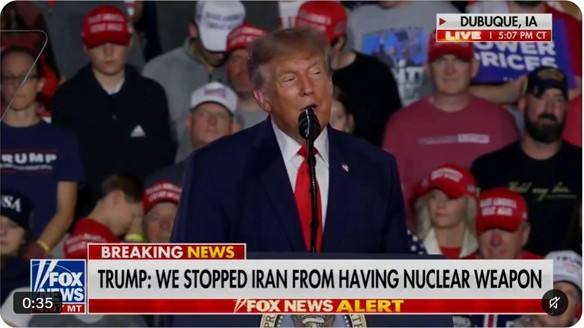
The circumstances surrounding Iran are different. This conflict began in February 2026, and its consequences have reached beyond the battlefield to energy markets and household budgets. In an October 8 report, Reuters noted that approximately 60 percent of Americans disapproved of Trump's handling of Iran, while higher gasoline prices were adding to voter concerns ahead of the midterms.
The question for voters is whether those discussions produce a credible settlement and measurable improvements in American security. If the conflict ends with a durable agreement and reduced threats, Republicans can argue that military pressure achieved its objectives. If the war continues without clearly defined goals, mounting costs and uncertainty may overshadow claims of strength.
Economic consequences will matter as well. When gasoline prices rise and families struggle with everyday expenses, foreign policy becomes a kitchen-table issue. The public may support confronting a genuine security threat while questioning whether the strategy is proportionate, sustainable, or effective.
The three historical precedents offer no automatic formula. Roosevelt’s party lost seats during World War II. Kennedy’s Democrats limited their losses after the Cuban Missile Crisis. Bush’s Republicans gained seats following September 11. Each outcome reflected a different combination of public sentiment, presidential leadership, economic conditions, and the perceived nature of the threat.
For Trump, the central issue is therefore not whether Americans favor strength. It is whether they believe the war has made them safer.
Kennedy’s warning against fearing negotiation remains pertinent, as does Roosevelt’s promise that the purpose of wartime action is to assure national security. Those are standards by which any administration can be judged.
The 2026 midterms will test whether voters see the Iran campaign as a necessary defense of American interests or a costly conflict whose objectives remain unresolved. Republicans may point to military achievements; their opponents may question the strategy, its economic consequences, and its long-term implications.
Ultimately, the ballot box will measure public confidence in the administration’s judgment. History suggests that wartime leadership can earn political support—but only when Americans believe the sacrifices being demanded have brought the country closer to security and peace.
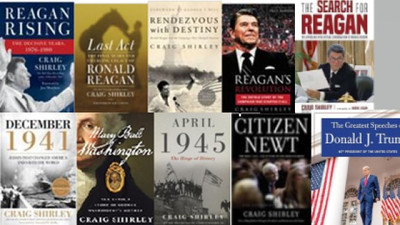
Historian and Reagan biographer Craig Shirley is the author of Reagan's Revolution: The Untold Story of the Campaign That Started It All; Rendezvous with Destiny: Ronald Reagan and the Campaign That Changed America; December 1941: 31 Days That Changed America and Saved the World; Last Act: The Final Years and Emerging Legacy of Ronald Reagan; Reagan Rising: The Decisive Years, 1976-1980; Citizen Newt: The Making of a Reagan Conservative; Mary Ball Washington: The Untold Story of George Washington's Mother; April 1945: The Hinge of History, as well as many articles and essays on politics and the conservative movement.
Craig Shirley worked on many campaigns before transitioning to being a historian having written eleven books of presidential history.