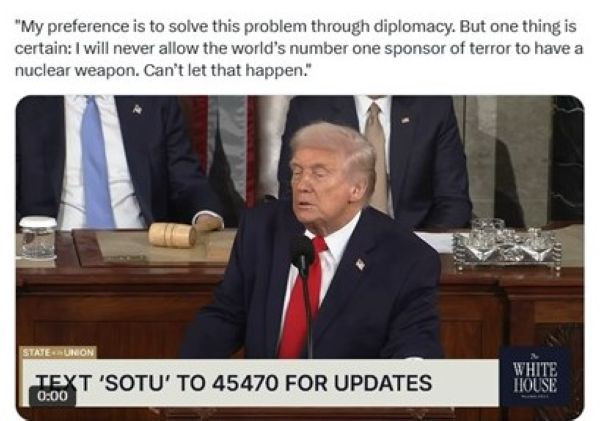

During last night’s state of the union address President Trump devoted a significant part of the address to his policy toward the Islamic Republic of Iran, saying:
Going into last night’s SOTU, Rasmussen Reports conducted a survey of voter attitudes about the confrontation between the United States and Iran. Rasmussen found most voters think the United States will launch military action against Iran soon, but nearly half say they would disapprove of such a strike.
The national telephone and online survey found that 65% of Likely U.S. Voters consider it likely that the U.S. will strike Iran militarily soon, including 25% who believe such a strike is Very Likely. Nineteen percent (19%) don’t think it’s likely the U.S. will attack Iran soon and 16% are not sure.
It is estimated that one-third of the U.S. naval fleet is within striking distance of Iran. Thirty-nine percent (39%) of voters would approve of a U.S. military strike against Iran, including 18% who would Strongly Approve. However, 49% would disapprove of an attack on Iran, including 30% who would Strongly Disapprove. Twelve percent (12%) are not sure.
Twenty-nine percent (29%) believe that, if the U.S. does strike Iran militarily, it is more likely that the United States will act alone, while 36% think it’s more likely that Israel will join the attack on Iran, and 19% consider it more likely other U.S. allies will join the United States and Israel in the attack. Sixteen percent (16%) are not sure.
More than a third of voters believe that Israel has too much influence over the Trump administration, and concerns about Israeli influence are higher among Democrats.
In the event of a U.S.-led attack on Iran, 30% say it’s more likely that the attack will last just a few days, while 25% believe that the attack would continue for a few weeks. Twenty-eight percent (28%) think it’s more likely that U.S.-led military action against Iran will last a month or more, and 17% are not sure.
Among those who would Strongly Approve of a U.S. military strike against Iran, 57% say it’s more likely that the attack will last just a few days, while among those who would Strongly Disapprove, nearly half (47%) consider it more likely the U.S.-led military action against Iran will last a month or more.
Sixty-two percent (62%) of Republicans would at least somewhat approve of a U.S. military strike against Iran, but that opinion is shared by just 23% of Democrats and 32% of voters not affiliated with either major party.
Majorities of all political categories – 68% of Republicans, 66% of Democrats, and 59% of unaffiliated voters – consider it at least somewhat likely that the U.S. will strike Iran militarily soon.
Republicans are more likely to think the United States will be joined by allies in attacking Iran and, while 40% of Republicans believe an attack on Iran would be over in a few days, only 24% of Democrats and 26% of unaffiliated voters share that belief.
More men (44%) than women voters (33%) would approve of a U.S. military strike against Iran.
Majorities of all racial categories – 65% of whites, 64% of black voters, 68% of Hispanics and 55% of other minorities – say it’s at least somewhat likely that the U.S. will strike Iran militarily soon. Black voters are most likely to disapprove of such an attack.
Forty-four percent (44%) of voters 50 and older would approve of a U.S. military strike against Iran, compared to 29% of those under 30.
Among those who voted for Donald Trump in the 2024 presidential election, 66% would approve of an attack on Iran, compared to just 14% of Kamala Harris voters.
As President, I will make peace wherever I can, but I will never hesitate to confront threats to America wherever we must. That’s why in a breakthrough operation last June, the United States military obliterated Iran’s nuclear weapons program with an attack on Iranian soil, known as Operation Midnight Hammer.
For decades, it had been the policy of the United States never to allow Iran to obtain a nuclear weapon, many decades. Since they seized control of that proud nation 47 years ago, the regime and its murderous proxies have spread nothing but terrorism and death and hate. They’ve killed and maimed thousands of American service members and hundreds of thousands and even millions of people with what’s called roadside bombs.
They were the kings of the roadside bomb. And we took out Soleimani. I did that during my first term, had a huge impact. He was the father of the roadside bomb. And just over the last couple of months with the protests, they’ve killed at least, it looks like 32,000 protests, 32,000 protesters in their own country.
They shot them and hung them. We stopped them from hanging a lot of them with the threat of serious violence. But this is some terrible people. They’ve already developed missiles that can threaten Europe and our bases overseas and they’re working to build missiles that will soon reach the United States of America.
They want to make a deal, but we haven’t heard those sacred words, “we will never have a nuclear weapon”.
My preference — My preference is to solve this problem through diplomacy. But one thing is certain, I will never allow the world’s number one sponsor of terror, which they are by far to have a nuclear weapon, can’t let that happen.
For decades, it had been the policy of the United States never to allow Iran to obtain a nuclear weapon, many decades. Since they seized control of that proud nation 47 years ago, the regime and its murderous proxies have spread nothing but terrorism and death and hate. They’ve killed and maimed thousands of American service members and hundreds of thousands and even millions of people with what’s called roadside bombs.
They were the kings of the roadside bomb. And we took out Soleimani. I did that during my first term, had a huge impact. He was the father of the roadside bomb. And just over the last couple of months with the protests, they’ve killed at least, it looks like 32,000 protests, 32,000 protesters in their own country.
They shot them and hung them. We stopped them from hanging a lot of them with the threat of serious violence. But this is some terrible people. They’ve already developed missiles that can threaten Europe and our bases overseas and they’re working to build missiles that will soon reach the United States of America.
They want to make a deal, but we haven’t heard those sacred words, “we will never have a nuclear weapon”.
My preference — My preference is to solve this problem through diplomacy. But one thing is certain, I will never allow the world’s number one sponsor of terror, which they are by far to have a nuclear weapon, can’t let that happen.
Going into last night’s SOTU, Rasmussen Reports conducted a survey of voter attitudes about the confrontation between the United States and Iran. Rasmussen found most voters think the United States will launch military action against Iran soon, but nearly half say they would disapprove of such a strike.
The national telephone and online survey found that 65% of Likely U.S. Voters consider it likely that the U.S. will strike Iran militarily soon, including 25% who believe such a strike is Very Likely. Nineteen percent (19%) don’t think it’s likely the U.S. will attack Iran soon and 16% are not sure.
It is estimated that one-third of the U.S. naval fleet is within striking distance of Iran. Thirty-nine percent (39%) of voters would approve of a U.S. military strike against Iran, including 18% who would Strongly Approve. However, 49% would disapprove of an attack on Iran, including 30% who would Strongly Disapprove. Twelve percent (12%) are not sure.
Twenty-nine percent (29%) believe that, if the U.S. does strike Iran militarily, it is more likely that the United States will act alone, while 36% think it’s more likely that Israel will join the attack on Iran, and 19% consider it more likely other U.S. allies will join the United States and Israel in the attack. Sixteen percent (16%) are not sure.
More than a third of voters believe that Israel has too much influence over the Trump administration, and concerns about Israeli influence are higher among Democrats.
In the event of a U.S.-led attack on Iran, 30% say it’s more likely that the attack will last just a few days, while 25% believe that the attack would continue for a few weeks. Twenty-eight percent (28%) think it’s more likely that U.S.-led military action against Iran will last a month or more, and 17% are not sure.
Among those who would Strongly Approve of a U.S. military strike against Iran, 57% say it’s more likely that the attack will last just a few days, while among those who would Strongly Disapprove, nearly half (47%) consider it more likely the U.S.-led military action against Iran will last a month or more.
Sixty-two percent (62%) of Republicans would at least somewhat approve of a U.S. military strike against Iran, but that opinion is shared by just 23% of Democrats and 32% of voters not affiliated with either major party.
Majorities of all political categories – 68% of Republicans, 66% of Democrats, and 59% of unaffiliated voters – consider it at least somewhat likely that the U.S. will strike Iran militarily soon.
Republicans are more likely to think the United States will be joined by allies in attacking Iran and, while 40% of Republicans believe an attack on Iran would be over in a few days, only 24% of Democrats and 26% of unaffiliated voters share that belief.
More men (44%) than women voters (33%) would approve of a U.S. military strike against Iran.
Majorities of all racial categories – 65% of whites, 64% of black voters, 68% of Hispanics and 55% of other minorities – say it’s at least somewhat likely that the U.S. will strike Iran militarily soon. Black voters are most likely to disapprove of such an attack.
Forty-four percent (44%) of voters 50 and older would approve of a U.S. military strike against Iran, compared to 29% of those under 30.
Among those who voted for Donald Trump in the 2024 presidential election, 66% would approve of an attack on Iran, compared to just 14% of Kamala Harris voters.