
President Donald Trump said that he was ordering a blockade be imposed off the coast Venezuela to prevent any sanctioned oil tankers from entering or leaving the country.
Since the U.S. imposed energy sanctions on Venezuela in 2019, traders and refiners buying Venezuelan oil have resorted to a "shadow fleet" of tankers that disguise their location and to vessels sanctioned for transporting Iranian or Russian oil. The “Skipper” seized last week was one such tanker.
The "Skipper" is a vessel that secretly ferries oil in defiance of sanctions, while also being part of an armada of roughly 1,000 tankers that quietly navigate global sea routes to move oil from sanctioned countries like Russia, Iran and Venezuela, according to the administration.
The Skipper's revenues reportedly fund terrorist activity by Iran's Islamic Revolutionary Guard Corps and Hezbollah, prop up hostile regimes and provide cut-price oil to China.
The so-called "ghost ships" sail under foreign flags to obscure their origins, repeatedly change names, shift ownership through shell companies, disable transponders to evade tracking and conduct mid-sea transfers to mask their cargo.
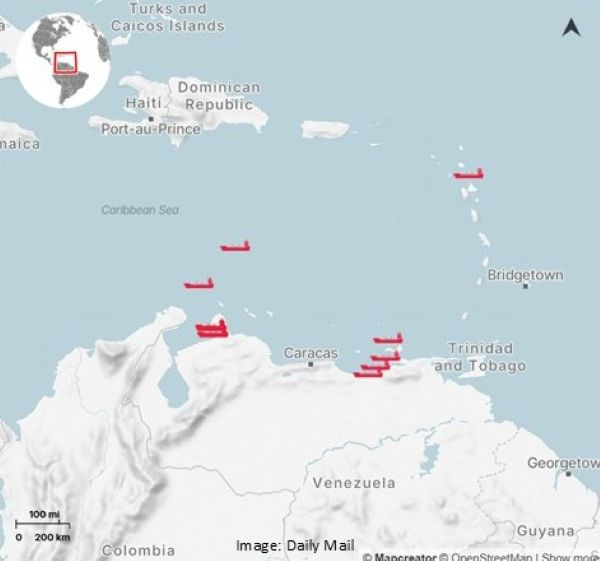
Axios reported about 18 tankers under U.S. sanctions that are fully loaded with oil currently lie within Venezuelan waters and eight are classified as "Very Large Cargo Container" ships like the “Skipper,” that the U.S. seized last week.
As of last week, more than 30 of the 80 ships in Venezuelan waters or approaching the country were under U.S. sanctions, according to data compiled by TankerTrackers.com and reported by Reuters.
“Venezuela is completely surrounded by the largest Armada ever assembled in the History of South America,” U.S. President Donald Trump announced on Truth Social on Dec. 16. “It will only get bigger, and the shock to them will be like nothing they have ever seen before—Until such time as they return to the United States of America all of the Oil, Land, and other Assets that they previously stole from us.”
This blockade comes after U.S. forces seized an oil tanker and continued to launch lethal strikes on drug boats speeding across the Caribbean Sea, reported T.J. Muscaro for The Epoch Times.
To emphasize the threat the President added, “It [the blockade] will only get bigger, and the shock to them will be like nothing they have ever seen before.”
According to the U.S. State Department, designating an entity as a “Foreign Terrorist Organization” makes it illegal for any U.S. citizen to knowingly provide “material support or resources” to such an organization, among other measures, reported CNBC.
It is unclear how Trump will impose the move against the sanctioned vessels, and whether he will turn to the Coast Guard to interdict vessels like he did last week. Reuters reported the administration has moved thousands of troops and nearly a dozen warships - including an aircraft carrier - to the region.
As the writers at Reuters observed, there has been an effective embargo in place after the U.S. seized a sanctioned oil tanker off the coast of Venezuela last week, with loaded vessels carrying millions of barrels of oil staying in Venezuelan waters rather than risk seizure.
Since the seizure, Venezuelan crude exports have fallen sharply, a situation worsened by a cyberattack that knocked down state-run oil company PDVSA's administrative systems this week.
By targeting oil, Trump is hitting the linchpin of Venezuela’s economy. The government’s supply of dollars is almost entirely tied to crude sales and oil-trading restrictions imposed by the US earlier this year are already pushing the nation to the brink of hyperinflation.
Bloomberg reported the squeeze has pressured the exchange rate and driven up prices, with annual inflation expected to top 400% by year’s-end, according to private estimates from local economists who requested anonymity for fear of reprisal.
While many vessels picking up oil in Venezuela are under sanctions, others transporting the country's oil and crude from Iran and Russia have not been sanctioned, and some companies, particularly the U.S. oil giant Chevron, transport Venezuelan oil in their own authorized ships.
Communist China is the biggest buyer of Venezuelan crude, which accounts for roughly 4% of its imports, with shipments in December on track to average more than 600,000 barrels per day, analysts told Reuters.
As Andrew Hart observed, and we agree, for 20 years, Venezuela nationalized American‑built oil projects, stiffed U.S. companies on billions in arbitration, and tried to bully its way into offshore fields near our ally Guyana. Trump’s armada and embargo finally make a socialist regime pay a price for expropriating U.S. assets and laundering that oil money into repression and chaos.
Since the U.S. imposed energy sanctions on Venezuela in 2019, traders and refiners buying Venezuelan oil have resorted to a "shadow fleet" of tankers that disguise their location and to vessels sanctioned for transporting Iranian or Russian oil. The “Skipper” seized last week was one such tanker.
The "Skipper" is a vessel that secretly ferries oil in defiance of sanctions, while also being part of an armada of roughly 1,000 tankers that quietly navigate global sea routes to move oil from sanctioned countries like Russia, Iran and Venezuela, according to the administration.
The Skipper's revenues reportedly fund terrorist activity by Iran's Islamic Revolutionary Guard Corps and Hezbollah, prop up hostile regimes and provide cut-price oil to China.
The so-called "ghost ships" sail under foreign flags to obscure their origins, repeatedly change names, shift ownership through shell companies, disable transponders to evade tracking and conduct mid-sea transfers to mask their cargo.
Axios reported about 18 tankers under U.S. sanctions that are fully loaded with oil currently lie within Venezuelan waters and eight are classified as "Very Large Cargo Container" ships like the “Skipper,” that the U.S. seized last week.
As of last week, more than 30 of the 80 ships in Venezuelan waters or approaching the country were under U.S. sanctions, according to data compiled by TankerTrackers.com and reported by Reuters.
“Venezuela is completely surrounded by the largest Armada ever assembled in the History of South America,” U.S. President Donald Trump announced on Truth Social on Dec. 16. “It will only get bigger, and the shock to them will be like nothing they have ever seen before—Until such time as they return to the United States of America all of the Oil, Land, and other Assets that they previously stole from us.”
This blockade comes after U.S. forces seized an oil tanker and continued to launch lethal strikes on drug boats speeding across the Caribbean Sea, reported T.J. Muscaro for The Epoch Times.
To emphasize the threat the President added, “It [the blockade] will only get bigger, and the shock to them will be like nothing they have ever seen before.”
According to the U.S. State Department, designating an entity as a “Foreign Terrorist Organization” makes it illegal for any U.S. citizen to knowingly provide “material support or resources” to such an organization, among other measures, reported CNBC.
It is unclear how Trump will impose the move against the sanctioned vessels, and whether he will turn to the Coast Guard to interdict vessels like he did last week. Reuters reported the administration has moved thousands of troops and nearly a dozen warships - including an aircraft carrier - to the region.
As the writers at Reuters observed, there has been an effective embargo in place after the U.S. seized a sanctioned oil tanker off the coast of Venezuela last week, with loaded vessels carrying millions of barrels of oil staying in Venezuelan waters rather than risk seizure.
Since the seizure, Venezuelan crude exports have fallen sharply, a situation worsened by a cyberattack that knocked down state-run oil company PDVSA's administrative systems this week.
By targeting oil, Trump is hitting the linchpin of Venezuela’s economy. The government’s supply of dollars is almost entirely tied to crude sales and oil-trading restrictions imposed by the US earlier this year are already pushing the nation to the brink of hyperinflation.
Bloomberg reported the squeeze has pressured the exchange rate and driven up prices, with annual inflation expected to top 400% by year’s-end, according to private estimates from local economists who requested anonymity for fear of reprisal.
While many vessels picking up oil in Venezuela are under sanctions, others transporting the country's oil and crude from Iran and Russia have not been sanctioned, and some companies, particularly the U.S. oil giant Chevron, transport Venezuelan oil in their own authorized ships.
Communist China is the biggest buyer of Venezuelan crude, which accounts for roughly 4% of its imports, with shipments in December on track to average more than 600,000 barrels per day, analysts told Reuters.
As Andrew Hart observed, and we agree, for 20 years, Venezuela nationalized American‑built oil projects, stiffed U.S. companies on billions in arbitration, and tried to bully its way into offshore fields near our ally Guyana. Trump’s armada and embargo finally make a socialist regime pay a price for expropriating U.S. assets and laundering that oil money into repression and chaos.