
Michael Every, Senior Global Strategist at Rabobank, recently published a very interesting analysis of how and why in his second term President Donald Trump is trying to shift the U.S. system from consumption and financialization to capital investment and military production.
While we don’t necessarily buy Mr. Every’s analogy with the shift in the Russian/Soviet economy after the failure of glasnost and perestroika, we do agree this shift is entailing radical changes and the comparison is useful.
US National Security Strategy (NSS) states economic security is national security and that US actions will from now on be guided by this stance. While not a Soviet-style 5-year plan, and not having buy-in from all stakeholders in the US system, it is nonetheless a strategic direction answering “What is GDP *for*?”
Indeed, the NSS states US strategy is: “To ensure that America remains the world’s strongest, richest, most powerful, and most successful country for decades to come, our country needs a coherent, focused strategy for how we interact with the world. And to get that right, all Americans [our emphasis] need to know what, exactly, it is we are trying to do and why.”
This shift logically requires Treasury control of the Fed, or at least to ensure it is ideologically aligned behind the NSS even if it acts ‘independently’. This goes beyond the level of interest rates and extends to ‘one-size fits all’ rate-setting, inflation targeting, QE, Yield Curve Control, capital controls, the use of swaplines, and stablecoins. All of these tools --and more-- must logically be available, argues Mr. Every.
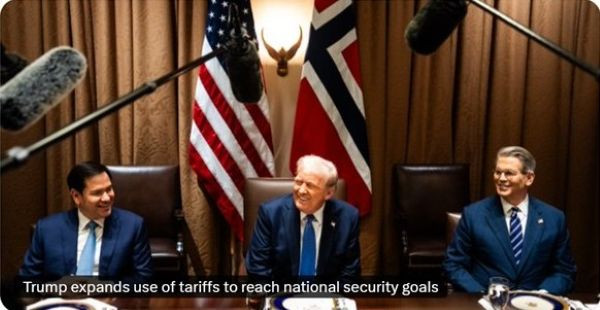
President Trump’s plan attempts to reduce government spending via DOGE to reduce the fiscal deficit; and via high tariff revenues; and a target of high nominal GDP growth that reduces the fiscal burden.
However, massive new fiscal expenditure is needed for the military: Trump is proposing a $500bn increase in the Pentagon budget for 2027, while the Golden Dome missile defense system is projected to cost at least $175 billion.
Moreover, notes Mr. Every, there are many areas where public sector subsidies are going to be needed as part of economic statecraft - and Trump is also talking about tariff revenue rebate cheques for each US household.
What Mr. Every calls “reverse perestroika” will logically therefore have to help sustain ongoing fiscal deficits that finance the shift towards more productive investment – that’s even as the US reforms the global financial architecture which currently sees a structural bid for its assets like Treasuries. Part of this will require help from the Fed on rates (for the government at least); another part will logically require more substantial structural changes to the US and global political-economies.
Beyond tariffs, non-tariff barriers, and export controls, the NSS demands: “balanced trade”; securing access to critical supply chains and materials; reindustrialization; reviving the defense industrial base; energy dominance (“in oil, gas, coal, and nuclear); and preserving and growing financial sector dominance.
The underlying aim, observes Mr. Every, is not just the balance of trade but to establish control over global choke points and critical supply chains. (Emphasis ours.) Raw materials will flow to the US cheaply, priced in dollars, while America will retain the ability to deny those flows to rivals, as via Venezuela.
For this system to work these commodities must be processed inside a US-led bloc as inputs into higher value-added production rather than as profit centers of their own. That can even mean particular commodities run at a loss.
Mr. Every notes this still doesn’t mean manufacturing jobs return on the same scale as in the past due to automation and AI: but equally they help obviate much of the inflationary impulse once the capital stock is built. “Reverse perestroika” therefore requires a structural, not cyclical, global sorting of who is ‘in’ and ‘out’ of this bloc. Countries that wish to access US markets will be forced to align their policies, and will benefit from lower US tariffs.
Crucially, those countries that do not align with the United States will face significantly higher US tariffs, and will be excluded from these integrated, upstream-to-downstream geopolitical supply chains and defense umbrellas.
So, what’s the bottom line?
Mr. Every says Trump is trying to replace an open, values-based alliance in a globalized world with a more closed group of ideologically- and economically-linked economies in a deglobalizing world.
First, the NSS demands “burden-sharing and burden-shifting” from its allies. A 5% defense spending figure has been promised by NATO by 2035, 3.5% of which is for core military spending. Australia and New Zealand haven’t promised 5%, nor Japan and South Korea, but the latter are nonetheless rapidly increasing their military budgets.
Second, the US is further trying to foster political-economy changes in its allies. Where President Reagan said, “Mr. President, tear down this wall,” to Gorbachev in Germany in 1987, in 2026, President Trump wants Germany (and others) to raise walls on trade, capital, migration, and against green policies. Indeed, the NSS accuses Europe of presiding over its own “civilizational erasure” such that it may not be a willing or able US ally.
As such, it also backs “cultivating resistance to Europe’s current trajectory within European nations.” Relatedly, the NSS states: “The purpose of the American government is to secure the God-given natural rights of American citizens... Regarding countries that share, or say they share, these principles, the US will advocate strongly that they be upheld in letter and spirit. We will oppose elite-driven, anti-democratic restrictions on core liberties in Europe, the Anglosphere, and the rest of the democratic world, especially among our allies.”
The NSS also offers a broader US economic development model to others globally. It states: “The goal is for our partner nations to build up their domestic economies, while an economically stronger and more sophisticated Western Hemisphere becomes an increasingly attractive market for American commerce and investment.”
In short, concludes Mr. Every, the US wants cheap commodities, but to also see their sellers move up the industrial value chain via industrialization, and more trade at the margin - if they stay ideologically aligned. The NSS adds: “The choice all countries should face is whether they want to live in an American-led world of sovereign countries and free economies or in a parallel one in which they are influenced by countries on the other side of the world.”
Mr. Every’s analysis provides many useful charts and analyses that are beyond the scope of this short article, and as stated above, we are not 100% on board with the analogy to Russia’s post-Soviet economy. However, the document provides one of the best explanations we’ve seen of how Trumponomics is intended to work and we highly recommend reading it in its entirety. Click this link to go to a PDF version.
While we don’t necessarily buy Mr. Every’s analogy with the shift in the Russian/Soviet economy after the failure of glasnost and perestroika, we do agree this shift is entailing radical changes and the comparison is useful.
US National Security Strategy (NSS) states economic security is national security and that US actions will from now on be guided by this stance. While not a Soviet-style 5-year plan, and not having buy-in from all stakeholders in the US system, it is nonetheless a strategic direction answering “What is GDP *for*?”
Indeed, the NSS states US strategy is: “To ensure that America remains the world’s strongest, richest, most powerful, and most successful country for decades to come, our country needs a coherent, focused strategy for how we interact with the world. And to get that right, all Americans [our emphasis] need to know what, exactly, it is we are trying to do and why.”
This shift logically requires Treasury control of the Fed, or at least to ensure it is ideologically aligned behind the NSS even if it acts ‘independently’. This goes beyond the level of interest rates and extends to ‘one-size fits all’ rate-setting, inflation targeting, QE, Yield Curve Control, capital controls, the use of swaplines, and stablecoins. All of these tools --and more-- must logically be available, argues Mr. Every.
President Trump’s plan attempts to reduce government spending via DOGE to reduce the fiscal deficit; and via high tariff revenues; and a target of high nominal GDP growth that reduces the fiscal burden.
However, massive new fiscal expenditure is needed for the military: Trump is proposing a $500bn increase in the Pentagon budget for 2027, while the Golden Dome missile defense system is projected to cost at least $175 billion.
Moreover, notes Mr. Every, there are many areas where public sector subsidies are going to be needed as part of economic statecraft - and Trump is also talking about tariff revenue rebate cheques for each US household.
What Mr. Every calls “reverse perestroika” will logically therefore have to help sustain ongoing fiscal deficits that finance the shift towards more productive investment – that’s even as the US reforms the global financial architecture which currently sees a structural bid for its assets like Treasuries. Part of this will require help from the Fed on rates (for the government at least); another part will logically require more substantial structural changes to the US and global political-economies.
Beyond tariffs, non-tariff barriers, and export controls, the NSS demands: “balanced trade”; securing access to critical supply chains and materials; reindustrialization; reviving the defense industrial base; energy dominance (“in oil, gas, coal, and nuclear); and preserving and growing financial sector dominance.
The underlying aim, observes Mr. Every, is not just the balance of trade but to establish control over global choke points and critical supply chains. (Emphasis ours.) Raw materials will flow to the US cheaply, priced in dollars, while America will retain the ability to deny those flows to rivals, as via Venezuela.
For this system to work these commodities must be processed inside a US-led bloc as inputs into higher value-added production rather than as profit centers of their own. That can even mean particular commodities run at a loss.
Mr. Every notes this still doesn’t mean manufacturing jobs return on the same scale as in the past due to automation and AI: but equally they help obviate much of the inflationary impulse once the capital stock is built. “Reverse perestroika” therefore requires a structural, not cyclical, global sorting of who is ‘in’ and ‘out’ of this bloc. Countries that wish to access US markets will be forced to align their policies, and will benefit from lower US tariffs.
Crucially, those countries that do not align with the United States will face significantly higher US tariffs, and will be excluded from these integrated, upstream-to-downstream geopolitical supply chains and defense umbrellas.
So, what’s the bottom line?
Mr. Every says Trump is trying to replace an open, values-based alliance in a globalized world with a more closed group of ideologically- and economically-linked economies in a deglobalizing world.
First, the NSS demands “burden-sharing and burden-shifting” from its allies. A 5% defense spending figure has been promised by NATO by 2035, 3.5% of which is for core military spending. Australia and New Zealand haven’t promised 5%, nor Japan and South Korea, but the latter are nonetheless rapidly increasing their military budgets.
Second, the US is further trying to foster political-economy changes in its allies. Where President Reagan said, “Mr. President, tear down this wall,” to Gorbachev in Germany in 1987, in 2026, President Trump wants Germany (and others) to raise walls on trade, capital, migration, and against green policies. Indeed, the NSS accuses Europe of presiding over its own “civilizational erasure” such that it may not be a willing or able US ally.
As such, it also backs “cultivating resistance to Europe’s current trajectory within European nations.” Relatedly, the NSS states: “The purpose of the American government is to secure the God-given natural rights of American citizens... Regarding countries that share, or say they share, these principles, the US will advocate strongly that they be upheld in letter and spirit. We will oppose elite-driven, anti-democratic restrictions on core liberties in Europe, the Anglosphere, and the rest of the democratic world, especially among our allies.”
The NSS also offers a broader US economic development model to others globally. It states: “The goal is for our partner nations to build up their domestic economies, while an economically stronger and more sophisticated Western Hemisphere becomes an increasingly attractive market for American commerce and investment.”
In short, concludes Mr. Every, the US wants cheap commodities, but to also see their sellers move up the industrial value chain via industrialization, and more trade at the margin - if they stay ideologically aligned. The NSS adds: “The choice all countries should face is whether they want to live in an American-led world of sovereign countries and free economies or in a parallel one in which they are influenced by countries on the other side of the world.”
Mr. Every’s analysis provides many useful charts and analyses that are beyond the scope of this short article, and as stated above, we are not 100% on board with the analogy to Russia’s post-Soviet economy. However, the document provides one of the best explanations we’ve seen of how Trumponomics is intended to work and we highly recommend reading it in its entirety. Click this link to go to a PDF version.