
The Trump White House's aggressive strategy of pressuring GOP-controlled states to eliminate as many Democratic House seats as possible to save the GOP's House majority set off a chain reaction that has fundamentally altered the fight for the House in 2026 and beyond.
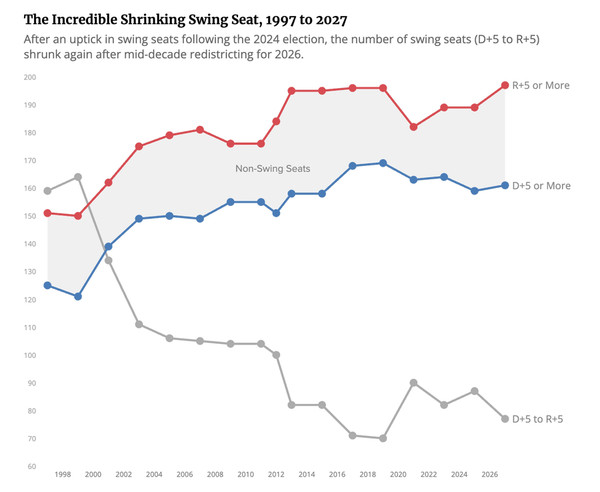
The (respected, but Left-leaning) Cook Political Report has updated its Partisan Voter Index (PVI) scores for all ten states that redrew their lines for 2026. And although 80% of states didn’t redistrict, the shift is still dramatic: the median House seat now sports a Cook PVI score of R+3, two points redder than prior to this cycle's gerrymandering arms race.
According to the Cook Team’s analysis, Democrats now need to win 57 of 77 seats in the R+5 to D+5 range (74%) to win a House majority.
And for reasons of ideology and dollars and cents winning those 57 seats is looking more difficult by the day.
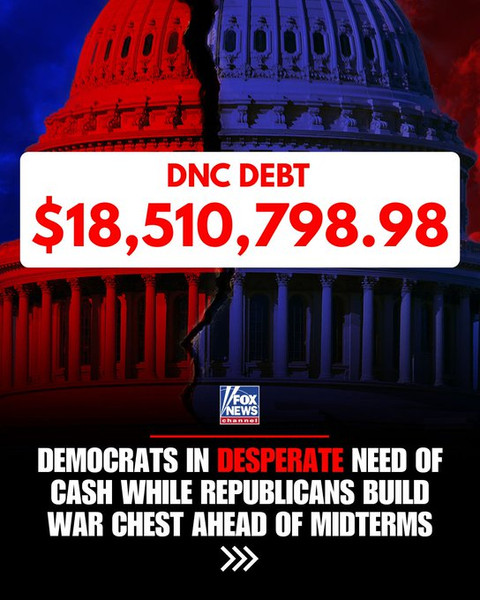
Democratic donors and advisers are raising alarms about the Democratic National Committee’s finances heading into the November midterms, warning the party’s top organization is facing a major cash deficit and expressing doubts about whether the situation will improve by the 2028 presidential cycle.
Federal Election Commission data shows the DNC ended June with $16.3 million in cash and $18.5 million in debt, putting the organization more than $2 million in the red. The same data shows the Republican National Committee ended June with $128 million in cash and no debt.
Democrats are entering the final stretch before the midterms staring down a massive cash crisis while Republicans are working with a growing war chest.
The DNC now has more debt than cash on hand, while the RNC holds an overwhelming fundraising advantage as the fight for control of Congress enters its most critical stretch.
With control of the House expected to come down to fewer than 20 swing districts, Democrats are facing growing questions about whether they'll have the resources to compete where it matters most.
Here's a look at just how dire the situation is for Democrats, according to the Cook Political Reports analysis.
And it gets worse for Democrats as Bernie Sanders and his Democratic Socialist allies rack-up more primary wins.
As Bill Mitchell observed in a recent post to X, “How does the Democratic Party unite against Trump when it can't even agree on who they are?”
For decades, Democrats knew what they stood for, observed Mitchell. Now the party is fighting an internal battle between the establishment wing trying to win elections and the activist wing trying to lurch the party towards Marxism.
Even leading strategists like Donna Brazile and James Carville are warning Democrats not to get swept up in the socialist wave.
In a recent interview with media ally George Stephanopoulos, Ms. Brazile said, “The problem right now, George, is that the Democratic Party must define itself and make sure that we don’t get caught in this socialist wave, which is, you know, popping up here, there and everywhere.”
James Carville was even blunter, on Sunday he ripped into popular left-wing Twitch streamer Hasan Piker, saying that if he shapes himself into a force within the Democratic Party, “I’m out of here.”
“To talk about the larger Democratic Party, post the election in Michigan going forward, I am not going to be in the same party with Hasan Piker,” Carville said on Fox News’s “The Sunday Briefing.”
That should tell you something.
And the panic is growing in the Democrat Party after Reuters found Republicans lead by +4 points on economy, +17 on crime, +7 on immigration, and only down -2 in the 2026 generic ballot, 40%-38% Inside Elections forecast suggests Republicans need merely 3 tossup seats to win back the majority.
Writing for Townhall, Amy Curtis reported that over the last several weeks, the generic congressional ballot has tightened significantly, and polling simply isn't backing up the media narrative that Democrats will reclaim the House.
On June 1, the Real Clear Politics (RCP) average was D+7.4; today, it's D+5.3. RMG Research also showed a tightening in the generic congressional ballot. From July 13-14, the polling showed Republicans were only two points behind the Democrats, 45 to 47. This marks a seven-point swing towards the Republicans since May.
Both the Washington Post/Ipsos poll from July 9-13 and the Morning Consult poll from July 17-19 had Democrats only up by three. The WaPo/Ipsos poll shows Democrats are down from five percent in April. The Harvard-Harris poll and the Reuters/Ipsos poll have Democrats up by only two.
Compare the 2026 numbers to the same point in 2018. Eight years ago, the RCP Average improved by more than four percent for Democrats. This year, it's gotten three percent worse for Democrats and better for Republicans. On June 1, the 2018 RCP Average was D+3.2 and on July 30, it was D+7.3. Compare that to today's RCP Average, where Democrats lost 2.1 points since June 1, noted Ms. Curtis.
Democrats are also experiencing historically weak approval ratings; CNN's Harry Enten noted the Democrats' approval rating is -39. Past elections have shown that the president's party loses seats in the midterms, but that assumes accurate polling, a strong Democratic alternative, and no structural undercounting of Republican support.
None of those things are true this cycle, and with Democrats failing to find a strong message or rein in the radical socialists, the trendline for the last several weeks is moving in favor of Republicans and not away from it.
Now all Republicans need to do to cash in on the nascent Democrat disaster is to shake off their habitual negativity and get out there and campaign on voters' fear of the Democrats' embrace of Marxism and the issues on which voters say they trust the GOP more than the Democrats: +4 points on economy, +17 on crime, +7 on immigration.