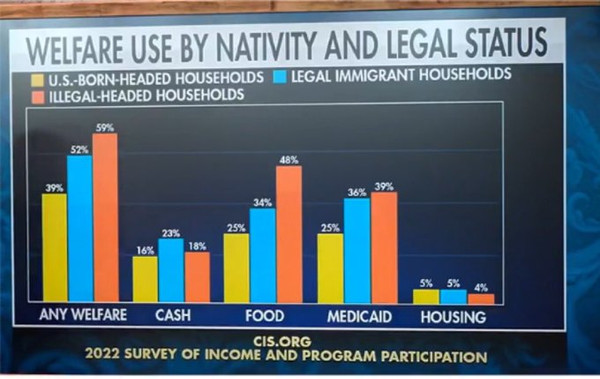

Recent revelations about welfare and immigration fraud among Somali immigrants in Minnesota have shocked many Americans. However, as our friends at the Center for Immigration Studies have documented, as long as they’re here illegal (and legal) aliens will consume welfare benefits at a higher rate than native-born Americans.
“Ending Taxpayer Subsidization of Open Borders”, an executive order signed by President Trump on February 19, requires federal agencies to ensure that illegal aliens do not improperly access welfare benefits. While the order is welcome, observed Jason Richwine of CIS, it cannot prevent illegal aliens from participating in the welfare state. No order can.
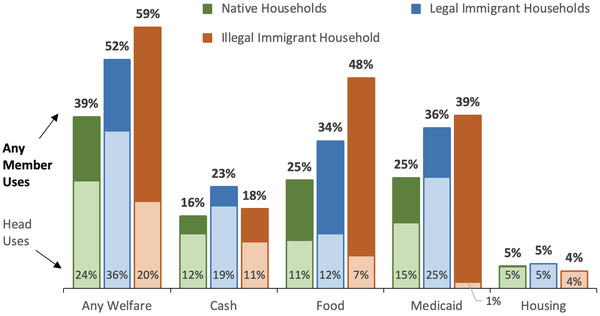
Since so many of the beneficiaries in illegal immigrant households are natural-born citizens of the U.S., new laws cannot exclude them. Due to birthright citizenship, whatever benefits are available to the children of Americans must be available to the U.S.-born children of illegal immigrants as well. Even if birthright citizenship were overturned, the political pressure to provide benefits to such children would be strong. Therefore, the most effective way to reduce illegal immigrant access to welfare is to reduce illegal immigration in the first place.
But it gets worse.
As Steven A. Camarota and Karen Zeigler of CIS documented in a report based on data from the 2022 Survey of Income and Program Participation (SIPP), analysis of this data shows both immigrants and the U.S.-born make extensive use of means-tested anti-poverty programs, with immigrant households significantly more likely to receive benefits. This is primarily because the American welfare system is designed in large part to help low-income families with children, which describes a large share of immigrants. The ability of immigrants, including illegal immigrants, to receive welfare benefits on behalf of U.S.-born citizen children is a key reason why restrictions on welfare use for new legal immigrants, and illegal immigrants, are relatively ineffective.
Among the findings:
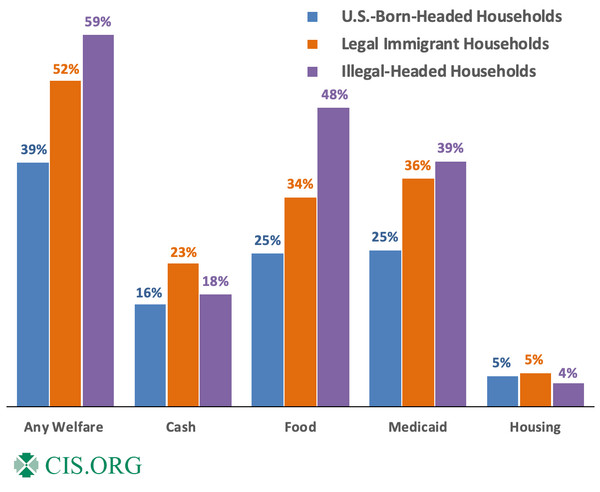
In Figure 2 Camarota and Zeigler show that households headed by illegal immigrants, also called the undocumented or unauthorized, have higher overall welfare use rates than the U.S.-born and the difference is statistically significant. They estimate that 59.4 percent of illegal immigrant households use one or more welfare programs. Compared to the U.S.-born, illegal-headed households use every program at statistically significant higher rates than the U.S.-born, except for SSI, TANF, and housing. Even the larger share of illegal immigrant-headed households using three or more programs at 35.5 percent (shown at the bottom of Table 2) is statistically significant relative to U.S.-born households.14 Assuming their calculations are correct, the SIPP data indicates that use of the welfare system by illegal immigrant households is extremely common. It is also important to note that Camarota and Zeigler have no evidence that their use rates reflect cheating or fraud. Their high rates of welfare use primarily reflect their generally lower education levels and their resulting low-incomes, coupled with the large share who have U.S.-born children who are eligible for all welfare programs from birth.
So, why Is Illegal Immigrant Welfare Use So High?
The influx of illegal aliens that caused this population to increase dramatically during the Biden years has profound implications for public coffers. This is especially true because a large share of those released into the country by Biden were granted parole. Parolees are “qualified aliens”, which means they generally have the same welfare eligibility as new permanent legal immigrants. After five years, this becomes full welfare eligibility with the exception of SSI, which requires 10 years of work.

Moreover, there are several more things to consider:
The bottom line: Beyond just the direct impact on public coffers of immigrant use of welfare, their use of these programs shows that many illegal aliens – and legal immigrants – are struggling in the United States. If illegal alien-headed households have high welfare use, then it also shows that efforts to restrict immigrants from accessing these “immigration magnet” programs once they are in the country is politically and practically difficult and not likely to be very effective. The only way to keep illegal and legal immigrants off welfare is to not admit them in the first place.
George Rasley is editor of Richard Viguerie's ConservativeHQ.com and is a veteran of over 300 political campaigns. A member of American MENSA, he served on the staff of Vice President Dan Quayle, as Director of Policy and Communication for former Congressman Adam Putnam (FL-12) then Vice Chairman of the Oversight and Government Reform Committee's Subcommittee on National Security and Foreign Affairs, as spokesman for retired Rep. Mac Thornberry formerly a member of the House Intelligence Committee and Chairman of the House Armed Services Committee, and as Director of Communications for now-retired Rep. Jeb Hensarling, formerly Chairman of the House Financial Services Committee.
“Ending Taxpayer Subsidization of Open Borders”, an executive order signed by President Trump on February 19, requires federal agencies to ensure that illegal aliens do not improperly access welfare benefits. While the order is welcome, observed Jason Richwine of CIS, it cannot prevent illegal aliens from participating in the welfare state. No order can.
The reason, as Mr. Richwine explained, is that illegal aliens, although not usually eligible themselves, can access welfare through eligible family members such as their U.S.-born children. The best way to reduce illegal immigrant consumption of welfare is not to construct new eligibility rules, but to reduce illegal immigration itself.
Since so many of the beneficiaries in illegal immigrant households are natural-born citizens of the U.S., new laws cannot exclude them. Due to birthright citizenship, whatever benefits are available to the children of Americans must be available to the U.S.-born children of illegal immigrants as well. Even if birthright citizenship were overturned, the political pressure to provide benefits to such children would be strong. Therefore, the most effective way to reduce illegal immigrant access to welfare is to reduce illegal immigration in the first place.
But it gets worse.
As Steven A. Camarota and Karen Zeigler of CIS documented in a report based on data from the 2022 Survey of Income and Program Participation (SIPP), analysis of this data shows both immigrants and the U.S.-born make extensive use of means-tested anti-poverty programs, with immigrant households significantly more likely to receive benefits. This is primarily because the American welfare system is designed in large part to help low-income families with children, which describes a large share of immigrants. The ability of immigrants, including illegal immigrants, to receive welfare benefits on behalf of U.S.-born citizen children is a key reason why restrictions on welfare use for new legal immigrants, and illegal immigrants, are relatively ineffective.
Among the findings:
- The 2022 SIPP indicates that 54 percent of households headed by immigrants — naturalized citizens, legal residents, and illegal immigrants — used one or more major welfare program. This compares to 39 percent for U.S.-born households.
- The rate is 59 percent for non-citizen households (e.g. green card holders and illegal immigrants).
- Compared to households headed by the U.S.-born, immigrant-headed households have especially high use of food programs (36 percent vs. 25 percent for the U.S.-born), Medicaid (37 percent vs. 25 percent for the U.S.-born), and the Earned Income Tax Credit (16 percent vs. 12 percent for the U.S.-born).
- Their best estimate is that 59 percent of households headed by illegal immigrants, also called the undocumented, use at least one major program. They have no evidence this is due to fraud. Among legal immigrants they estimate the rate is 52 percent.
- Illegal immigrants can receive welfare on behalf of U.S.-born children, and illegal immigrant children can receive school lunch/breakfast and WIC directly. A number of states provide Medicaid to some illegal adults and children, and a few provide SNAP. Several million illegal immigrants also have work authorization (e.g. DACA, TPS, and some asylum applicants) allowing receipt of the EITC.
- No one program explains the higher overall use of welfare by immigrants. For example, excluding the extensively used but less budgetary costly school lunch/breakfast program, along with the WIC nutrition program, still shows 46 percent of all immigrant households and 33 percent of U.S.-born households use at least one of the remaining programs.
- The presence of extended family or unrelated individuals does not explain immigrants’ higher welfare use, as the vast majority of immigrant households are nuclear families. Further, of immigrant households comprised of only a nuclear family, 49 percent use the welfare system compared to 35 percent of nuclear family U.S.-born households.
- The high welfare use of immigrant households is not explained by an unwillingness to work. In fact, 83 percent of all immigrant households and 94 percent of illegal-headed households have at least one worker, compared to 73 percent of U.S.-born households.
- Immigrants’ higher welfare use relative to the U.S.-born is partly, but only partly, explained by the larger share with modest education levels, their resulting lower incomes, and the greater percentage of immigrant households with children.
- Immigrant households without children, as well as those with high incomes and those headed by immigrants with at least a bachelor’s degree, tend to be more likely to use welfare than their U.S.-born counterparts.
- Most new legal immigrants are barred from most programs, as are illegal immigrants, but this has a modest impact primarily because: 1) Immigrants can receive benefits on behalf of U.S.-born children; 2) the bar does not apply to all programs, nor does it apply to non-citizen children in some cases; 3) most legal immigrants have lived here long enough to qualify for welfare; 4) some states provide welfare to otherwise ineligible immigrants on their own; 5) by naturalizing, immigrants gain full welfare eligibility.
In Figure 2 Camarota and Zeigler show that households headed by illegal immigrants, also called the undocumented or unauthorized, have higher overall welfare use rates than the U.S.-born and the difference is statistically significant. They estimate that 59.4 percent of illegal immigrant households use one or more welfare programs. Compared to the U.S.-born, illegal-headed households use every program at statistically significant higher rates than the U.S.-born, except for SSI, TANF, and housing. Even the larger share of illegal immigrant-headed households using three or more programs at 35.5 percent (shown at the bottom of Table 2) is statistically significant relative to U.S.-born households.14 Assuming their calculations are correct, the SIPP data indicates that use of the welfare system by illegal immigrant households is extremely common. It is also important to note that Camarota and Zeigler have no evidence that their use rates reflect cheating or fraud. Their high rates of welfare use primarily reflect their generally lower education levels and their resulting low-incomes, coupled with the large share who have U.S.-born children who are eligible for all welfare programs from birth.
So, why Is Illegal Immigrant Welfare Use So High?
The influx of illegal aliens that caused this population to increase dramatically during the Biden years has profound implications for public coffers. This is especially true because a large share of those released into the country by Biden were granted parole. Parolees are “qualified aliens”, which means they generally have the same welfare eligibility as new permanent legal immigrants. After five years, this becomes full welfare eligibility with the exception of SSI, which requires 10 years of work.
Moreover, there are several more things to consider:
- First, more than half of all illegal immigrant households have one or more U.S.-born children.
- Second, many states offer Medicaid directly to illegal immigrants. For example, a dozen states offer Medicaid to all low-income children regardless of immigration status and even more states provide it to all low-income pregnant women, again without regard to legal status. A few states go beyond this and offer Medicaid to other adult illegal immigrants.
- Third, illegal immigrant children have the same eligibility as citizens for free subsidized school lunch/breakfast and WIC under federal law.
- Fourth, six states also offer SNAP benefits to illegal immigrants under limited circumstances.
- Fifth, several million illegal immigrants have work authorization, which provides a Social Security number and with it EITC eligibility. This includes those with DACA, TPS, many applicants for asylum, and those granted suspension of deportation and withholding of removal.
- Sixth, prior research indicates that the overwhelming majority of illegal immigrants have no education beyond high school and, as a result, a very large share of illegal immigrants have incomes low enough to qualify for welfare.
- Finally, it should be remembered that the job of the those in the welfare bureaucracy is to help low-income residents receive the welfare for which they are eligible.
The bottom line: Beyond just the direct impact on public coffers of immigrant use of welfare, their use of these programs shows that many illegal aliens – and legal immigrants – are struggling in the United States. If illegal alien-headed households have high welfare use, then it also shows that efforts to restrict immigrants from accessing these “immigration magnet” programs once they are in the country is politically and practically difficult and not likely to be very effective. The only way to keep illegal and legal immigrants off welfare is to not admit them in the first place.
George Rasley is editor of Richard Viguerie's ConservativeHQ.com and is a veteran of over 300 political campaigns. A member of American MENSA, he served on the staff of Vice President Dan Quayle, as Director of Policy and Communication for former Congressman Adam Putnam (FL-12) then Vice Chairman of the Oversight and Government Reform Committee's Subcommittee on National Security and Foreign Affairs, as spokesman for retired Rep. Mac Thornberry formerly a member of the House Intelligence Committee and Chairman of the House Armed Services Committee, and as Director of Communications for now-retired Rep. Jeb Hensarling, formerly Chairman of the House Financial Services Committee.