
This week’s state visit of Red China’s dictator Xi Jinping offers President Donald Trump an opportunity to communicate directly with our most potent state adversary. However, what President Trump does will be much more important than what he says.
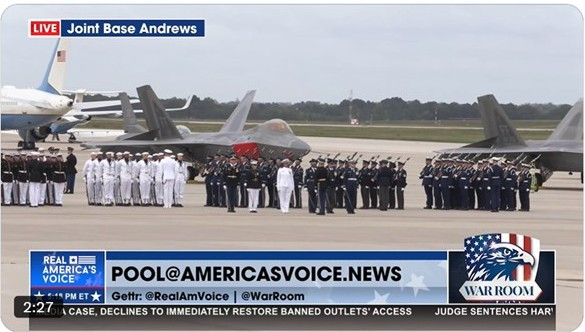
Washington pundits and readers of tea leaves have been sifting the air looking for “messages” and non-verbal cues the President might be sending Xi – for example the obvious show of strength of the B-1 Lancer flyover upon Xi’s arrival.
Xi seemed visibly annoyed, but we wonder what his real takeaway was after being threatened with a bomber that entered service on October 1, 1986, almost 40-years to the day of yesterday’s flyover.
Because, while the B-1 flyover was good optics for American TV, other happenings in Washington show Xi that the United States does not take seriously the unrestricted all-domain warfare Red China has declared on the United States.
One recent example is the decision made somewhere in the bowels of the Pentagon to close down the Air Force’s the China Aerospace Studies Institute (CASI). CASI, along with its sister institutions the China Maritime Studies Institute (CMSI), China Landpower Studies Center (CLSC) and China Warfighting Initiative. These three specialty institutes that study primary sources in Mandarin that pertain to each of these three mission areas: sea, air, land.
These small offices are the most prolific producers of publicly-accessible open-source research about Red China’s Peoples Liberation Army in the United States. CASI has published hundreds of studies and translations over the years, regularly sponsors educational courses about the PLA, and hosts a biennial conference. CASI has measurably increased knowledge about the PLA within the U.S. government, academia, think tanks, and the broader public--which should be in the U.S. government's interest, given that strategic competition with the PRC is the most important and consequential state-level national security challenge facing the United States.
As our friend Capt. James Fanell (USN Ret.), the Office of Naval Intelligence Senior Intelligence Officer for China from 2006-08, observed in a social media exchange with CHQ:
During that tour, we collaborated with the newly established CMSI and in the 20 years since, CMSI has been the single most important and productive USG agency to examine the PRC’s maritime power. Actually, it is more accurate to say that CMSI is the leading center on the analysis of the PRC’s maritime strategy across the globe. CASI has also established the same bona fides in the realm of analysis of PLAAF.
So, the word that CASI, and possibly the others, are being defunded crosses a line. This is totally insane and should not be allowed to happen. These three institutes are not pro-PRC, they are the independent and objective, but in that regard they have done more than any FFRDC or most of the IC to provide unclassified insights into the PRC’s sea, air and land warfare activities and developments.
These institutes should not be closed, they should be expanded. They are all relatively small (around 10 people) with staffs of Mandarin speakers/readers who are real experts in their areas of expertise. It is unfathomable to me that for the past decade the DoD allowed DEI to take hold at our War Colleges at the expense of these institutes…and now the DoW is going to shut them down?
I cannot imagine why this decision was made, if it was, and that [President Trump] if notified about this boneheaded decision, will see to it that it will be reversed immediately.
In an email exchange with CHQ, Capt. Fanell further observed, “Who in their right mind, cuts the funding for these civilians who are doing extra-ordinary work for the Pentagon and national defense. Such a small group of people, who have their heads down in researching Chinese open-source literature that our intelligence community does NOT do for the services. I know, I lived this for 20 years with CMSI in Newport. If we lose CASI we are essentially cutting off the USAF from better understanding of PLAAF tactics, techniques, procedures and new platform information. This must not be allowed to stand.”
As just one example, it was CASI that broke the story of Communist China’s mountain missile bases.
We agree with Capt. Fanell, and urge reversal of the defunding decision, but so far, the message does not seem to be getting through.
Bill Gertz, leading conservative national security commentator and longtime national security reporter for The Washington Times has posted an article in which Air Force spokeswoman Ann Stefanek was quoted as saying the action to shut down the three specialty institutes is part of an “ongoing civilian restructure within Air Education and Training Command.”
According to Mr. Gertz’s report Ms. Stefanek said the “CASI mission continues, with the organization leveraging assigned military service members to accomplish its objectives.” The institute said in a statement it is disappointed by the closing but will continue operating for a time.
“We will continue to publish articles and reports; we have plenty in the queue,” the statement said, noting its researchers will seek work elsewhere. “Unfortunately, it does mean that we will have to cancel the plans for the 10th anniversary CASI event that was scheduled for next February.”
But Brendan S. Mulvaney, the CASI director, said the action effectively guts the institute since only two master sergeants and a vacant lieutenant colonel position will remain authorized.
“So technically CASI will still exist, just without the researchers or the director,” he said.
We call BS in the claim that the “CASI mission continues” and shake our heads in astonishment at the clear message closing CASI and the other specialty institutes sends to the Chinese Communist leadership, which is, “While we threaten you with 40-year-old technology, we turn a blind eye to what you are developing today.”
George Rasley is editor of Richard Viguerie's ConservativeHQ.com and is a veteran of over 300 political campaigns. A member of American MENSA, he served on the staff of Vice President Dan Quayle, as Director of Policy and Communication for former Congressman Adam Putnam (FL-12) then Vice Chairman of the Oversight and Government Reform Committee's Subcommittee on National Security and Foreign Affairs, and as spokesman for retired Rep. Mac Thornberry formerly a member of the House Intelligence Committee and Chairman of the House Armed Services Committee.