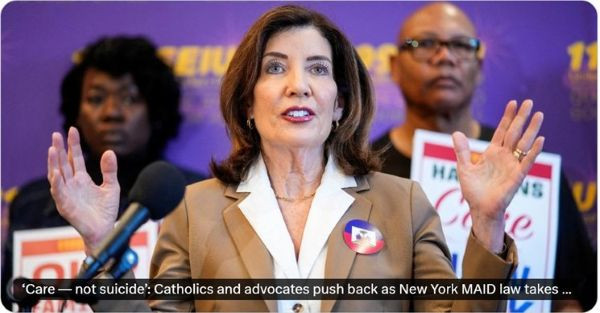

As western societies embrace assisted deaths, our friend John Anthony observes America's progress is following a dark pattern through the rapid increase of euthanasia in the west, and especially the United States, and how our attitudes are being shaped to accept assisted suicide as ‘normal’.
The Disturbing Rise of Assisted Death
A 52-year-old Canadian grandfather, Dan Quayle, was forced to wait 10 weeks for chemo to treat his esophageal cancer by Canada’s socialized health care bureaucrats. After suffering and still receiving no treatment date, he lost hope and applied for Medical Aid in Dying (MAiD). No delay here. His death application was completed within hours, and he was euthanized within 2 days.
“I think I could still have my Dan if he had gotten treatment sooner. If we had more money, we could have gone to the States. But we’re just regular people,” his wife told reporters.
In the summer of 2023 Kristin Logan suffered from irregular menstruation and severe bloating. Canadian doctors insisted there was nothing they could do for her and that HIPEC (hyperthermic intraperitoneal chemotherapy), a specialized two-step treatment for advanced abdominal cancers, would not save her life.
Luckily, Logan was able to come the US where she received the treatment. Two and one half years later, she is doing fine.
According to her husband James,
“If we stayed in Canada, her only option would have been to kill herself on MAID because they had no treatment for her; they lied to her and said that the HIPEC surgery wouldn’t ever save her life, but it did.”
In Canada MAiD applications are so common many hospitals actively promote the procedure to long term patients.
While Canada had 13,000+ euthanized patients in 2025, a fivefold increase in just 9 years, they are not alone. In 2025, Belgium saw a 230% increase to 4,486 euthanized deaths, and in the same year Netherlands recorded 10,341 euthanizations. The Dutch health ministry commissioned a study that attributed this to "cultural shift". In other words people have just gotten comfortable with the idea of ending their lives.
The United States
Because euthanasia programs are rolled out by each state, the U.S. may have the slowest growth, yet most dangerous implementation of any nation.
Oregon’s Death with Dignity Act is at the forefront of the movement. There have been 3,691 assisted deaths since the program’s 1994 inception. In 2023, Oregon removed the residency requirement meaning out-of-state residents can now travel there for a lethal prescription.
As of 2026, there are 12,400 confirmed legal deaths from reporting states. 14 states plus DC have legalized physician-assisted death, covering about 33% of the U.S. population:
- California
- Colorado
- Delaware
- District of Columbia
- Hawaii
- Illinois
- Maine
- Montana (Authorized via state court ruling)
- New Jersey
- New Mexico
- New York
- Oregon
- Vermont
- Washington
A look at the evolution of euthanasia gives a better understanding of why America’s quietly progressing euthanasia program is so troubling.
History of Euthanasia
Greeks
Euthanasia comes from the Greek eu (good) + thanatos (death). Ancient Greeks frequently argued its societal role. Most classical philosophers like Hippocrates, Plato, and Aristotle believed it was only for the “weak and depraved.”
Romans
Attitudes shifted with the rise of the Roman Empire. Their law accepted suicide by the terminally ill who lacked access to medicine. Since there was little effective medicine at the time, many of the ill simply waited to die. Suicide was considered an acceptable option.
Middle Ages
During the Middle Ages, as Catholicism gained control over science, the arts, and medicine, suicide was forbidden. Saint Augustine called it an “abominable and detestable act”. By 693 AD, the Church formalized the penalty. Anyone who took their own life was excommunicated, denied Christian burial, their property seized, and their family shamed. For over 1500 years death by suicide was outlawed.
The 20th Century
Euthanasia re-emerged like a tornado in 1920’s Germany with “mercy killing” (Gnadentod) to “end suffering and maintain dignity”. The policy spoke of the cost burden of “useless eaters” on society.
The 1920 Essay, Allowing the Destruction of Life Unworthy of Life by German Law Professor Karl Binding, clarified the purpose of euthanasia. It was a progressive undertaking. The initial movement only affected the terminally ill. It soon expanded to the severely disabled, then the chronically mentally ill were included, then the “incurably insane.” By the time the Nazis took power in the1930’s, the intellectual groundwork for mass killings had already been laid by the medical establishment.
The Nazi regime didn’t invent euthanasia, it was built on the platform that German doctors and academics had been advocating for decades. Between 1939 and 1945, the T4 program murdered an estimated 200,000–300,000 disabled adults and children. The methods developed for T4 including gas chambers disguised as showers and lethal injection protocols, were later exported to the concentration camps.
After the war, the Nuremburg Trials exposed the horrors of eugenics and euthanasia. While no laws were passed outlawing the practice, human rights frameworks and strict guidelines were established for human experimentation. The exposure alerted the public and again, euthanasia went underground. But only for 30 years until the mid-1970’s.
1975 to Today
In 1975, in a much publicized event, Derek Humphry helped his wife, who was dying from breast cancer, take her own life.
Five years later Humphry founded the Hemlock Society, the first right-to-die organization in the U.S. The name was a reference to Socrates drinking hemlock rather than accepting exile. He framed euthanasia as noble, philosophical, and a choice made by the greatest mind of antiquity. As you will see, the misleading framing represents the beginning of a pattern of deception that continues today.
In 1990, Dr. Jack Kevorkian, nicknamed “Dr. Death,” attended the death of 54-year-Janet Adkins from Portland, Oregon who was diagnosed with Alzheimer’s disease. Adkins was the first to die in his Volkswagen van, using his self-built “suicide machine”. Kevorkian who estimated he killed 130 people, claimed,
“My ultimate aim is to make euthanasia a positive experience. I’m trying to knock the medical profession into accepting its responsibilities, and those responsibilities include assisting their patients with death.”
Again, assisted suicide is being defined as an enlightened experience. Humphry and the Hemlock Society distanced themselves from Kevorkian publicly claiming he was too willing to help non-terminal patients.
But privately, Kevorkian provided what the movement needed: he made assisted suicide a national conversation. By the time he went to prison, the question was no longer whether assisted suicide should be legal, but under what conditions.
In 1994: Oregon passed Measure 16, The Death with Dignity Act by public ballot. Like so many devious government measures, the original bill was intentionally narrow, (it only applied to those with terminal illness, required two doctors’ approvals, there was a residency requirement, and treatment had to be self-administered). But the highly conservative wording was designed only to open the door in one state so others would follow. The parameters could be easily expanded in the future. They were.
As soon as the bill passed money flooded in from George Soros’ Open Society Institute, the Columbia Foundation, and more.
In 2022, Compassion & Choices, who helped get the bill passed, sued Oregon claiming that to deny euthanasia to other states was unconstitutional. In 2023 the residency requirement and most of the other conservative requirements were dropped.
2003–2005 Rebranding
In 2003 Humphry’s original Hemlock Society became End-of-Life Choices, which, two years later merged with Compassion in Dying to become Compassion & Choices.
Compassion & Choices not only supported Oregon’s law and once passed sued the state it partnered with to liberalize the Act’s terms, the measure empowered the organization to promote euthanasia in other states.
The ultimate goal of these organizations is to gain a federal mandate requiring assisted suicides nationwide under specific conditions they can define and redefine. Which brings us to Barack Obama and the Affordable Care Act.
2010 The Affordable Care Act
The 2009 House Version of the Affordable Care Act included section 1233, Advanced Care Planning Consultation, which innocently helped patients complete living wills, hospice options, do-not-resuscitate orders; all the paperwork of dying. Sarah Palin, suspecting this could be expanded after passage called 1233, Death Panels. The name resonated with the public and an uproar by backers ensued dismissing her claims as quackery.
But they missed her point. Section 1233 was part of a cost reduction bill. Yet nothing in the section reduced costs, unless the patient chose to die. Her concern was based on government ‘s history of expanding its reach. Palin warned Americans that section 1233 could easily transform into government approved death counseling, (similar to what is beginning in 14 states today.)
While the administration denied this, their handling of the issue suggests their true agenda. Section 1233 was stripped from the final ACA. The legislation that Obama signed in March 2010 contained no end-of-life counseling provision.
Except that’s not what happened.
In December 2010 — less than a year after the bill passed — the New York Times reported that the Obama administration had reinserted the policy through Medicare regulation, effective January 1, 2011. No congressional vote. No public debate. Just a discreet administrative rule change tucked into the fine print of Medicare’s annual wellness visit coverage.
In 2015, CMS further embedded it by creating two new billing codes allowing doctors to bill ACP as a standalone service. The AMA recommended the codes, CMS adopted them, and the section that was supposedly too controversial to include in the legislation became standard practice.
The CMS guidance today is explicit:
- No limit on how many times ACP can be billed for a single patient
- Billing just requires documenting a “change in health status” or change in wishes
- The service can be provided during annual wellness visits (where it’s free to the patient) or as a separate Medicare Part B service
- It covers discussions of DNR orders, living wills, health care proxies, and “medical orders for life-sustaining treatment”
Expansion is Already Underway
Most of the language, as with the states’ initial programs is benign discussions and paperwork. But ‘program creep’ was always the goal and expand they have.
Oregon’s 2023 Omnibus Expansion eliminated every conservative portion of the original Death With Dignity Act framework. The residency requirement, restricted witness requirement, paper only prescription requirement, and the 48 hour waiting period after requesting a written prescription were all eliminated. The 15-day waiting period between oral requests was reduced to 48 hours, and in some cases eliminated altogether.
Colorado’s Medical Aid in Dying (MAID) expansion under SB24-068 (2024) is virtually identical to Oregon’s euthanasia expansion.
Washington's Death with Dignity Act (2008)has been amended less dramatically than Oregon's, but the direction is the same. The requirement that only physicians can provide End-of-life consulting has been expanded to any “qualified medical provider”, the 15 day wait period has been reduced to 7 days.
Vermont’s Medical Aid in Dying Act 39 never had a residency requirement, expanded APRNs to physician’s assistants, removed the waiting period altogether, and allowed for telehealth consultations. (Your decision to end your life can now be made using FaceTime.)
There’s more, but you get the idea. Hawaii and California follow the same pattern. These assisted suicide bills were never intended to be benign and consultative only. The federal government can easily be called on to provide continuity of euthanasia practices across states through federal regulation and the ACA provides the framework.
Or, as President Obama said at his first 2014 Cabinet meeting, “I’ve got a pen and I’ve got a phone.”
Why this is happening
The single biggest factor that few mention is money. Simply put, ending a life is cheaper than end of life care. In Canada, a MAiD death costs the system roughly $2,000–$5,000 in drugs and administration. Keeping an elderly person in long-term can cost $40,000–$100,000 per year. A terminal cancer patient can be substantially more.
When health systems are strained euthanasia becomes a cost-saving option. In Netherlands the Dutch report was direct. It explicitly flagged that “cutbacks and staff shortages in elderly and terminal care could reinforce a patient’s decision.” Instead of patient autonomy, they are creating a system that nudges people toward euthanasia because medical care is too costly.
The Obamacare-Euthanasia Connection
The continuity between Obamacare’s backdoor regulation and today’s euthanasia is the gradual shift the move made in the default attitude of the medical system toward death.
1. The Shift from Saving Lives to Managing End of Lives
The original Section 1233 was sold as patient empowerment that gave people more control over how they die. Taken by itself this isn’t sinister. Most people should have living wills.
But 1233 was written into a system explicitly designed to contain costs. The doctor sitting across from you is employed by a hospital network that’s evaluated on cost metrics. The Medicare reimbursement structure rewards certain financial outcomes. The subtle pressure to “choose wisely”, meaning, choose the cheaper path, becomes part of the structure.
What started as “let’s pay doctors to talk about living wills” has evolved, step by step, into a system where:
- Doctors are financially incentivized to have end of life conversations
- The conversations occur during routine wellness visits, normalizing them
- The patient’s “choice” happens against a backdrop of a system that benefits financially when they choose less care
- That same logic, extended a few degrees further, leads to “if less care is good, no care, via assisted death, is better”
2. The Same Advocates Following the Same Patterns
Organizations like Compassion & Choices that are pushing assisted suicide legalization today have been following the same pattern for decades:
1. Tell people this is about patient autonomy and dignity
2. Illustrate a few sympathetic cases (terminal cancer, intractable pain)
3. Once the principle is accepted, expand to broader categories
4. Dismiss critics as religious zealots or conspiracy theorists
5. Use euphemistic language to reframe suicide as healthcare
The “death panels” smear was effective in 2009 because it named the logical endpoint of their programming in language people could understand. The administration’s telling response was to ignore the substance of Palin’s comments, mock the messenger, kill the provision publicly, and then stealthily implement it through backdoor regulations. This is not about providing the best medical care for patients.
3. The Cost Imperative
The CBO scored Section 1233 at $2.7 billion over 10 years, meaning it would cost money in the short term (paying doctors for counseling sessions). The long-term savings from patients choosing less aggressive end-of-life care were never scored. The reason, it’s too politically radioactive to acknowledge. But the savings are enormous.
The assisted suicide regime in Oregon and elsewhere costs $500 to $3,000 for a lethal prescription. End-of-life cancer care for the same patient can run into hundreds of thousands.
Consider: Our own Medicare is projected to be insolvent by1993. (This will mean reducing benefits or increasing taxes or both.) Now imagine a regulatory framework where the sicker a patient is, the more their health payor (the US government) benefits from you choosing end of life.
In summary
The stealth and consistency with which euthanasia plans are being rolled out and gradually expanded should concern all Americans. Once our government becomes the payor for end-of-life counseling, and once cost containment is a specific goal of the system, the institutional incentives will move toward encouraging less care, not better, or more care. The Hippocratic Oath is out the window and the “voluntary” conversation between doctor and patient now happens on an uneven playing field favoring assisted suicide.
The mindset that in 2009 claimed “Medicare should pay doctors to discuss end-of-life options”, now says “Medicare should pay doctors to provide the option.”
In a coming article, I’ll show Why People Choose Assisted Suicide and What You Can Do to Protect Yourself and Loved Ones from the expanding medical death state.
Truth Monster John Anthony is a national speaker, researcher, founder of the Sustainable Freedom Lab, and an expert on HUD and property rights infringements click here to subscribe to his must-read Substack. The Truth Monster is a reader-supported publication. To receive new posts and support its work, consider becoming a free or paid subscriber.