
It is axiomatic in today’s politics that the longer the vote count goes on, the more likely it is that the Democrat will win, and the same goes for the institution of novel election schemes, like ranked choice voting.
So, it should surprise no one that two weeks after Election Day it was announced that under Alaska’s ranked choice voting scheme Far Left Democrat Mary Peltola has unseated Republican Dan Sullivan.
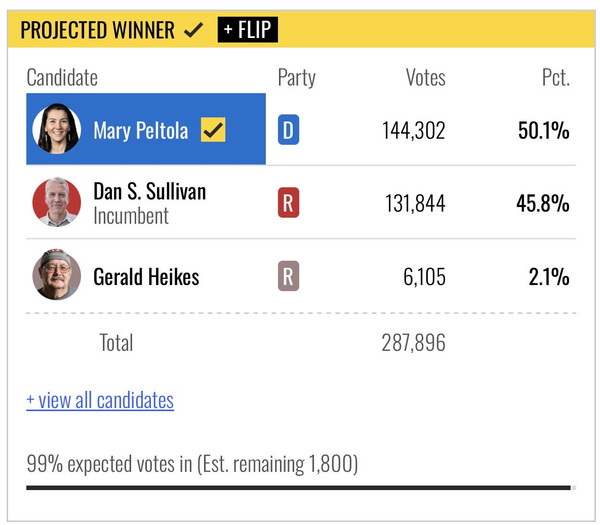
The Associated Press called the race at 10:19 p.m. on Nov. 17, Peltola held 50.1 percent of the vote—just barely above the threshold to avoid a runoff, which would have been triggered if Peltola had failed to receive a majority of the vote.
Sullivan was several points behind, taking in 45.8 percent of the vote. Another Republican, Gerald L. Heikes, received 2.1 percent. Daniel J. Sullivan Jr., whose similar name to the incumbent senator had drawn national scrutiny, received 1.7 percent of the vote.
The Epoch Times reported Senator Sullivan’s campaign spokesperson, Nate Adams, said in a statement on Monday that the campaign would let the process run its course “until every legal vote is counted and certified.”
“The Division of Elections has work left to do, and we respect the Alaskans doing it. We will not be commenting on individual ballot updates or outside projections in the meantime,” Adams said. “The campaign will have more to say by the end of this week.”
Last month, Alaska Gov. Mike Dunleavy ordered a probe into allegations that Peltola’s campaign had attempted to manipulate Alaska’s ranked choice voting scheme by recruiting a candidate, Daniel J. Sullivan, with the same last name as Republican Senator Dan Sullivan to draw votes away from the incumbent, citing a report from The New York Times.
The Justice Department filed a lawsuit on Oct. 22 seeking to block certification of the Alaska Senate race if the incumbent loses, citing tainted results because Daniel J. Sullivan was included on the ballot.
A federal judge rejected the lawsuit on Nov. 1, finding that the department lacked the capacity to bring the lawsuit and that ballots had already been prepared, reported the Epoch Times.
The Justice Department has filed a notice of intention to appeal the ruling.
Democrats will now enter the 120th Congress with 56 Senate seats—the most of any party since January 2011—after they flipped seats in North Carolina, Texas, Kansas, Iowa, Ohio, Maine, and, most recently, Mississippi. Republicans will hold 44 seats.
If the result holds, as seems likely, it still leaves Democrats below the all-important 60-vote filibuster threshold, meaning that even with their commanding majority in the upper chamber, Democrats will need the support of at least four Republicans to pass most legislation.
However, with a solid majority of 56 votes, it is very likely that the first order of business for Democrats will be to do away with the filibuster when the new Senate convenes in January and adopts rules for the 120th Congress.