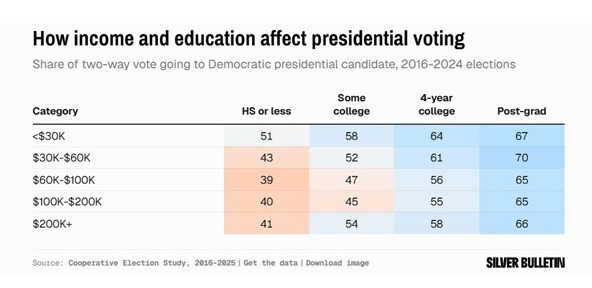

One reason the Democrats have lurched to the left is that its voter base increasingly consists of college and post/graduate Americans who way underperform in the real-world economy and earn less than $60k a year; a sum vastly short of the inflated expectations they had when they chose to pursue college degrees with no value in the private sector job market.
In a recent edition of his must-read Committee to Unleash Prosperity Hotline, our friend Steve Moore shared a chart assembled by political guru Nate Silver showing how income and education affect presidential voting, and it demonstrates the most Democratic voting group in America is voters with postgraduate degrees but lower-to-middle household incomes of $30K to $60K per year. Mr. Silver’s article on this subject is definitely worth a read BTW.
This is very much also the sweet spot for the DSA. In the group's most recent member survey in 2021, 80 percent of members aged 25 or older had bachelor's degrees, but 45 percent had household incomes below $60,000 per year.
In his Wednesday night monologue Fox News late night host Greg Gutfeld delivered a brutal takedown of these Leftist Losers and their politics of inflated self-worth and envy.
As Steve Moore pointed out, this has real world policy implications, and helps explain why dumping student loans on taxpayers has become a core policy plank of the Left - and what a mistake it was to publicly finance so many low-value degrees in the first place.
But it may also explain why younger voters are angry with the Democratic Party’s old establishment and have been voting out their longtime incumbents and voting in radical Democratic Socialists.
Democrats are ahead in the generic congressional ballot by an average of 4.7 percentage points according to the latest Real Clear Polling data, a 3.4-percentage-point decline since May.
As Manzanita Miller, senior political analyst at Americans for Limited Government Foundation observed, while the race is narrowing, data on favorability indicates that voters under age 44 view the Democratic Party significantly less favorably heading into the 2026 general election than they did in 2022.
And the largest decline in support has occurred among millennial voters ages 30–44. In the latest Democratic Party tracker data from YouGov, which surveys 1,055 to 2,440 registered voters and has tracking data dating back to 2017, Democrats have lost substantial ground among millennials.
The GOP has mostly held steady and even gained modest ground, indicating that the last four years — which saw the transition from the Biden administration to the Trump administration — have weakened support for Democrats, but not Republicans.
The Democratic Party has gone from a net favorable rating of +6.4 points in the summer of 2022 among millennials to a net approval rating of -17 points in the latest survey. Democrats are currently underwater by just over 17 points, with 56.4 percent of voters holding an unfavorable view of the Democratic Party and only 38.7 percent holding a positive view. This is a steep decline compared to four years ago, when the Democratic Party held a net favorable rating of +6.4 percentage points, with 48.4 percent approving of the party and 42 percent disapproving.
Overall, Democrats have suffered a 23.4-percentage-point decline in favorability among millennials.
The data indicates that even if Gen Z and millennial voters are split on their decision in November, the Democratic Party’s reputation has suffered an erosion of support that could be difficult to recover from. Ms. Miller suggests that this decline in the Democrats favorability among Millennials may be attributable to the fact that they now have families.
But if that is the case why no significant shift to Republicans, the party of “family values”?
A recent Rasmussen Reports survey suggests an answer.
Rasmussen found that young voters are significantly more likely than those 50 and older to identify as progressives. A majority (51%) of voters 65 and older believe progressives have too much influence in the Democratic Party, however, younger voters are more likely to think progressives don’t have enough influence on Democrats.
Taking a deeper dive into the data suggests to us that Gen Z and millennial voters are substantially overrepresented in the Democratic Socialist core demographic – those holding bachelor's degrees with household incomes below $60,000 per year – and that they are taking out their rage and envy on the Democratic Party’s establishment first, before moving on to the rest of us.