
Commentators and so-called Republican political gurus surveying the wreckage of Election Day 2026 keep calling the Republican electoral wipeout “unprecedented” and suggesting that it represents a national rejection of the MAGA agenda.
It’s an understandable conclusion – but only if you think history started on 9/11/2001 or when Barack Obama was elected President.
However, reality is something quite different, and offers conservatives and the MAGA Movement a path forward out of the political wilderness they think they are in, but only if they snap out of their post-disaster funk and get back to work.
As CHQ Chairman Richard A. Viguerie explained in his book TAKEOVER, “If things look bleak for conservatives today, trust me: conservatives were in a darkness of biblical proportions after Goldwater’s [1964] defeat.”
Official 1964 returns showed that Republicans lost over 500 seats in the state legislatures of the nation in the 1964 election. In the House of Representatives, the Republicans suffered a 38-seat loss, reducing them to the lowest level since the Democratic landslide of 1936. The House balance after the 1964 election would be 295 Democrats vs. 140 Republicans – a Democratic majority of 155 seats.
The Senate elections resulted in a net Democratic gain of two seats, making the new balance after the 1964 election 68 Democrats vs. 32 Republicans, a filibuster-proof majority for Democrats.
Then, as now, the search for scapegoats was on, and the long knives of the Republican establishment were out for anyone who had supported Barry Goldwater or who questioned the “go-along, get-along” attitude of the Party’s congressional leaders whose failure to stand for conservative principles had assigned Republicans to what appeared to be the status of a permanent minority on Capitol Hill.
Back in 1964 the Republican establishment made no real attempt to debate Goldwater on domestic policy or national defense or refute his criticism of establishment Republican me-tooism. Instead, he was attacked on a personal level as an “extremist,” a “kook,” and a “crackpot” who had no hope of winning the general election.
Sound familiar?
Now, as then, the pattern set in the Goldwater campaign still holds true. When a conservative loses, he is expected to campaign for the establishment Republican winner, as Taft did for Eisenhower in 1952. When a conservative wins, the losing establishment candidate routinely undermines the conservative, as Rockefeller, Scranton, and Romney did to Goldwater in 1964 and establishment Republicans like John Cornyn, Karl Rove and the other Bush people did to Ken Paxton and Gregg Abbott this election.
Frustrated and angry at the Republican establishment’s betrayal of the conservative standard bearer some conservatives were starting to talk about forming a third party – and the same rumblings are being heard today in the darker corners of MAGA Movement.
William F. Buckley, Jr. disagreed. Buckley argued that conservatives should take over the Republican Party. Believe it or not, to many of us in the conservative movement, the plan to take over the Republican Party advocated by Bill Buckley made more sense than ever—even after Goldwater’s defeat.
The Goldwater campaign, the campaign to get Goldwater the Republican nomination, and what conservatives did after that historic electoral defeat are a model with a lot of utility for today’s frustrated and angry conservatives.
In 1961, F. Clifton White organized a movement to nominate a Republican conservative for president. Traveling around the country, White exhorted conservatives to seize control of their local Republican Party organizations and elect conservative delegates to the Republican National Convention.
The movement he orchestrated gave conservatives more influence over the inner workings of the Republican Party, and should inform how we conservatives approach the coming 2028 election cycle.
Angry as conservatives were about the criticism verging on sabotage Senator Goldwater received from the Republican establishment, and as insulted as some conservatives were over the personal attacks they received at the hands of establishment Republicans, many conservative leaders had a sense that even though Goldwater had lost the election, his grassroots support demonstrated that millions of Americans thought he was right on many issues.
Conservatives, such as William F. Buckley, Jr., M. Stanton Evans and their young acolytes at Young Americans for Freedom, saw the establishment leadership of the Republican Party as intellectually bankrupt, and believed that if they could just get the message out, they could, as the late Margaret Thatcher allegedly said, “First win the argument and then win the vote.”
So, rather than bolt the Republican Party, movement conservatives cinched up their belts; started new publications, think tanks, policy advocacy organizations, and newfangled political committees (called political action committees); and began to build a new conservative coalition around the two issues that attracted those millions of grassroots supporters to Goldwater’s cause: anti-Communist national defense conservatism and economic conservatism, or what the Sharon Statement called economic liberty.
We conservatives have the same opportunity today, because, while voters may have rejected some of our candidates, and the personality-driven campaign strategy President Trump chose to pursue, they are with us on the issues.
Obviously, war in the Middle East, the economy, inflation and gas prices were great motivators for the Democrat vote, but not nearly as important to Democrats as expressing opposition to President Trump, which polls found to be the top issue for many Democrat voters. (See our article “The Trump Derangement Syndrome Election” for how TDS drove Democrat turnout.)
However, Donald Trump won’t be on the ballot in 2028, but the big issues that transcend personalities and the day-to-day ups and downs of the economy will be.
And there, the voters are with us conservatives.
Going into Election Day roughly half of U.S. voters viewed socialism unfavorably in a poll conducted by The New York Times and Siena University. The results show that despite democratic socialists scoring significant victories against the Democratic establishment, the movement remains unpopular with much of America.
Among likely voters, 51 percent held an unfavorable view of socialism in the poll, compared with 31 percent who viewed it favorably. The poll did not define either socialism or democratic socialism for respondents.
More tellingly, voters nationwide were twice as likely to say they would rather not support a democratic socialist candidate (30 percent) than support one (13 percent).
Another poll conducted by NBC showed that a whopping 77% percent of Independents have a bad view of socialism.
The 2026 election was a debacle for Republicans because they failed to nationalize it on those big issues, and allowed it to be about President Trump and his personality.
But now, Far Left socialists and outright Communists are the “majority makers” for the Democratic Party’s control of Congress.
To take back our country we need to follow the post-1964 example of the conservative movement: Hit the road, organize candidate recruitment events, go to every church, civic organization and Republican club and draw the contrast between our vision of American constitutional liberty and the Democrats who want to open the borders, give voting rights to illegal aliens, open the prisons and put criminals back into our communities. All while they defund the police, defund the military and empower Islamists and other enemies of freedom and constitutional liberty.
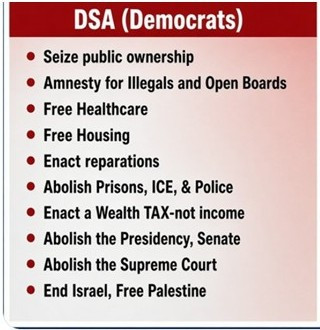
The Democratic Socialists now controlling the Democratic Party have clearly laid out what they want to do. The Democratic Party’s new Far Left Socialist and Communist agenda is deeply unpopular and deeply distrusted by a majority of voters.
Between 1978 and 1980 conservative Republicans replaced 20 liberal Democratic Senators, turning the Senate from a liberal Democrat supermajority into a Republican majority, and if we conservatives snap out of this post-defeat funk and get back to work that massive political shift can be repeated.
The post-1964 conservative movement showed us the way. Now it is up to us to spend the next two years organizing and branding Democrats as the radical Leftwing Socialist and Communist Party they have become.
George Rasley is editor of Richard Viguerie's ConservativeHQ.com and is a veteran of over 300 political campaigns, including every Republican presidential campaign from 1976 to 2012. A member of American MENSA, and an expert in grassroots political organization, he served in government positions from city hall to the White House.