
Over the course of several issues of his must-read Committee to Unleash Prosperity Hotline (Click here to subscribe–it's free.) our friend Steve Moore has chronicled examples of just how crazy Democrats suffering from Trump Derangement Syndrome (TDS) have become.
The craziest example is those parents who refuse to sign up their kids for “Trump accounts.”
Trump Accounts offer families $1,000 in tax-free federal seed money for their newborns, and, more importantly, allow employers to contribute up to $2,500 pre-tax to the accounts of their employee's children.
The idea is to create a nation of owners. With the maximum contributions over 18 years, complemented by the historical growth of the stock market, an account's projected value will exceed $300,000. Just a decade later, it will be nearly $1.1 million.
So far, 26 million accounts have been funded.
But The Atlantic reports that many Americans are not signing up for the accounts - and thus turning down the free money.
Why? Because the accounts are named for Trump.
The article quotes someone from the National Association of Tax Professionals, who says, "I have had personal experience where people have said, 'I just can't go along with something that has that man's name on it.'"
So, Democrats hate President Trump so deeply and viscerally that they would deprive their children of a million dollars?
With the answer apparently being “YES” you have to ask yourself where does this craziness come from?
No doubt some of it is homegrown – individuals consumed by virtue signaling pick hating Donald Trump as the next cause célèbres after “climate” or DEI.
However, in our view TDS has become Big Business for Democrat “influencers” who vie with each other for the most outlandish clickbait headlines or video riffs.
And one of the worst is James Carville, the “Sage of the South” the Democrat political guru who managed Bill Clinton’s successful campaign against Republican President George H.W. Bush.
We used to consider Carville to be “must-watch” TV for his insights into what Democrats were thinking and how they saw the political landscape.
But in the era of Donald Trump’s second term as President Carville has become unwatchable, because he is consumed by Trump Derangement Syndrome.
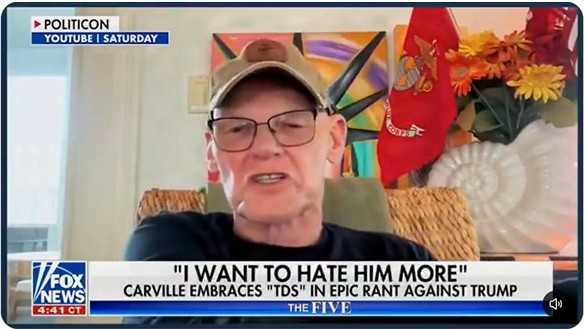
Carville appears as a Democratic "wise man" on countless news shows, and he admits he has a severe case of TDS when was asked last week on the "Politics War Room" podcast about TDS.
As Steve Moore documented, Carville embraced the label in a profane, unhinged rant.
Some left-wingers insist Carville must have been speaking tongue-in-cheek, but as Steve Moore observed, “some of us know the man and there is more sincerity in his views than they give him credit for.”
TDS is real, and Mark Halperin of 2WAY Media says that if Democrats don't have a wildly successful midterm election "they're setting up their base for rage and disappointment."
Here is an excerpt and a video Steve Moore captured of Carville sounding, well, a bit deranged:
Trump Derangement Syndrome… I got it. And I want it. And I want it to get worse. If I could take a pill that would help me hate that motherf - er more and obsess on him more, I would take that pill. I hate the son of a bitch. I hate what he's doing to this country. I'm obsessed with it.
I can't sleep at night. I get distracted. I sometimes gotta call my physician or shrink and say, you gotta give me something, man. I got to calm down…
And [Trump voters] think that we're crazy because we are so obsessed. We think that you're crazy because you don't see the gravity of the threat that this country faces… Our insanity is proof of our sanity.
Insanity is proof of sanity? Great for an undergraduate college philosophy class, not so great as a platform for the midterm elections.
However, as John Connor observed in a recent post to the Campaign Now website, as the country looks ahead to the 2026 midterm elections, understanding TDS is essential to grasping the motivations of a vocal and energized segment of the electorate.
Whether it represents pathological hatred, justified alarm, or a strategic political label, TDS sits at the center of how both the left and right interpret American politics.
The term “Trump Derangement Syndrome” was first popularized by the late conservative intellectual and psychiatrist Charles Krauthammer, who defined it as the:
“inability to distinguish between legitimate policy differences and… signs of psychic pathology.” (National Post)
In essence, TDS describes a state where an individual’s intense hatred of Trump impairs their political judgment, leading to what many see as a complete detachment from reality.
Journalist Fareed Zakaria has similarly described TDS as a:
“hatred of President Trump so intense that it impairs people’s judgment.” (Wikipedia)
From this perspective, TDS is less about policy and more about an emotional and psychological fixation.
Mr. Connor observed some commentators have gone further, wondering whether TDS might resemble a genuine psychological phenomenon.
Psychotherapist Jonathan Alpert, writing for The Wall Street Journal, described the phenomenon as a form of:
“‘obsessive political preoccupation’ — an obsessive-compulsive spectrum presentation in which a political figure becomes the focal point for intrusive thoughts, heightened arousal and compulsive monitoring.” (Fox News)
Alpert notes that for many of his patients, the mere mention of Trump is a trigger for intense mental distress. In this telling, Trump is no longer just a politician; he is the main character in people’s inner lives, a source of:
- Intrusive thoughts
- Heightened anxiety
- Compulsive consumption of news and social media
Whether or not the term “Trump Derangement Syndrome” ever appears in a diagnostic manual, this kind of obsessive political focus has real emotional and behavioral consequences.
How TDS Energizes the Anti-Trump Left
In John Connor’s analysis, which we tend to agree with, the visceral emotions tied to Trump are a potent force in American politics, and TDS appears to be a powerful motivator on both sides of the spectrum. For those in the grip of TDS, political engagement is fueled by a relentless sense of crisis.
Every action taken by Trump is seen as an existential threat to:
- Democracy
- Minority rights
- The rule of law
- America’s global standing
This constant state of alarm drives them to:
- Organize
- Protest
- Donate
- And, most importantly, vote
So, TDS can and will drive Democrat turnout, but will it attract the independent voters who usually decide close elections?
We see no evidence TDS has much appeal outside the Democratic Party base, but there it has a great deal of utility in a turnout-driven midterm election.
And there’s one other thing.
Inciting their base to rage and disappointment if the midterm elections don’t go their way may be the whole point of ramping up the TDS going into the final week of the campaign.
As we explained in our coverage of the @DataRepublican document dump, Democrats have a post-election plan to “delegitimize” and overthrow President Trump’s government, and one of the elements essential to the plan’s success is enraged mobs taking over the streets, a la France, prompting the Trump administration to violently crackdown using the Insurrection Act against “peaceful protestors.”