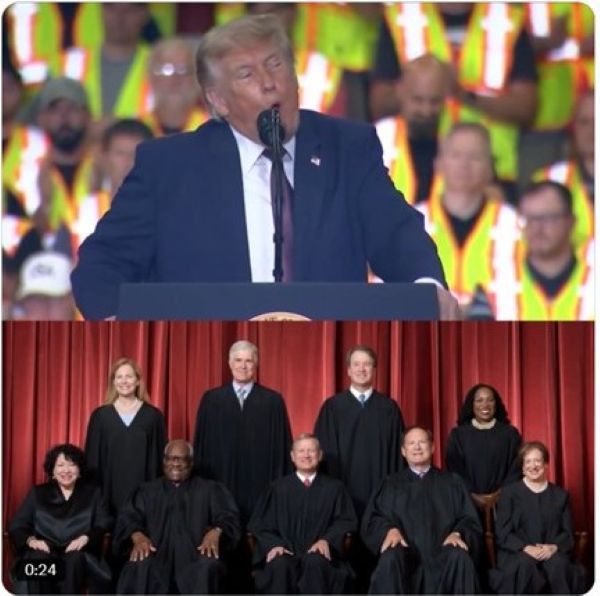

Did you notice that no Democrats called for stacking the Supreme Court after the Justices released Monday’s hot mess of decisions nullifying several of President Trump’s major agenda items – and stiffing him for millions in the E. Jean Carroll lawfare case.
In the first case the President’s multipronged effort to rein-in the unaccountable Federal Reserve Board of Governors, and hold them to the same ethical standards as the rest of us must follow, was stymied by what we’ve come to think of as the Court’s “Swamp Majority” of Chief Justice Roberts, and Justices Sonia Sotomayor, Elena Kagan, Brett Kavanaugh (or Amy Coney Barrett depending on the issue), and Ketanji Brown Jackson.
“The Supreme Court on Monday ruled in favor of Lisa Cook, a member of the Federal Reserve’s Board of Governors whom President Donald Trump had attempted to fire. By a vote of 5-4, the court held that Cook can continue to remain in her job while her challenge to Trump’s efforts to fire her moves forward.
Writing for the majority, Chief Justice John Roberts contended that, if the Trump administration were correct, it “would in effect transform the Federal Reserve’s for-cause protection into at-will employment—an interpretive leap out of step with the statute Congress enacted and our Nation’s tradition of central banking protected from political interference.”
Justices Sonia Sotomayor, Elena Kagan, Brett Kavanaugh, and Ketanji Brown Jackson joined the Roberts decision.
In his dissenting opinion, Justice Clarence Thomas called the ruling “incorrect.” “Although the Court expresses concern that the President removed a Board member for ‘the first time in the Federal Reserve’s 111-year history,’” he wrote, “it expresses no such concern that it today upholds an injunction against the President’s removal of an executive officer for the first time in the Constitution’s 237-year history.””
This case was a bit confusing in light of the on the Court’s FTC opinion, but to be clear, while the Lisa Cook issue is not over, the Supreme Court in effect said the Federal Reserve is immune to presidential oversight, even in the face of serious ethical lapses on the part of the members of the Board of Governors.
The birthright citizenship case was even more directly anti-Trump, with Justice Clarence Thomas, scorching the majority’s stretch to avoid giving President Trump a win.
The mail-in ballot case was even more hostile to the agenda President Trump ran on, and the people elected him to implement, by a vote of 5-4, the justices in Watson v. Republican National Committee rejected an argument, made by the political parties and others challenging the law, that federal law requires mail-in ballots to be received by Election Day.
So, just over four months before the 2026 midterm elections, on an issue President Trump has said may determine the outcome of the Republican majorities in the House and Senate, the Supreme Court upheld a Mississippi law that allows mail-in ballots to be counted as long as they are postmarked by, and received within five days of, Election Day.
Writing for the majority, Justice Amy Coney Barrett concluded that “the election-day statutes require the electorate’s choice to be made on election day. That occurs so long as election day is the deadline for individuals to vote—as it is in Mississippi. But the election-day statutes do not set a deadline for ballot receipt, so they do not prevent Mississippi from counting ballots postmarked before election day yet received afterward.”
George Washington University Law School professor Jonathan Turley weighed in Monday on the Supreme Court’s 5-4 ruling to allow for states to continue to count mail-in ballots that arrive after Election Day, which he called a “significant loss for Republicans” on the issue.
“I think this is a significant loss for Republicans who have wanted to try to rein in the way that we do our elections. California, of course, is the nightmare where you can go for weeks without a decision,” Turley said, referencing one of President Trump’s favorite examples of mail-in ballot abuse and potential fraud. Justice Amy Coney Barrett and Chief Justice John Roberts joined the court’s liberal justices to form the majority, with Barrett writing the opinion and Justice Samuel Alito writing the dissent in the case.
On Monday, the Supreme Court also refused to hear President Trump’s appeal in the E. Jean Carroll case, which alleged the trial judge made errors when he allowed certain evidence to be shown to the jury. And that decision was even more anti-Trump. The Court’s majority denied him even a hearing on the important issues, which are broadly applicable to other litigants, his lawyers raised.
After the Supreme Court rejected President Donald Trump’s effort to challenge a jury’s finding that he sexually abused and defamed her, Carroll’s lawyers asked the trial judge to expedite the briefing schedule on her motion to release the funds, saying both sides previously agreed to do it after the nation’s highest court ruled.
“Given that the Supreme Court yesterday denied Defendant’s petition for certiorari, and given the cost to Plaintiff of further delay in this nearly four-year-old litigation, we submit that there is good cause to adopt a modestly compressed briefing schedule as to payment of the judgment,” they wrote, according to a CNN report.
As the Court was poised to rule against President Trump, and for the Swamp’s position in these important cases, dozens of progressive organizations and more than 100 prominent political figures, including over 60 members of Congress, endorsed court expansion because, as they put it. legislative maneuvering empowered Trump to appoint Justices Gorsuch and Barrett, and create a pro-Trump supermajority on the Supreme Court.
Perhaps busting the myth of the “pro-Trump supermajority on the Supreme Court,” and knocking down that argument in favor of expanding the Court, is the one good thing to come out of Monday’s hot mess of decisions by the Court’s real majority – the “Swamp Majority” of Chief Justice Roberts, and Justices Sonia Sotomayor, Elena Kagan, Brett Kavanaugh (or Amy Coney Barrett depending on the issue), and Ketanji Brown Jackson.