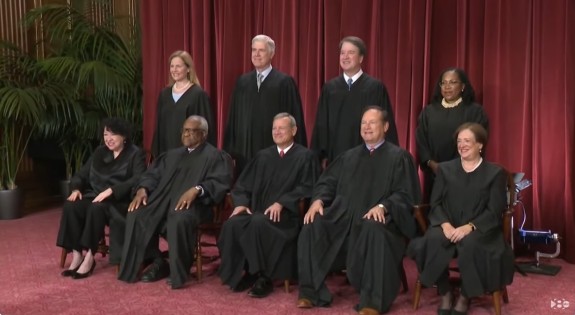

In a recent issue of Americans for Limited Government’s must-read Daily Torch our friend Robert Romano explained two seemingly contradictory Supreme Court rulings on the President’s power to fire the heads of so-called independent agencies.
As Mr. Romano explained, two very important decisions on the scope of executive removal power over Senate-confirmable appointees were handed down by the Supreme Court: Trump v. Slaughter, which found that “for cause” removal statutes violate Article II of the Constitution, and Trump v. Cook, which found an injunction against President Donald Trump’s “for cause” removal of Federal Reserve Governor Lisa Cook should remain in place.
Both the Federal Reserve and the Federal Trade Commission are unquestionably a part of the executive branch, both were set up to be “independent,” and so the apparently contradictory set of rulings might something of a head-scratcher for court observers and the American people who are expecting consistent rulings from the court.
A lot of it, however, might boil down to the way President Donald Trump removed members of the Federal Trade Commission for being out of line with the President’s policy priorities, whereas the firing of Cook invoked the “for cause” removal statute for the Fed.
As Justice Brett Kavanaugh noted in his concurring opinion in Cook, “[T]he Federal Reserve is an independent agency whose Governors enjoy for-cause removal protection consistent with Article II of the Constitution. The Government itself expressly ‘acknowledge[d]’ and did ‘not disput[e]’ that point in this case, even as the Government simultaneously (and successfully) argued that the for-cause removal protections for most independent agencies violate Article II.”
That is, while in Slaughter, the government argued without qualification that the “for cause” removal statute for the Federal Trade Commission was unconstitutional, in Cook, it was boxed in by President Trump’s invocation of the “for cause” removal of Cook. In other words, the government was obliged to defend the way Trump had removed Cook, and in so doing, had to argue that a “for cause” removal of Cook was both constitutional and legal.
This might have been a good reason to join the two cases — it could have just cleanly considered whether “for cause” removals are unconstitutional — but that’s not what happened.
In any event, the Slaughter case was a full argument on the merits, whereas the Cook case was looking was an emergency stay application by the government of a lower court injunction temporarily barring Cook’s removal pending conclusion of the litigation surrounding her removal. Meaning, the Cook removal could have been viewed as not a “ripe” case for arguing a “for cause” removal is unconstitutional.
That might have meant it could again come later, but to get there, a president would have had to remove a Federal Reserve governor over policy differences to test it, perhaps some years later. It could have easily punted.
But, instead the court decided to determine that very hypothetical case right then and there even if it was not yet justiciable — courts do not usually answer hypothetical questions, and yet that’s exactly what they did in the Cook case.
Neither party in the Cook case was arguing against the constitutionality of “for cause” removals at the Fed on the basis of the Article II unitary executive, and yet the court deigned to rule on them anyway. Unbelievable.
Again, Kavanaugh’s concurring opinion illustrates on both why the Fed was getting a carveout from a core Article II consideration and why it the court was answering this hypothetical question. Per Kavanaugh, the Fed’s fighting inflation and unemployment, and its administration interest rates, treasuries markets and mortgage markets was just too important: “I agree with the Court, moreover, that we should not leave open the question whether the Federal Reserve can remain an independent agency in the wake of Slaughter,” wrote Justice Kavanaugh.
“After Slaughter, said Kavanaugh, “there is a clear choice: Either the Federal Reserve may remain independent (with the Governors removable for cause, not at will), or it may not. Leaving that question open would create significant uncertainty about whether the Court might soon eliminate the Federal Reserve’s independence, and thereby expose the Federal Reserve to political influences and jeopardize the efficacy of U.S. monetary policy. Even temporary uncertainty about the status of the Federal Reserve could spark political upheaval, including confusion about whether the President could immediately remove multiple Governors at will, as well as turmoil in the U. S. and world economies.”
Kavanaugh added, “I would not go down that road. I would not risk destabilizing the U. S. economy just so that we can further mull over an issue that, in various permutations, we have been thinking about for many years. As the Court’s opinion explains and the Government agrees, the Federal Reserve occupies a unique role in the U. S. Government and maintains critical responsibility for the stability and success of the U. S. and world economies.”
But what was lacking was an adversary to that position. That, the executive administration of monetary policy is super important, but still not above the Constitution’s Article II vesting of executive power in the President.
Who controls the nation’s nuclear weapons is important, too, and invokes the lives of not just all Americans, but all of humanity — a nuclear war in a very real sense could lead to human extinction — and yet nobody questions the President’s constitutional executive power to oversee the ultimate deterrent, and which officers in the chain of command will be the ones to guard and potentially operate them. Just because something is important does not mean the Constitution ceases to be a check.
But now, for better or for worse, the Constitution’s check of the presidential oversight of the executive branch does not apply to the Federal Reserve. The only consolation might be that in its more than a century history of the central bank, it never has. It’s as unaccountable to the elected branches as ever.
Robert Romano is the Executive Director of Americans for Limited Government Foundation.