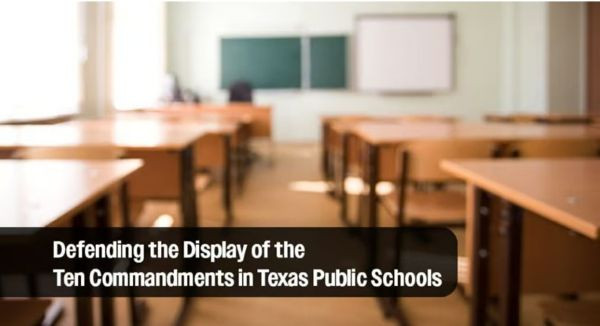

Our subscription to the Heritage Foundation’s Daily Wire alerted us to an important decision by the Fifth Circuit Court of Appeals in the case of Nathan v. Alamo Heights Independent School District (USDC No. 5:25-CV-756) in the Western District of Texas, in which plaintiffs alleged a Texas law mandating the display of the Ten Commandments in classrooms was unconstitutional.
As Zack Smith explained, last year, Texas passed S.B. 10 requiring all public schools to conspicuously display the Ten Commandments — just the text with no commentary.
Of course, challengers immediately ran to court, crying foul and claiming that this requirement violated both the First Amendment’s Establishment and Free Exercise Clauses.
But after careful consideration, the Fifth Circuit Court of Appeals, in a masterful opinion by Judge Kyle Duncan, said that’s just not so.
Now, here’s the important part – Judge Duncan’s opinion reaffirmed a fundamental principle broadly applicable to constitutional jurisprudence: If a practice was not understood at the time of the Founding — by those who ratified the First Amendment — as a violation, then it should not be considered a violation today.
In short, Judges are not tasked with updating the Constitution to suit current political sensibilities.
From an historical perspective, wrote Mr. Smith:
In Nathan v. Alamo Heights Independent School District, the Fifth Circuit concluded that the Supreme Court now requires lower federal courts to ask whether those challenging a certain practice have “prov[en] a set of facts that would have historically been understood as an establishment of religion.”
Among the facts that would need to be proven are:
Clearly, Texas SB 10 included none of those requirements and thus did not constitute the establishment of religion or restrict the free exercise thereof.
Mr. Smith concluded that, “What’s clear from this case and others is that lower federal courts are starting to take seriously the requirement that courts should not impose their own policy preferences under the guise of interpreting the Constitution.”
Instead, they must interpret and apply the Constitution as it would have been understood at the time “We the People” adopted it. To accomplish that task, courts should — as the Fifth Circuit did here — look to history and tradition to guide their textual interpretations.
In adhering to the principle that Judges are not tasked with updating the Constitution to suit current political sensibilities the Fifth Circuit delivered a huge win for Second Amendment cases — and now First Amendment ones too. And as Zack Smith wrote, and we agree, they should continue until they have adopted that correct approach for all constitutional cases.
CHQ Editor George Rasley is a member of American MENSA, an ordained Elder of the Presbyterian Church and a member of Faith Leaders for America. The views expressed in this column are his own and not necessarily the views of any denomination, congregation or organization.
As Zack Smith explained, last year, Texas passed S.B. 10 requiring all public schools to conspicuously display the Ten Commandments — just the text with no commentary.
Of course, challengers immediately ran to court, crying foul and claiming that this requirement violated both the First Amendment’s Establishment and Free Exercise Clauses.
But after careful consideration, the Fifth Circuit Court of Appeals, in a masterful opinion by Judge Kyle Duncan, said that’s just not so.
Now, here’s the important part – Judge Duncan’s opinion reaffirmed a fundamental principle broadly applicable to constitutional jurisprudence: If a practice was not understood at the time of the Founding — by those who ratified the First Amendment — as a violation, then it should not be considered a violation today.
In short, Judges are not tasked with updating the Constitution to suit current political sensibilities.
From an historical perspective, wrote Mr. Smith:
While this commonsense proposition seems straightforward, it hasn’t been for many years. In 1971, the U.S. Supreme Court issued its infamous Lemon v. Kurtzman opinion where it set forth a confusing three-part test to help courts determine whether the government had violated the Establishment Clause: Did the statute or action have a secular purpose? Did it primarily advance or inhibit religion? And did it result in “excessive government entanglement” with religion — whatever that means? Rather than providing clarity, this test quickly proved unworkable as lower federal courts struggled to consistently apply its prongs across cases.
And while the Supreme Court for far too long declined to overrule it explicitly, the Lemon test did lose favor among many justices. But because it continued to lurk among the Supreme Court’s case law, rearing its ugly head from time to time, Justice Scalia once described it as being like “some ghoul in a late-night horror movie that repeatedly sits up in its grave and shuffles abroad, after being repeatedly killed and buried …”
And it remained that way for almost 30 more years after Justice Scalia penned that line until the Court officially overruled Lemon and its progeny in Kennedy v. Bremerton School District.
And while the Supreme Court for far too long declined to overrule it explicitly, the Lemon test did lose favor among many justices. But because it continued to lurk among the Supreme Court’s case law, rearing its ugly head from time to time, Justice Scalia once described it as being like “some ghoul in a late-night horror movie that repeatedly sits up in its grave and shuffles abroad, after being repeatedly killed and buried …”
And it remained that way for almost 30 more years after Justice Scalia penned that line until the Court officially overruled Lemon and its progeny in Kennedy v. Bremerton School District.
In Nathan v. Alamo Heights Independent School District, the Fifth Circuit concluded that the Supreme Court now requires lower federal courts to ask whether those challenging a certain practice have “prov[en] a set of facts that would have historically been understood as an establishment of religion.”
Among the facts that would need to be proven are:
(1) government control over religious doctrine, governance, and church personnel;
(2) compulsory church attendance;
(3) compelled financial support, especially in the form of land grants and religious taxes;
(4) prohibitions on worship in dissenting churches;
(5) use of church institutions for civil functions; and
(6) restriction of political participation to members of the established church.
(2) compulsory church attendance;
(3) compelled financial support, especially in the form of land grants and religious taxes;
(4) prohibitions on worship in dissenting churches;
(5) use of church institutions for civil functions; and
(6) restriction of political participation to members of the established church.
Clearly, Texas SB 10 included none of those requirements and thus did not constitute the establishment of religion or restrict the free exercise thereof.
Mr. Smith concluded that, “What’s clear from this case and others is that lower federal courts are starting to take seriously the requirement that courts should not impose their own policy preferences under the guise of interpreting the Constitution.”
Instead, they must interpret and apply the Constitution as it would have been understood at the time “We the People” adopted it. To accomplish that task, courts should — as the Fifth Circuit did here — look to history and tradition to guide their textual interpretations.
In adhering to the principle that Judges are not tasked with updating the Constitution to suit current political sensibilities the Fifth Circuit delivered a huge win for Second Amendment cases — and now First Amendment ones too. And as Zack Smith wrote, and we agree, they should continue until they have adopted that correct approach for all constitutional cases.
CHQ Editor George Rasley is a member of American MENSA, an ordained Elder of the Presbyterian Church and a member of Faith Leaders for America. The views expressed in this column are his own and not necessarily the views of any denomination, congregation or organization.