
Renowned investor and thinker Rod D. Martin is one of the smartest guys we know, and if you are not subscribed to his must-read substack you are missing out on a great deal of insight into how the world of today works.
A lot of the media coverage of today’s Space X initial public offering has focused on whether Elon Musk “deserves” to become the world’s first trillionaire or predictions of the drubbing investors will take if the IPO doesn’t immediately skyrocket to multiples of the offering price.
In a recent post Rod explained why and how most of the media coverage of today’s Space X IPO is leading potential investors astray, not just about the potential payout from the IPO, but about the future it represents.
As Mr. Martin explained:
Fourteen years ago, almost to the week, Facebook stumbled out of the gate.
It debuted at $38. It briefly touched $45. Then it fell, and the press behaved exactly as the press always behaves when an extraordinary company fails to provide ordinary investors with an instant casino payout.
They called it overvalued. They mocked Mark Zuckerberg (and Peter Thiel). They said Facebook would never monetize. They treated the IPO as a failure because the people who actually built the company did not leave half their money on the table for CNBC’s favored traders.
I called Facebook a Strong Buy. If you listened, you made a LOT of money.
The reason, wrote Rod, was that the market was asking the wrong question.
The question was not whether Facebook would trade down from its IPO price. The question was whether Facebook already dominated the social graph, and whether that dominance would eventually monetize at a scale the critics refused to imagine.
It did. Spectacularly. Of course.
Now SpaceX is about to go public, and a lot of the same people are making the same type of mistake. Except this time the mistake is bigger. Much, much bigger.
Facebook organized the social graph. SpaceX is organizing the economic graph, of a new terrestrial economy, a new geopolitical reality, and of a multiplanetary human future.
And Mr. Martin is not the only thinker and investor who has come to this conclusion.
A new book by Dr. Rainer Zitelmann argues that free market entrepreneurs and risk takers will be the ones who can provide space travel and planetary exploration.
In a “New Space Capitalism, The Entrepreneurial Path to the Stars,” Dr. Zitelmann makes the case (with a foreword by Newt Gingrich) that this marks the starting signal of the dawn of a new era in space capitalism. Of 324 global rocket launches last year, SpaceX accounted for 165. If SpaceX were a country, it would be the world’s number one spacefaring nation, far ahead of China.
In his book, Dr. Zitelmann, a world-renowned economics historian, explores the historical factors underpinning the success of private space exploration and offers insights into its future trajectory. His thesis: While the technical prerequisites for conquering Mars and mining asteroids already exist, the true breakthrough in space exploration will only occur once a framework for buying and selling land on celestial bodies exists.
This book makes it possible for the first time to understand the history of public and private spaceflight in their interplay, while at the same time providing a scientifically sound outlook on the great opportunities of the space economy.
Which brings us back to Rod D. Martin’s analysis and conclusions about the Space X IPO.
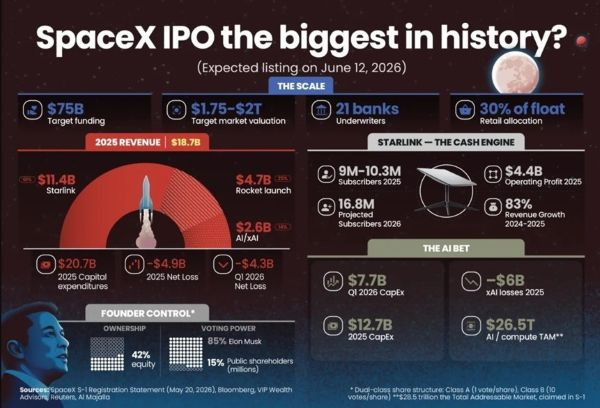
SpaceX is expected to go public on the NASDAQ under the ticker SPCX at $135 per share, raising around $75 billion at roughly a $1.75 trillion valuation. That makes it, by far, the largest IPO in history. It also makes the usual crowd faint, observed Mr. Martin in his substack post.
If you are trying to flip shares on Friday afternoon, and many will, volatility will matter. If the market decides it’s priced to perfection, as Facebook was, it will leave little money on the table in the near term for the kind of lottery win many are looking for, warned Rod.
The market is going to spend the next few days asking whether SpaceX is worth $1.75 trillion today. That’s the wrong question. The right question is whether any other company on Earth is remotely positioned to own the transportation layer between this planet and the rest of an inhabited, productive, militarily contested Solar System.
SpaceX no longer merely sells rocket launches. Launch is becoming its production line. The old business model was carrying someone else’s payload to orbit for a fee. It still does that: in 2025 it launched at least 85 percent (or more) of the total payload mass to orbit for the entire world.
But SpaceX’s new business model is much bigger: using its own rockets to put its own products into orbit — Starlink first, orbital data centers next, manufacturing, mining, and whole cities after that. The rockets enable a far bigger expansion of human civilization, so ordinary launch-company multiples miss the point entirely.
SpaceX dominates launch. Starlink dominates satellite broadband. Starship, once fully operational, changes the payload economics of orbit, the Moon, Mars, point-to-point terrestrial transport, even military logistics. And Elon intends to build hundreds if not thousands per year. Thousands of Starships mean ubiquitous, cheap, regular travel between continents in less than an hour. They’ll also enable the deployment of whole armies around the world in that same short time.
The company’s AI infrastructure adds another layer. Its future is not one market but an interlocking sequence of markets that become possible because first it collapsed launch costs.
That is what the skeptics cannot value. They see only today’s revenue and tomorrow’s capex, not the radical expansion of human civilization that is finally upon us, much less the geopolitical (indeed, astropolitical) stakes.
How would you measure that? How would you have measured or valued the radical expansion of human civilization coming when Columbus set out in 1492 and discovered the New World?
For the answer to that and Rod D. Martin’s further evidence that “The SpaceX IPO Isn’t Overpriced. The Future Is Underpriced” you are going to have to go to RodMartin.org and read the entire article.