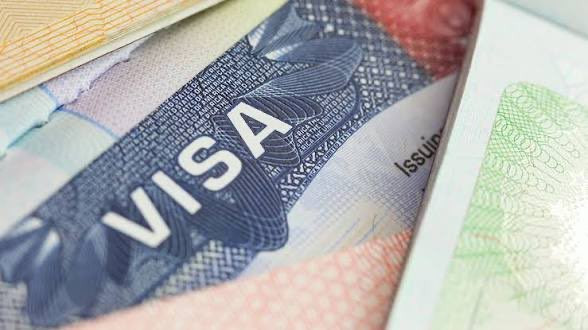

The Trump administration has paused all visa applications around the world as it moves to tighten restrictions on foreigners that could become a financial burden for the American taxpayer.
Fulfilling a campaign promise, President Trump has pursued aggressive curbs on immigration since returning to office last year, including the revocation of visas and green cards and the rejection of applications for a range of reasons, such as political activism and violent pro-Palestinian protests against the United States and Israel.
The President has also implemented requirements that some visa applicants provide information about their social media histories, required expensive bonds to process visas and banned the issuance of visas to citizens of terrorist hotbeds, including Afghanistan, Iran and Syria.
Over the past 18 months, the State Department has revoked some 175,000 visas for people who have been convicted or accused of crimes ranging from drink-driving to rape and robbery, as well as for foreigners who have come to our country and then abused our hospitality by advocating against our government's policies.
Earlier this year the Trump administration implemented a visa bond program to apply to a total of 50 countries. The program will require foreign nationals from those countries to post a bond of up to $15,000 before receiving B1 or B2 visas for business and tourism in the United States. The bond will be returned to visa recipients who return home in compliance with the terms of the visa.
The visa bond program has already proven effective at drastically reducing the number of visa recipients who overstay their visas and illegally remain in the United States.
According to a State Department news release, nearly 1,000 foreigners have been issued visas under the program, and 97% of bonded travelers have returned home from the United States on time.
By contrast, in Biden’s last year in office, more than 44,000 visitors from the 50 current Visa Bonds countries overstayed.
The State Department’s April 2 action applied the visa bond policy to a total of 50 nations. The Department may continue to place Visa Bonds on countries based on a range of immigration risk factors.
The State Department says the expanded visa bond program saves the American taxpayer hundreds of millions of dollars every year.
It costs the U.S. taxpayer over $18,000 on average to remove an alien illegally present in the United States.
The Department of State is saving U.S. taxpayers up to $800 million per year that would otherwise be required to remove these aliens who overstay.
The countries added to the Visa Bond program were Cambodia, Ethiopia, Georgia, Grenada, Lesotho, Mauritius, Mongolia, Mozambique, Nicaragua, Papua New Guinea, Seychelles, and Tunisia.
Those countries joined 38 nations that are already included in the visa bond program. Those countries are Algeria, Angola, Antigua and Barbuda, Bangladesh, Benin, Bhutan, Botswana, Burundi, Cabo Verde, Central African Republic, Cote d’Ivoire, Cuba, Djibouti, Dominica, Fiji, Gabon, The Gambia, Guinea, Guinea Bissau, Kyrgyzstan, Malawi, Mauritania, Namibia, Nepal, Nigeria, Sao Tome and Principe, Senegal, Tajikistan, Tanzania, Togo, Tonga, Turkmenistan, Tuvalu, Uganda, Vanuatu, Venezuela, Zambia, and Zimbabwe.
Bondholders are often restricted to entering and exiting through designated major airports, such as Boston Logan, New York JFK, or Washington Dulles, to ensure proper departure tracking.
The State Department is also restricting visas for applicants deemed likely to rely on U.S. government assistance.
According to reporting by the Financial Times an administration spokesman said, “A more prosperous America means ensuring that visa applicants are not likely to become a public charge, as defined under US law and regulation, and not likely to become dependent on US public benefits reserved for qualified Americans in need.”
The State Department said the halt in processing was to allow for a global training initiative at all American embassies and consulates to ensure “officers are fully equipped to evaluate every visa applicant comprehensively and consistently.”
This decision a day after the Trump administration proposed a new $103,265 application fee for every H-1B visa.
A State Department official confirmed that the initiative has begun at U.S. embassies and consulates.
Visa applicants with scheduled interviews were sent an email informing them they would receive notice of a new date and time for their appointments, the newspaper reported. It is not clear how long the training will last or when visa processing will resume. The announcement does not change the travel requirements for tourists heading to the United States for short stays.
A big victory for returning to immigration sanity.