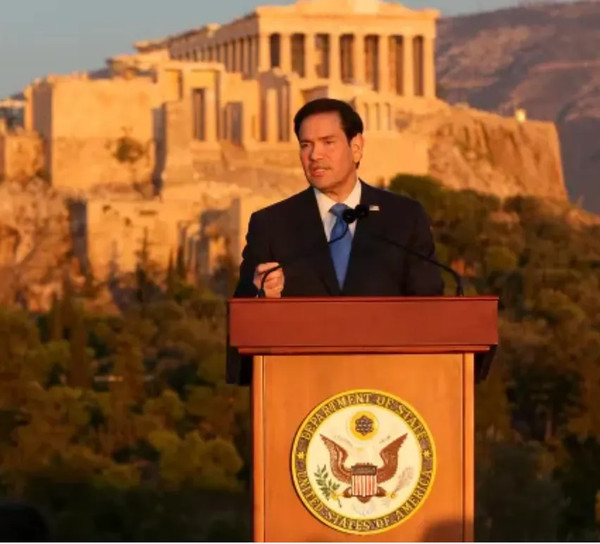

In “Rubio and the Islamic West,” a recent post to her must-read substack, our friend Diana West identified a crucial error of omission in Secretary of State Marco Rubio’s much-lauded speech October 7, 2026 in Athens, Greece.
As Ms. West observed:
I am wondering when someone will point out that the Secretary of State, with multiple cameras recording his Major Address on “The West,” with the Parthenon and Acropolis lit up like a real sound stage behind him, made an error. It’s the kind of error tweedy professors once, not even that long ago, would have rushed to their typewriters (I guess it is a long time ago) to zap out Letters to the Editor, muttering “gotcha” under their sherry-inflected breath. No more. More likely to be hijabbed than tweedy, most Profs don’t read The Federalist Papers back in Sri Lanka anyway —and they have far too much work to do on the Intersectional Intifada on ICE to notice such nonentities as “Founding Fathers” or a “Secretary of State.”
I noticed. But first I found myself puzzling over a strange, recurring empty space in Rubio’s mantra on “Western civilization.” It goes like this: Athens to Rome to Philadelphia — and, if we’re pondering Trump administration policy-makers, happens to echo the very words of Stephen Miller’s souped-up peroration at Charlie Kirk’s public funeral. There were variations. Rubio also discussed the Greek belief in “a rational order to the cosmos” as being “the foundation of the Western mind,” which “paved the way for the gospel of Jesus Christ to find fertile soil in Europe and flourish into the empire of Christendom.” He added: “It was the foundation of the riches of Christian theology – of Augustine and Aquinas and the whole tradition of natural law.”
To recap the Rubio mantra: Cosmos to Gospel to European Christendom. May I ask what happened to the Torah? What happened to Mosaic Law? Isn’t, say, monotheism along the way to the Gospel of Jesus Christ, a Jew, worth just a quick mention? In the sharpest of contrasts, Geert Wilders, who leads the Party for Freedom in the Netherlands — who has spent more than 20 years under Islamic death-fatwas for fighting the Islamization of his country and the wider West — describes “the cradle of our Western civilization” as being Jerusalem, Athens and Rome. This isn’t a choice; it’s a lineage.
However, here’s another round of the Rubio survey of Western civ:
The greatest Americans of every generation have carried the unmistakable features of their forefathers – born in Athens, formed by Rome, baptized in Christendom, hardened in the furnace of medieval Europe, endowed with the English genius for liberty, and then carried across the Atlantic to be reborn on the shores of a new world.
Together, we must now rediscover that spirit.
By Rubio’s lights, the Pilgrim Fathers should have thought of themselves as Zeus’s New Athens not God’s New Israel.
If it weren’t October 7 when Rubio made this address, I might not have noticed the recurring omission, But it was October 7. And this is a time in which Israel and Jews are being used as the lure, the bait, to distract from what is an epochal cataclysm: the Islamic transformation of “the West,” such as it is, after more than century of corrosive Marxist destruction. Given the repetitiousness, it would seem that Rubio chose not to invoke the Judeo-Christian West, or the West of Jerusalem, Athens and Rome. Which makes me wonder whether we might look back on this speech and see when it was that the Judeo-Christian West officially ended and the Islamic West began.
There is something else. That same week, to “celebrate” October 7, the capitals of the charter members of “the West” — Paris... Amsterdam, London, Brussels — were engulfed by days of mass, noticeably militaristic pro-jihad demonstrations. On October 11, a Dutch account on Twitter commented:
Yesterday I felt very unsafe and unhappy in my hometown Amsterdam. The pro-Hamas motorbikes on the Rokin made me think of the entry of the Nazis into the capital on 10 May 1940. Then and now with sympathizers along the road. Why is this allowed?
Here are his pictures:

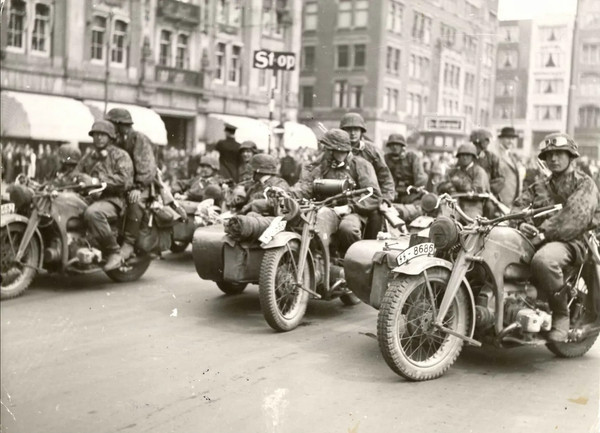
That jihad surging deep into Europe was also missing from Rubio’s address. The Secretary of State, blinkered, looked into his teleprompter and exhorted Europe to “rediscover” its “spirit,” its Greek “thumos,” without raising any alarms over the continent’s advanced state of Islamization. But this is the story, the tragedy, of our times. It is also what has finally captured Europe’s “spirit,” its “thumos,” not to mention our own.
How can there be silence on so gigantic a civilizational shift? I know the reason. It is the same reason Italian PM Silvio Berlusconi extolled the superiority of liberty, of the achievements of the West to Islam after 9/11 and then recanted his words. It is the same reason Rupert Murdoch in 2005 removed the term “Muslim” from “riots” when the first Muslim riots broke out in Paris after Saudi potentate Alwaleed bin Talal told him to. The reason is fear. Fear of Islam. And corruption. And complicity so normalized that few will ever notice.
Now for Rubio’s error. Take a look at this point about ancient Greece which he makes most emphatically:
Many, many people are surprised to learn that the most commonly cited author in the Federalist Papers was not an Enlightenment philosopher or political theorist. No, the most commonly cited author in the Federalist Papers was Plutarch, the Greek biographer of Greece and Rome’s great men.
I hate to tell you, Mr. Secretary, but this is not true. Not by a long shot. I know because — shocker — I looked it up. I looked it up because Plutarch as a go-to source for The Federalist Papers just didn’t sound right. And no wonder. I find three references to Plutarch in the Index, and they may all be described as passing. The most frequently cited author is Montesquieu (1689–1755), who should ring a bell somewhere in the US State Department for separation of powers, that old thing.
What I suspect may have happened is that someone in Rubio’s office was, fie & alas, using Wikipedia, whose Plutarch page calls him “the most frequently named of the ancient historians in the Federal Papers.” Ancient historians. And that’s correct. Polybius, 1; Plutarch, 3. But who cares? Who notices? It’s the message of the day that’s important to politicians. Emphasize Athens to the exclusion of Jerusalem — was that the political message being driven behind the grand sweep of civilization?
Rubio concluded his address with a story going back to Greece’s War of independence in the early 19th century.
Our friendship [with Greece] dates back to the earliest years of my nation. When Greece rose in 1821 to recover its independence after centuries of Ottoman rule, Americans recognized something familiar in that struggle. Three years later, the great American statesman Daniel Webster, he delivered a famous address to Congress, helping bring the cause of the Greek Revolution before the representatives of the young American republic.
And he began by calling their attention to everything around them. This is what he said in his speech; he said: “This free form of government, this popular assembly… this practice of free debate, and public discussion, the contest of mind with mind… even the edifice in which we assemble, these proportioned columns, this ornamented architecture, all remind us that Greece has existed, and that we, like the rest of mankind, are greatly her debtors.”
There is a tangle of irony here. Having conjured the potent zeitgeist of “the West” for his performance on the world stage, Rubio ignored the jihad subsuming it. Now, building to his rhetorical finish, he understated a historic Christian victory over Islamic jihad from a time when, as Paul Fregosi writes in Jihad in the West, “Islam was on the decline.” (If America opposed the jihad today rather than leading it, in Libya, for example, or being corrupted by it, Qatar, our thumos would hit the roof.) What interested Rubio, though, was Webster’s paean to ancient Greek democracy — certainly not Webster’s discussion of Ottoman tyranny, which consigned Christian Greeks to the downtrodden state common to non-Muslims under Muslim rule. Interestingly, Fregosi makes it very plain that after five centuries of Islamic occupation, early 19th century Greeks had very little connection to the culture and “thumos” of those distant pagans whose glorious ruins dotted their country.
Webster, however, saw the legacy of Ancient Greece in 1824 America: “This free form of government, this popular assembly… this practice of free debate, and public discussion, the contest of mind with mind…” Honestly, what connection do any of our societies in “the West” have to it now? What Webster described exists no longer in the Marxified West, now Islamizing past recognition.
For the record, America remained neutral in Greece’s independence war. In 1827, at the Battle of Navarino, combined British/French/Russian forces decisively destroyed the Turkish fleet in the last battle fought by wooden sailing ships. Fregosi concludes:
The British government, politically correct and anxious to maintain good relations with Egypt and Turkey, referred mildly to the victory at Navarino as “an untoward event.”
Some things never change.
The Greeks, of course, were jubilant. Without a fleet to bring in troops and land them in Greece and all its island, the Turks could not win. Greece was now free and jihad was becoming a synonym for Turkish defeat in all the Balkans.”
Nevertheless, it was a fine, if hushed up and forgotten, moment for mankind. In our twisted time, British/French/Russian and other governments don’t destroy, but rather provide the fleets to advance the Hijra into all of Eurabia, and the US Secretary of State says nothing.
You’ve heard of Eurabia? Everyone’s heard of Eurabia. It came after Ancient Europe.
Author Diana West is a longtime syndicated newspaper columnist and author of the must-read books The Death of the Grown-Up, American Betrayal, The Red Thread as well as hundreds on columns and articles on politics, culture, national security and “investigative history.”