
"Disparate impact" is the legal term for "systemic racism," "structural racism," or just "racism" (as Leftists now use the term). This is the foundation of DEI and the Left’s “anti-racism” scam. No need to prove actual discrimination by an individual or organization, just show that the system produces certain outcomes the Left doesn’t like.
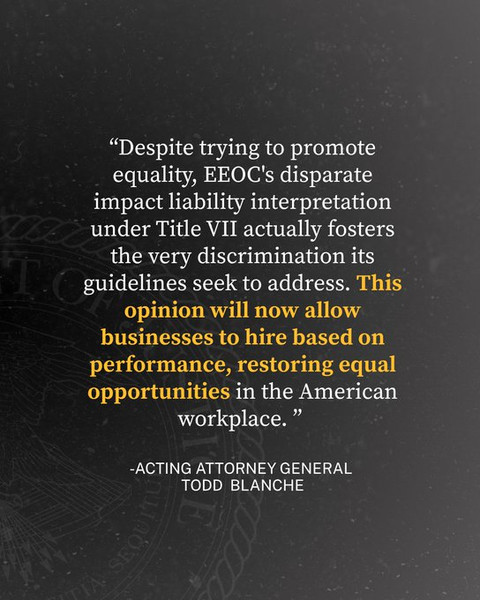
Now, the Trump Justice Department Office of Legal Counsel has issued an opinion explaining that disparate-impact liability under federal employment law is unconstitutional. This is an earthquake in federal civil rights law. If upheld, this is the foundation to overturn that pernicious regime.
This opinion, authored by Assistant Attorney General Elliot Gaiser and Deputy Assistant Attorney General Josh Craddock, with heavy reliance on the outstanding work of the Manhattan Institute’s Gail Heriot, who is cited throughout the opinion, should be a fatal blow against one of the Left’s most egregious race scams.
As Josh Blackman explained in a post to Reason Magazine’s The Volokh Conspiracy page, in 2009, the Supreme Court decided Ricci v. DeStefano. The Justices reversed Judge Sonia Sotomayor's indefensible ruling against Frank Ricci and other firefighters. But the Court stopped short of deciding whether New Haven, Connecticut's attempt to avoid liability for disparate impact violated the Equal Protection Clause. Justice Scalia concurred to explain the Court was merely postponing the inevitable question:
But the war between disparate impact and equal protection will be waged sooner or later, and it behooves us to begin thinking about how—and on what terms—to make peace between them.
Nearly two decades later, with a very different Supreme Court, this question is now primed for resolution.
That resolution is likely to come through litigation over an Office of Legal Counsel opinion finding that the Equal Employment Opportunity Commission's Title VII guidelines are unconstitutional.
EEOC's existing interpretations, including the Uniform Guidelines on Employee Selection Procedures ("Guidelines"), embrace an unconstitutional reading of Title VII. Rather than treating disparate impact as an evidentiary mechanism to smoke out intentional discrimination—imposing liability only when disproportionate adverse effects give rise to a strong inference of intentional discrimination—EEOC's historic interpretations contemplate liability based on disproportionately adverse effects alone, without regard to an employer's likely intent. Because EEOC's historic approach divorces liability from circumstances giving rise to a strong inference that intentional discrimination occurred, it functions as a qualified racial-proportionality mandate and spurs employers to engage in race-based decision making to avoid liability. That approach is unlawful and unconstitutional.
The opinion relies on Allen v. Milligan, which declared for the first time that our Constitution is "color-blind," observed Mr. Blackman.
This opinion is earth-shattering, wrote Blackman. The Department of Justice ruled that disparate-impact compels employers to engage in unconstitutional race discrimination:
Just as "the Federal Government is prohibited from discriminating on the basis of race," so too is it "prohibited from enacting laws mandating that third parties—e.g., employers, whether private, State, or municipal—discriminate on the basis of race," unless those laws survive strict scrutiny. Ricci, 557 U.S. at 594 (Scalia, J., concurring) (first citing Bolling, 347 U.S. at 500; and then citing Buchanan v. Warley, 245 U.S. 60, 78–82 (1917)). And just as it is unconstitutional for the federal government to "force[] States to engage in the very race-based discrimination that the Constitution forbids," Callais, 146 S. Ct. at 1142; see also Miller v. Johnson, 515 U.S. 900, 926–27 (1995), so too it is unconstitutional for the federal government to coerce employers to adopt employment policies or make employment decisions motivated by race. Disparate-impact liability does not just raise constitutional doubt in occasional cases; unless narrowly circumscribed, it structurally compels the very racial discrimination that the Constitution forbids.
The OLC opinion states this is a similar approach to the one that the Supreme Court took in Callais, which held that section 2 of the Voting Rights Act of 1965, Pub. L. No. 89-110, 79 Stat. 437, "imposes liability only when the circumstances give rise to a strong inference that intentional discrimination occurred." . . . Applying Griggs, Wards Cove, Inclusive Communities, and Callais, we identify three limiting principles on disparate-impact liability that prevent a constitutional collision under current Supreme Court precedent. We emphasize, as the Supreme Court has, that no single limiting principle is wholly sufficient; rather, each caveat is essential to avoid the conclusion that disparate impact policies compel the very racial discrimination that the Constitution prohibits.
Mr. Blackman suggests that the EEOC will bring suit against firms that have made race-conscious decisions to avoid disparate impact suits (or more likely because they agree with separating people based on race). At that point, the constitutionality of disparate-impact is squarely teed up for the Supreme Court to issue an opinion finding disparate impact policies to be unconstitutional racial discrimination.