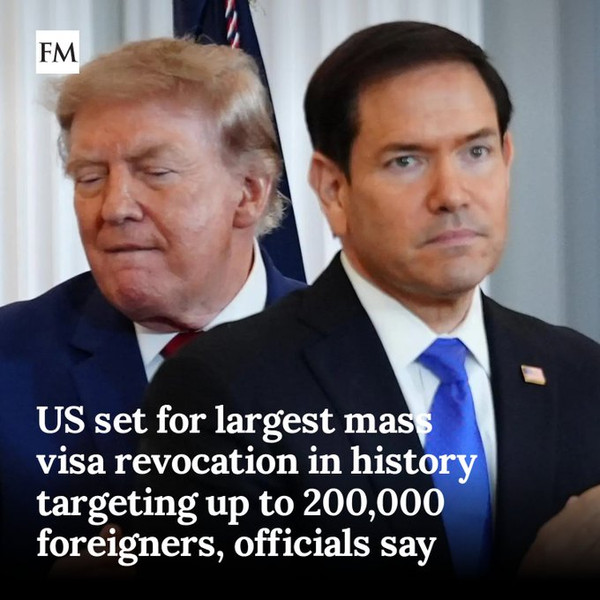

“We are coordinating with DHS to identify and revoke the nonimmigrant visas of foreigners who have come to the United States claiming to be short-term visitors, but then file for asylum to stay here permanently,” said State Department spokesman Tommy Pigott.
The action would result in the revocation of so-called B1 and B2 visas issued between 2016 and 2026 whose holders have sought asylum or are now seeking asylum after entering the country under the false pretense of engaging in business or tourism.
If it happens, the move would be the largest single mass revocation of visas in U.S. history, however, we expect that an activist Democrat judge will quickly rule against the policy and send another case hurtling toward the Supreme Court’s emergency docket.
According to a report by the Associated Press, the revocations would not necessarily result in their immediate deportation, the officials said. Most of those with asylum cases currently pending would be recategorized but would lose their status as business or tourism travelers, according to the officials, who spoke on condition of anonymity because the revocations are not final yet.
In a social media post on Monday, Deputy Secretary of State Christopher Landau called out people who he said try to use tourist and business visas to get into the United States and then apply for asylum.
“People in the US and all over the world are fed up with bogus asylum claims,” Landau wrote on X. “Asylum isn’t supposed to be a loophole to circumvent immigration law.” Landau cited the case of a Colombian citizen who came to the U.S. in 2015 on a tourist visa and then applied for asylum.
The AP further reported that current applicants for B1 and B2 visas are asked to affirm that they will not apply for asylum in the United States and prove that they intend to return to their home countries.
In the past 18 months, the State Department has revoked about 175,000 visas for people who have been convicted or accused of crimes ranging from drunken driving to rape and robbery, as well as for people who have spoken out publicly against U.S. policies, particularly in the Middle East.
Earlier this summer, in support of National Security Presidential Memorandum-7 and ongoing U.S. Government efforts to disrupt networks fomenting political violence before they escalate to criminal action, the Department of State announced a new visa restriction policy that targets members of Far-Left Terrorist and other aligned groups who have supported or incited acts of terrorism; supported violent criminal activity; participated in economic sabotage; financed, recruited, or provided logistical support for violent or criminal actions committed by Far-Left Terrorist and other aligned groups; and/or facilitated the convergence of Far-Left Terrorist and other aligned networks for the purposes of violent action.
When announcing the new policy, the State Department said it is intended to safeguard the American homeland by restricting entry of foreign nationals who finance, recruit, incite, or otherwise enable terrorist, violent, and criminal Far-Left Terrorist networks – closing the visa pathways that Far-Left Terrorists and other aligned groups exploit to threaten American lives, undermine economic stability, and coordinate violent action on U.S. soil.
Unfortunately, Far Left activist judges have routinely struck down similar efforts by the Trump administration, most recently in a case regarding visa applicants who are likely to apply for public benefits.
U.S. District Judge Jeannette Vargas, a federal judge in New York and an appointee of former President Joe Biden, vacated a Trump administration policy that suspended the processing of visas from 75 countries, including Afghanistan, Iran, Russia and Somalia, whose nationals the Trump administration deemed likely to require public assistance in the United States.
Ignoring the unitary executive established by the Constitution and upheld by the Supreme Court in its June 29, 2026 decision in Trump v. Slaughter, Judge Vargas held that “consular officers” are at the forefront of any visa decision.
"Congress imbued these officers with exclusive authority and discretion to determine if an immigrant is eligible for a visa based upon review of specific and detailed criteria set forth in the statute," she wrote. "The Policy, which categorically prohibits the issuance of immigrant visas based upon the nationality of the applicant, represents a direct abrogation of this statutory scheme."
The absurdity of the ruling that relatively low-level State Department employees, who are not even Senate-confirmed, can ignore the policy and direction of the President and Secretary of State demonstrates once again the necessity of reining-in these judicial activists who will embrace any claim, no matter how specious, to stymie President Trump and his agenda.