
A new analysis by our friends at Americans for Limited Government shows U.S. manufacturing reached its highest growth in four years in May and companies are promising multi-billion-dollar investments to develop critical pharmaceuticals, semiconductors, safe electrical equipment, and many more products in the United States.
As Manzanita Miller, senior political analyst at Americans for Limited Government Foundation, explained, “According to the Institute for Supply Management’s Purchasing Managers’ Index (PMI), U.S. manufacturing rose 1.3 percentage points in May, marking the fifth consecutive month of growth and the highest recording of the index since May 2022. This is a significant healthy signal that U.S. companies are beginning to compete once again.”
The report notes that indexes that measure inventories on hand, customer inventories on hand, new orders, and new export orders are all up over the past month.
The inventories index rose 0.9 percentage points since April while the customers’ inventories index is up 3.6 points since April according to the report.
The report also notes that “demand orders” are up, with both the new orders index and new export orders index expanding by 2.7 points since April.
Indexes that measure output are also up, with the production index rising for the seventh consecutive month according to the report.
U.S. manufacturing is rising across a multitude of critical industries including petroleum, computers and electronics, mineral products, electrical equipment, machinery, appliances, transportation equipment, printing, textile mills, and food and beverages.
The manufacturing boom is a result of President Donald Trump’s two-pronged economic approach to court companies with reduced corporate tax burdens signed into law with the One Big Beautiful Bill Act while making importing goods from foreign countries costly.
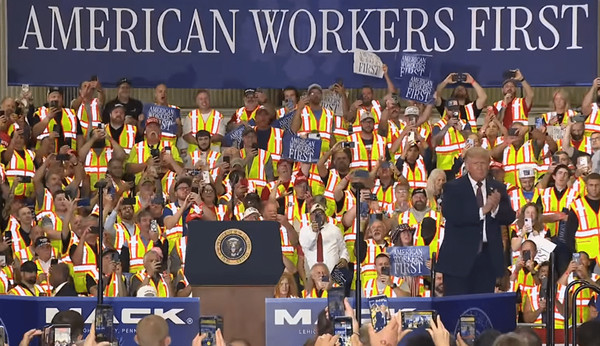
Speaking at a campaign stop in a Mack Trucks facility in Macungie, Pa. on June 23, President Trump touted manufacturing’s impact on job creation, “[M]ore Americans are working today than at any time in the history of our country. And we’ve created over… 32,000 new jobs just starting in Pennsylvania alone. David, you have to get ready for that. And in the last few months alone, we’ve added 2,600 Pennsylvania manufacturing jobs. And that number is going to go much, much higher as the factories start to open.”
The approach is working, with U.S. manufacturing reaching a four-year high in May. Companies are committing to expanding the creation of products like prescription drugs, semiconductors, safe electrical equipment, and many more products on American soil as a result of the strategy.
In March, Taiwan Semiconductor Manufacturing Company (TSMC), which produces semiconductors for electronics, announced an additional $100 billion investment in the U.S. on top of the previously committed $65 billion.
CEO C.C. Wei thanked President Trump for his support in company’s expansion, saying, “we have to thank President Trump’s vision and his support. TSMC started the journey of establishing the advanced chip manufacturing in Arizona. And now, let me proudly say the vision becomes reality.”
TSMC’s investment will include six semiconductor wafer fabs, two advanced packaging facilities and a research and development center, and is already underway in Phoenix, AZ.
According to the company’s announcement, the facilities will create 6,000 high-tech jobs, as well as thousands of construction and supplier jobs. The company’s original investment is estimated to generate around $1.4 billion in direct and indirect tax revenues combined over the next thirteen years. The company is also estimated to create $9.3 billion in personal income and indirect income combined.
In May, Siemens, a German company that develops critical power equipment and transportation infrastructure, announced it had reached $1 billion in domestic manufacturing investments in the United States over the past five years.
Siemens’ investments include $165 million to expand two electrical equipment manufacturing facilities and add three more locations in North and South Carolina and $190 million for a new data center in Fort Worth, Texas to build important electrical infrastructure. The company has also dedicated $95 million to expand electrical infrastructure manufacturing in Pomona, California. The projects should generate more than 2,200 new jobs in advanced manufacturing, skilled trades, and engineering by 2028.
Multiple pharmaceutical companies including Eli Lilly, the U.S. manufacturer of the popular GLP-1 weight regulating drug Retatrutide have announced multi-billion dollar investments in the U.S. Eli Lilly announced plans to spend $27 billion to build four U.S. plants, with plants being announced in Alabama, Virginia and Texas so far.
AstraZeneca, a Swedish pharmaceutical company that makes a multitude of prescription drugs including those used in oncology has committed $50 billion to expand U.S. manufacturing by 2030. The company will create a new facility in Virginia and expand into Maryland, Massachusetts, California, Indiana and Texas.
The White House estimates that $10.6 trillion in U.S. and foreign investments have been made possible through President Trump’s economic approach as of this writing, spanning the industries of AI, energy, datacenters, food and beverages, manufacturing, pharmaceuticals and biotech, and many more.
What this says is that the slate of tariffs on imports are doing exactly what President Trump theorized and encouraging a revitalization of the U.S. manufacturing sector. Not only is this healthy for businesses and consumers, but it is also critical to ensuring American-made products are available no matter how the geopolitical landscape looks. With a rise in U.S.-made products from semiconductors to essential electrical infrastructure to critical pharmaceuticals, Americans are becoming more self-reliant than they have been for decades.
As Manzanita Miller, senior political analyst at Americans for Limited Government Foundation, explained, “According to the Institute for Supply Management’s Purchasing Managers’ Index (PMI), U.S. manufacturing rose 1.3 percentage points in May, marking the fifth consecutive month of growth and the highest recording of the index since May 2022. This is a significant healthy signal that U.S. companies are beginning to compete once again.”
The report notes that indexes that measure inventories on hand, customer inventories on hand, new orders, and new export orders are all up over the past month.
The inventories index rose 0.9 percentage points since April while the customers’ inventories index is up 3.6 points since April according to the report.
The report also notes that “demand orders” are up, with both the new orders index and new export orders index expanding by 2.7 points since April.
Indexes that measure output are also up, with the production index rising for the seventh consecutive month according to the report.
U.S. manufacturing is rising across a multitude of critical industries including petroleum, computers and electronics, mineral products, electrical equipment, machinery, appliances, transportation equipment, printing, textile mills, and food and beverages.
The manufacturing boom is a result of President Donald Trump’s two-pronged economic approach to court companies with reduced corporate tax burdens signed into law with the One Big Beautiful Bill Act while making importing goods from foreign countries costly.
Speaking at a campaign stop in a Mack Trucks facility in Macungie, Pa. on June 23, President Trump touted manufacturing’s impact on job creation, “[M]ore Americans are working today than at any time in the history of our country. And we’ve created over… 32,000 new jobs just starting in Pennsylvania alone. David, you have to get ready for that. And in the last few months alone, we’ve added 2,600 Pennsylvania manufacturing jobs. And that number is going to go much, much higher as the factories start to open.”
The approach is working, with U.S. manufacturing reaching a four-year high in May. Companies are committing to expanding the creation of products like prescription drugs, semiconductors, safe electrical equipment, and many more products on American soil as a result of the strategy.
In March, Taiwan Semiconductor Manufacturing Company (TSMC), which produces semiconductors for electronics, announced an additional $100 billion investment in the U.S. on top of the previously committed $65 billion.
CEO C.C. Wei thanked President Trump for his support in company’s expansion, saying, “we have to thank President Trump’s vision and his support. TSMC started the journey of establishing the advanced chip manufacturing in Arizona. And now, let me proudly say the vision becomes reality.”
TSMC’s investment will include six semiconductor wafer fabs, two advanced packaging facilities and a research and development center, and is already underway in Phoenix, AZ.
According to the company’s announcement, the facilities will create 6,000 high-tech jobs, as well as thousands of construction and supplier jobs. The company’s original investment is estimated to generate around $1.4 billion in direct and indirect tax revenues combined over the next thirteen years. The company is also estimated to create $9.3 billion in personal income and indirect income combined.
In May, Siemens, a German company that develops critical power equipment and transportation infrastructure, announced it had reached $1 billion in domestic manufacturing investments in the United States over the past five years.
Siemens’ investments include $165 million to expand two electrical equipment manufacturing facilities and add three more locations in North and South Carolina and $190 million for a new data center in Fort Worth, Texas to build important electrical infrastructure. The company has also dedicated $95 million to expand electrical infrastructure manufacturing in Pomona, California. The projects should generate more than 2,200 new jobs in advanced manufacturing, skilled trades, and engineering by 2028.
Multiple pharmaceutical companies including Eli Lilly, the U.S. manufacturer of the popular GLP-1 weight regulating drug Retatrutide have announced multi-billion dollar investments in the U.S. Eli Lilly announced plans to spend $27 billion to build four U.S. plants, with plants being announced in Alabama, Virginia and Texas so far.
AstraZeneca, a Swedish pharmaceutical company that makes a multitude of prescription drugs including those used in oncology has committed $50 billion to expand U.S. manufacturing by 2030. The company will create a new facility in Virginia and expand into Maryland, Massachusetts, California, Indiana and Texas.
The White House estimates that $10.6 trillion in U.S. and foreign investments have been made possible through President Trump’s economic approach as of this writing, spanning the industries of AI, energy, datacenters, food and beverages, manufacturing, pharmaceuticals and biotech, and many more.
What this says is that the slate of tariffs on imports are doing exactly what President Trump theorized and encouraging a revitalization of the U.S. manufacturing sector. Not only is this healthy for businesses and consumers, but it is also critical to ensuring American-made products are available no matter how the geopolitical landscape looks. With a rise in U.S.-made products from semiconductors to essential electrical infrastructure to critical pharmaceuticals, Americans are becoming more self-reliant than they have been for decades.