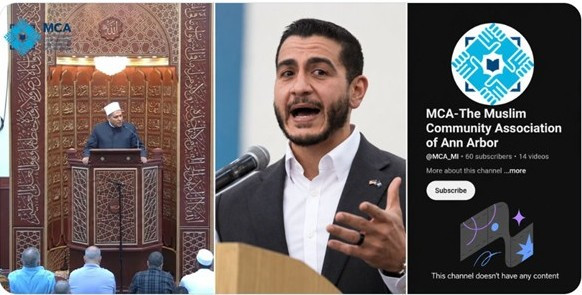

Once again evidence has surfaced that the United States government is committing national suicide by giving Islamic organizations and mosques a pass on regulations that it has deployed vigorously, sometimes with deadly force, against Christian churches and religious organizations it decided it didn’t like. A new investigation by our friends at the Middle East Forum documents tax-exempt Islamist organizations openly intervening in U.S. elections, from a Dearborn Heights imam who told his congregation that “voting is as wajib [religiously required] as prayer … let us vote for Brother Abdul El-Sayed” to a campaign fundraising booth on the floor of the Islamic Society of North America’s annual convention. The report, “Weaponized Charity: Islamist Nonprofit Electioneering in America,” by Islamist Watch research associate Mahyar Entezari, was published September 24 by the Forum’s Focus on Western Islamism (FWI) project. The Forum takes no position on the election of any candidate named in the report. Its concern is the conduct of tax-exempt organizations, which the law binds regardless of the party or views of the candidates they favor. Measured against the Internal Revenue Service’s own training course on the ban on political campaign intervention by 501(c)(3) organizations, the conduct catalogued in the report matches the agency’s textbook examples of prohibited activity: endorsing candidates, soliciting campaign contributions, distributing campaign literature, hosting candidates with no evident equal opportunity for opponents, and publishing editorialized voting records timed to elections. The clearest case is the 2026 Michigan Democratic Senate primary, which El-Sayed won on August 4 by 13,792 votes, a margin of less than one percent. In the weeks before the vote, imams at tax-exempt Michigan mosques campaigned for him from the pulpit, and two hosted the candidate himself during services. For example:
After the speech, ISNA’s chief executive told the audience that Muslims “know exactly what decision they should take,” having moments earlier stated that ISNA endorses no party or candidate and that El-Sayed’s Republican opponent, Mike Rogers, had not replied to invitations to attend. The report notes that the IRS treats context as part of the message: the remark came immediately after El-Sayed’s campaign speech, while volunteers were parading his campaign posters across the hall. El-Sayed’s campaign had said before the convention that he “is not affiliated with and does not endorse any other participant of the conference.” The IRS states that “no political fundraising should be allowed” at a candidate event. The report also documents the Council on American-Islamic Relations publishing color-coded congressional scorecards, some expressly flagging incumbents “up for re-election,” in every federal election year from 2018 to 2024 and, according to its website, in none of the intervening off years, a timing pattern the IRS treats as a marker of election intervention. The 2024 scorecard was published on cair.com by CAIR Foundation, Inc., CAIR’s 501(c)(3) entity, not by CAIR Action, the 501(c)(4) arm it founded in 2024. CAIR’s “2026 Strategic Election Plan” promises an expanded effort this cycle. Beyond Michigan, the report identifies many others:
Several of the organizations named are tied to the Islamic Republic of Iran, the Republic of Türkiye, or the Muslim Brotherhood, several branches of which the U.S. government designated as terrorist organizations in January 2026. The report notes that not every organization it names has such ties, and that every organization and individual named was contacted for comment. Enforcement, the report finds, is nearly nonexistent. The IRS states that it has found political campaign intervention in more than two-thirds of the 501(c)(3) organizations it selected for examination since 2004, yet describes itself as “primarily interested in educating organizations and promoting compliance.” Available IRS data show that only a handful of organizations have lost their exemption for campaign intervention. “Tax exemption is a public subsidy. Americans are underwriting mosques and charities that told their congregants whom God requires them to vote for, then handed the candidate the microphone,” said Gregg Roman, executive director of the Middle East Forum. “The IRS has the law, the evidence, and its own training materials. What it lacks is the will. If it will not act, the Federal Election Commission, state charity regulators, and Congress must.” “Every incident in this report is documented, from video and audio recordings, newsletters, convention programs, the organizations’ own social media, and published reporting,” said Mahyar Entezari, the report’s author. “The IRS wrote the rules and published a course explaining them. Measured against that course, the conduct we found appears to violate them, and no organization has faced any consequence. The pattern is not subtle, and it is growing.” The Middle East Forum report calls for the following action, which we strongly endorse as a minimum corrective to these obvious violations for federal law. 1. The Internal Revenue Service and the Treasury Department to examine every organization named in the report for violation of the political campaign intervention prohibition in section 501(c)(3), to apply the excise tax and revocation remedies that the law provides, and to review the tax-deductible status of any organization on the Auto-Revocation List that still solicits tax-deductible gifts. 2. The Federal Election Commission to investigate whether any tax-exempt corporation named in the report provided anything of value to a federal campaign, including pulpit time or official communication channels, that would constitute a prohibited corporate contribution. This is the Forum’s request; the report itself addresses the tax-law prohibition on campaign intervention. Rep. Keith Self has separately asked the Treasury Department to investigate whether ISNA violated that prohibition, citing FWI’s September 9 reporting on the convention. 3. The attorneys general, secretaries of state, and campaign finance regulators of Michigan, New York, and New Jersey, together with county election officials in Wayne, Macomb, and Washtenaw Counties, Michigan, where the mosques named in the report are located, to open inquiries under state charitable trust and campaign finance laws into the mosques and organizations named in their jurisdictions. 4. The House Committee on Ways and Means, building on its existing referrals, and the Senate Committee on Finance to refer to the IRS each organization documented in the report and to require the agency to report on the disposition of every referral. 5. Congress to give the IRS’s Political Activities Compliance Initiative a public reporting requirement, so that the number of allegations, examinations, and outcomes each election cycle is a matter of public record. Read the full report: “Weaponized Charity: Islamist Nonprofit Electioneering in America”. | |