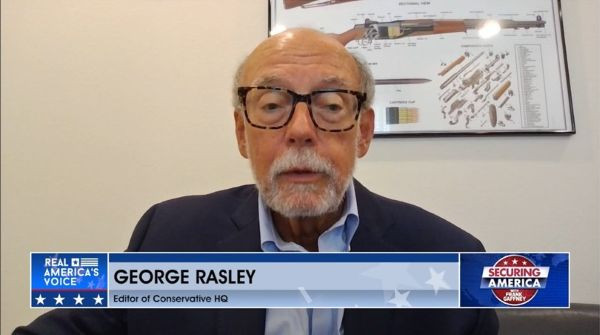

CHQ Editor George Rasley and Securing America's host Frank Gaffney discuss Democrats' attempted redistricting power grab in Virginia, the Supreme Court's rejection of racial gerrymandering, President Trump's trip to Communist China and the effort to thwart Sharia-supremacism in America and especially in Texas.
The program's the kind of owner's manual for protecting the country we love against all enemies, foreign and domestic to the glory of God and his kingdom.
We're going to talk with men whose contributions to this program I consider to be glorious.
He is our duty genius, as we call him here at Securing America.
Don't take my word for it.
He is a Mensa Society certified genius.
His name is George Rasley, and he graces this program with great faithfulness for which we are eternally grateful, but especially when he gives us a full hour of his time, which we're going to do today.
And I am especially appreciative of that.
He's served in the executive branch, the legislative branch of our government, run, or been involved in some 300 campaigns at every level of government.
And he is these days the managing editor of a marvelous online resource, Conservative HQ, the newsletter of our dear friend Richard Viguerie.
George, as always, it is a great honor to have you with us, especially for the full show.
God bless.
Welcome.
Rasley: Well, thank you for having me, Frank.
I always do my best to live up to your buildup. So, I'm ready to rock.
Gaffney: Let's rock and roll.
So, we're going to start with redistricting, George. As you say, you've spent a lot of time in political campaigns.
There's a lot of that going on at the moment, though.
It's been mostly in the form of states redistricting their congressional districts.
Virginia, the Commonwealth of Virginia, has been a particularly interesting spectacle.
Let's talk first about that and then we'll broaden the lens to talk about the rest of the country and what the Supreme Court recently did.
Rasley: Well, yeah, spectacle is a very polite way of putting it.
You know, the Democrats in Virginia went you know, full anti-constitutional totalitarian to attempt to erase the four Republican congressional seats in that state.
And the Virginia Supreme Court, which is, I would say, largely oriented toward the Democratic Party, smacked down that effort quite vociferously, actually, on variety of procedural grounds and basically said that you know the Democrats violated the law and the Virginia Constitution by the means that they used to get that referendum on the ballot and so the
Gaffney: And then there was just the plain language of the darn thing, which was extraordinary, too, that they were going to be restoring fairness. I mean, please.
Rasley: Well, you know, it's the Orwellian Democrats at work in the drafting of that thing.
But anyway, the results of the referendum were struck down.
And so, you know, the champagne corks on the Republican side were popping and everything like that over the weekend.
And then the Democrats came forth with, well, basically to heck with the Supreme Court, we're going to figure out another way to grab power.
Gaffney: Get us a new Supreme Court specifically.
Rasley: Yeah. I haven't fully absorbed exactly what that proposal is. I kind of read the headline in the first paragraph of the, you know, the coverage of it, but.
Gaffney: Well, as I understand it, George, if I can help clarify, the plan is to change the mandatory retirement age for Supreme Court justices in Virginia to below the age of the youngest member of the Supreme Court.
I don't know what that is.
I don't, maybe it's 40 or 50, whatever, but off with their heads, basically.
Everybody will be frog marched out of the Supreme Court. And then I guess they envision the, somehow the legislature is gonna appoint themselves a new bunch of Supreme Court justices, and they're all gonna be on side, and they're all gonna say that, no, no, no, never mind.
It was perfect.
We're gonna have that district.
And apparently the minority leader in the United States House of Representatives, who aspires, of course, to be the majority leader, though I will tell you that I've heard tell that the actual agenda is to get him into that job and then to impeach President Trump and J.D. Vance. so that he can then fleet up to become the next president of the United States.
How about them apples?
So, this is, I mean, full on totalitarian, I think is the right word for it.
Rasley: Yeah, that that's a little more than what was in the first paragraph of the article. I know. But anyway, the point I was getting ready to make is simply that, you know, the whole thing puts to lie the Democrats claim that they're restoring fairness and all of this stuff, and it was just the grossest, vilest, gutter-level power grab that would make any communist dictator from Lenin to Pol Pot happy as heck to take their shot at it.
Gaffney: Well, we'll see how that all plays out. Yeah.
But George, so let's back the lens up a little bit because of course there have been a few other things that have been taking place too.
Notably, SCOTUS, the Supreme Court of the United States has weighed in on this whole deal.
And it's kind of like, you know, 52 card pickup.
What did you make of the ruling, first of all, and talk a little bit about the ripple effect that it's having nationwide.
Rasley: Well, the Supreme Court ruling was, you know, gave us a lot clearer picture of the future than, you know, what the Virginia legislature is doing.
But basically, they, the Supreme Court said that any sort of racial bias in the creation of a congressional district was unconstitutional.
What they said in essence was, Racism is racism and it's unconstitutional.
And so that has thrown into...
Gaffney: But George, if I may just ask you to pause on that, this notwithstanding the fact that the so-called Voting Rights Act has been in place for decades, which indeed enshrined this notion of racism for a good cause, I guess, is the way it would be put.
Rasley: Well, the Voting Rights Act has largely, I think, been misapplied by state legislatures, and some past Supreme Court decisions as well.
And it was intended to address historic biases.
In other words, where minority voters were intentionally disempowered.
And so, the solution that state legislatures came up with and that the Supreme Court occasionally seemed to endorse was these racially biased congressional districts as a way of remedying that.
And what the Supreme Court said in the most recent case, the Louisiana case, was basically that you can't remedy racism with more racism.
And so, this is thrown into doubt more than a dozen congressional districts across the country.
And if one were to construct compact geographically continuous -- contiguous -- congressional districts following the Supreme Court ruling, it wipes out probably at least a dozen racially biased congressional districts that favor the Democrats.
Gaffney: George, we have to pause because we've got a break coming up.
I want to ask you on the other side of the break, whether the redrafting that has followed from the Supreme Court's ruling is aligned with what you've just said, which I think makes eminent sense, that they're reasonably compact and contiguous districts.
Or is it just another gerrymandering opportunity for political purposes?
We'll get into that and much more with one of our great authorities on political matters, George Rasley, right after this.
Stay tuned.
Gaffney: We're back, as is George Rasley, our duty genius, exhibiting his acumen, particularly in things politic, by helping us to, well, examine the entrails, one might say, of the redistricting business at the moment.
And George, I put to you a question at the end of the last segment that I want to pick up on.
Are the revised districts in places like Louisiana and I guess Georgia, I think, Tennessee, some of these other places where there were concerns about racially determined district lines being drawn? Are they in fact compact and contiguous as you put it or is it just basically another set of gerrymandered?
You know drafts well the political purposes in mind.
Rasley: Yeah, let's start with the proposition that constructing districts is a political act and so legislatures will act according to their political instincts to do that, the question is: Do they intentionally discriminate in that process? And so far, in Tennessee, in Florida, and some other states that are have already acted; it appears that they have not.
And however, what they have done is to eliminate these previously constructed racially biased districts.
And so in Florida, for example, it eliminated for sure one, probably two of these districts.
And what I found very interesting was that the far left racial grifters of various organizations in Florida, for example, my home state, demanded that [Democrat] Congresswoman Debbie Wasserman Schultz not run in a heavily Democrat district that would probably favor a black Democrat candidate, Wasserman Schultz being white, Jewish, and also one of the most senior women in Florida politics, I might add.
So, it tells you again that these districts were created as racial grifts to satisfy these far-left members of the Democrat coalition.
And so, it's very interesting that now they're having a civil war within the Democratic Party on who gets these most favorable districts.
And so that's just one anecdote from Florida.
In Tennessee, the Democrats in the Tennessee legislature had a near riot when their racially biased district was eliminated. And having looked at the map quite reasonably, I might add.
Of course, in Indiana, the state legislature failed to act previously on doing a redistricting, which would have eliminated, again, two racially biased districts.
And the state senators, Republican, who stymied that effort were all almost all voted out of office in the Republican primary.
So whether the legislature comes back and revisits that or not, I don't know.
I used to live in Indiana, began my political career there.
And I think it's unlikely given the leadership, the present leadership of the state Senate in Indiana, that they would do that.
But after the election, there's likely to be new leadership in the state Senate, and they may very well come back and take another swipe at that for the 2028 elections.
Gaffney: Right. So, George, let me just ask you, there are states in the country, Massachusetts comes to mind, in which there are no Republican districts at all.
There are states in the country where there has been, as in I think six to five, Democrat to Republican.
The state legislature, as we just were discussing, changed that to, I think, ten to one.
Rasley: Yeah.
Gaffney: I'm curious what your thoughts are, because it seems as though now that Republicans have the latitude to do this, they're perfectly prepared to create, you know, the comparable kind of well, shall we say, lack of representation in the congressional districts in their state that Democrats have been doing now for some time.
Is that just politics and the way the cookie crumbles, especially if the Supreme Court has given us a new set of guidelines?
Rasley: Well, interesting question, Frank.
As I said before, redistricting or setting up districts is a political act.
However, there's been a couple of interesting, I'll call them thought experiments, if you will, where organizations have asked AI to conduct a redistricting based simply on creating equal population contiguous districts.
And if that were done, if we turn this job over to AI, it would help Republicans even more. You're looking at maybe as many as 276 GOP leaning seats because it would, for example, in California, restore the balance that Democrats have eliminated there over time.
And so, the notion that, well, gerrymandering is just who's in charge, so to speak, is simply not accurate in the sense that you cannot construct a fair map without gerrymandering. I mean, the bottom line is the fairest map that AI can create would give Republicans even more advantages than they already have.
And not that I'm in favor of turning such things over to AI, but it's just a good thought experiment that once again proves, for example, that what the Democrats are doing in Virginia is a power grab, it's not restoring fairness or anything like that.
Gaffney: Yeah, that will. I must say, as a voter in Virginia, when I saw that on the ballot, I thought to myself,
This is absolutely shameless, unfair, and... Outrageous it's shameless that they would characterize it as such for the purposes of misleading the public and I think that was one of the things that the Supreme Court rightly ruled George we've got a lot of other things to talk about I want to segue in the briefest of forum the beginning to our next block by asking you about Sharia. The jihadis in this country, the Sharia supremacists, I think they're best described as, are now talking about, well, I don't know that they're using this term, but I think it fits electoral jihad of using very disciplined voting blocs, managed and weaponized really, by the Muslim Brotherhood, I think, predominantly, and other Sharia supremacists, to ensure that in particular, in electoral units that are closely divided, they may be able to play a kingmaker role and assure the victory of, if not actually, a fellow Muslim jihadists at least people who are willing to do business with them and aligned with them or otherwise Serving their interests.
I want to get your thoughts on what that can mean in this country and whether it's like what we're seeing in Britain
But much more with George Rasley stay tuned.
Gaffney: Welcome back.
George Rasley is with us for this full hour.
What a red-letter day.
Thank you for doing so, George.
We're talking politics, as we often do with you, and particularly the nexus with national security.
And it's hard to overstate how real that would be if, as I was suggesting before the break, the Sharia supremacists in this country have their way.
and have the ability to engage in what I think of as electoral jihad, winning elections on very narrow votes, possibly, but that might bring into power considerable numbers of their ilk or at least their allies.
You did a marvelous job in a recent production for the Victory Coalition of making plain, in their own words, what the agenda is of these guys, which is to take down our country and our Constitution and use democracy for the purpose.
Walk us through the implications of all of this, especially against the backdrop of what our friend Peter McIlvenna has been telling us is what's happening in his native nation, namely the United Kingdom.
Rasley: Well, I'm actually working on another presentation called "Ballots or Bullets," and it reviews the statements of these Muslim Brotherhood aligned Imams and Muslim leaders.
And they're not at all bashful about saying right out loud that this is their intention.
And you use the word disciplined, and I think that's crucial.
You know, every Friday when Muslims go to a mosque, they are instructed quite clearly by their leaders on who to vote for, how to vote, how to get registered, and I suspect how to get registered, whether they're citizens or not.
And so these disciplined blocks of voters that they're trying to assemble, you know, mirror past efforts, particularly on the left, to take control of local jurisdictions.
And so, we see, you know, they're just copying what labor unions and others have done in the past to move given jurisdictions in their direction.
And a perfect example of that is the election of Mamdani in New York, where you have these Imams now going around saying that Mamdani's election was a model, it's crucial for the Ummah to follow that plan.
And so, it doesn't take them to have a majority.
In fact, as we see in Great Britain with their parliamentary system, they can elect a large number of aligned candidates, either Muslims or Muslim adjacent leftists, to local office, which are known as, you know, the council offices there, or to parliament.
And so fortunately, the last, most recent council elections They got pretty well wiped out by a groundswell of pro-nationalist candidates from the Reform Party.
Gaffney: You would say wiped out, you mean the Labour Party, but not necessarily the Green Party, which they have been making common cause, as I understand it.
Rasley: The Green Party has been making some progress, but the Islamist Party in Great Britain is largely Labour aligned.
But to bring that back to the United States, Again, looking at Virginia, some of the elections that threw the Virginia legislature to Democrat control were decided by just a handful of votes.
And those handful of votes came in areas where there are blocks of Muslim voters.
And I would submit that they had a lot to do with turning the Virginia legislature into this radical leftist Democrat cesspit that it now is.
Gaffney: Well, red, green, one might call it.
Rasley: Yeah.
Gaffney: So George, let me just ask you, as you see this playing out, is that not only a problem for us at the local level in the states, but also more and more likely to be a problem in the federal legislature or other elections here.
Rasley: Yeah, absolutely. Because, again, you know, you're looking at the majority makers for each party are typically decided by a relative handful of votes.
I mean, you know, the last couple of members of Congress that you need to elect to get to, you know, 218 often are winning their elections by less than a thousand votes.
They're not big, you know, landslide elections, even in a in a wave year.
And so, these kind of what I call instructed voting blocks are crucial to those close wins.
Gaffney: So, in short, and we look forward to your "Ballots or Bullets" production, and
I hope you'll come back to the Victory Coalition and share that with us as well, George, in the near future.
It's hard to overstate the importance of it.
As you know, we've been working intensively in the state of Texas, where this fight is happening in real time.
And I know that the antidote to this is obviously to have more and more and more voters informed about what these Sharia supremacists have in mind. The more they know, the less appetite they have for any of it, as we saw with that incredible victory on Proposition 10
in the Republican primary.
It was an open primary, by the way, but in the Republican primary, this ballot that simply said Texas should prohibit Sharia law.
1.9 million Texans voted for it. It suggests that that's a unifying and turnout, you know, animating topic.
And I think it's imperative that it be made, you know, so to the utmost degree if we can.
And look forward to working with you and of course that enormous group of subscribers you have to ConservativeHQ.com, something like a quarter million of them, I believe.
But what else should we be talking about, George, in terms of contesting this gambit of electoral jihad?
Rasley: Well, the you know, the crucial thing and I was so honored to be part of the effort to to pass the referendum there in Texas. But the crucial thing is to assemble a coalition of the informed, as I would call it.
And one of the big pieces that's been missing from that in other places, for example, Virginia, is what Sharia means, what Sharia supremacism means for women.
And so we have a lot of liberal women, elected public officials, Nancy Pelosi, the governor of New Jersey, the lieutenant governor of Minnesota, all far left Democrats, you know, appearing in hijabs and normalizing Sharia supremacism when it actually means the most degrading kinds of oppression of the women that they purport to represent.
And definitely we need to inform women what Sharia supremacism and Islam means for them as it gains more adherents here in the United States.
Gaffney: It's not a fashion statement, that's for sure.
What these folks have in mind is the absolute subjugation of women.
To say nothing of, you know, beating them abusing them in other ways, mutilating their genitals. I mean, it's just absolutely staggering that any woman... in the United States and I would even argue Muslim women would voluntarily want this to be imposed upon them but you're so right you know and speaking of that campaign in Texas George one of the things that we also tried to bring to the fore was Sharia is not so good for dogs either if you don't care about women or children or you know yourselves for heaven's sakes what about your pet dog because, as you know, George, we did a Dogs for Freedom rally, a little sort of prototype, if you will, of what I hope might be done across this country.
Because, again, when people learn more about Sharia, and in this case, that its application would require surrendering your dogs, and presumably their elimination in the manner that the jihadis kill all animals, which is by slitting their throats without any kind of stunning or knockout and letting them bleed out.
I mean, it's just absolutely barbaric, as is all of Sharia, and the American people need to know that and now take matters to their hands to oppose it, especially at the ballot box.
George, we have to take a break. We'll be right back with more on China next.
Stay tuned. We're back, as is George Rasley, our friend at the marvelous online resource Conservative HQ.
He brings to the job a wealth of experience in government and in political life.
And we are so grateful for his time each week, especially when we get a full hour-long conversation going.
Gaffney: George, I wanted to turn from Sharia supremacism to the other part of the red-green axis,
namely communism, and specifically that practiced by and enabled by the Chinese Communist Party.
You're a member of our Committee on the Present Danger China.
You're very clear-eyed about what you call Red China, a throwback to an earlier era, but absolutely accurate.
Donald Trump is headed there this week.
We did at one of our Committee on the Present Danger China webinars, you did not participate in this one, but I think you would have liked it, about what a front meeting this is.
Talk to us about what you think might be some of its downside risks and perhaps how it will shape up.
Rasley: Well, I would commend that webinar to your viewers today it was great I've had a chance to read through the transcript and watch some of it on the video on Rumble and...
Gaffney: I would it's all available by the way folks at presentdangerchina.org in fact I hope you'll consider subscribing to participate in those programs each roughly each week and I think that the panel did a superb job in outlining the risks, the relatively few benefits, quite frankly, from what we know of the agenda so far.
Rasley: And I would, my thought would be, quite honestly, it should be postponed.
But if it's not postponed, my advice to the president would be to go there and to explain to Xi Jinping that we control his former oil resources, that Venezuelan oil and Iranian oil is no longer going to flow to Red China, and that the president ignore the billionaire voices who are constantly squawking about supply chains and all the other things, economic advantages that we've surrendered to Red China over the years and be tough and simply tell Xi no oil until you guys behave and stay behaved.
Because the Chinese have a tendency, much like the Iranians, to say one thing in order to sort of get us beyond that point in so-called negotiations and then renege.
And so, you know, we get a deal, six months later, we don't have a deal.
We get a deal, three months later, we don't have a deal.
And so if the president goes in there and simply tells him, Sorry boys, no oil without a deal that sticks.
That's the only thing in my mind that makes this trip worthwhile.
Otherwise, he might as well cancel it.
Gaffney: Amen.
George, let me just ask you, because honestly, I've gone back and forth on this. The president clearly, at the moment, seems to be of a very different mind.
He doesn't want to alienate Xi Jinping.
He actually wants to enlist his help, we're told, in trying to open up the Strait of Hormuz and otherwise come to some sort of understanding with the Iranians.
That seems to me to be exceptionally fraught.
But then there's this other Trump agenda, and you've sort of alluded to it just now.
He has put us in a position to cut off the Chinese supply of oil.
He has taken down, if not out altogether, two of its most important allies, and he's pushing back in other places, notably the Panama Canal to other parts of the world as well, in Africa perhaps particularly.
What is your net assessment of where Donald Trump is on this, having written books and spoken for decades about the threat from China?
Is it the good cop, bad cop that we're seeing, or is there really a consistent strategy being applied?
Rasley: You know, there may be some good cop, bad cop going on there.
But I think, you know, I don't purport to be able to psychoanalyze the president, but looking at his record and what he says over many years, his inclination is to believe that everybody wants peace and prosperity, to make money, be happy, and that is what motivates him, and he believes, I think correctly, that that's what motivates most Americans.
I think we have to be honest and say that you and I, over our careers and many years in government, national security, have concluded that a lot of the rest of the world does not have that agenda, and that peace and prosperity means zip to the Red Chinese, it means less than zip to the Iranians.
And so, you know, the blandishments of economic growth and prosperity do not appeal to the Red Chinese and the Iranians in the same way that they would appeal to Western European or most other Asian countries, quite honestly.
You know, that that's an appeal that works with the Japanese, with the Indonesians in large measure.
It doesn't work with the Red Chinese.
Gaffney: But isn't it basically at the end of the day, George, that the countries it doesn't work with are totalitarian?
Rasley: Yeah, absolutely.
Gaffney: Or authoritarian or whatever you want to call it.
Rasley: Yeah.
Gaffney: Whereas the countries where it does work have to at least pay some attention to the will of their populations.
And it's one of the reasons why I think it's been true throughout history that generally...
Democracies don't relish the prospect of war and tend to be late to those parties when the bad guys bring them the War that they would just as soon give a miss to We have to take a quick pause.
We'll be back for one final segment with George Rasley. I very much hope you'll stay with us.
Gaffney: Welcome back to this final installment of a very thought-provoking, as always, very illuminating conversation with our duty genius, George Rasley.
And thank you again, George, for making yourself available for this full hour.
I wanted to pivot to one other piece of this Iran drama.
Obviously, the blockage of the Strait of Hormuz, initially by the Iranians, now by us, has had some very significant implications, I think it's fair to say, for, well, the world, the world economy, but also for the Iranian regime.
And yet, as our friend and colleague, another member of our Committee on the President Danger China, one of the people who participated in that webinar that we spoke of earlier, again, available for free at presidentdangerchina.org, is Charles Sam Faddis, a man who devoted 20 years of his life to fighting, much of that two decades at least, against the Iranians.
He knows them well. He understands how they think and act. And he's very clear-eyed about the necessity now of defeating them.
In fact, he's written a piece, George, at his post at And Magazine, which can be found at AND magazine.substack.com,
about what I think he said is, Stop talking to the Iranians and, quote, Go for the jugular, unquote.
And I'm very much of that mind myself, and I think you are as well.
He lays out a number of specific things that should be done in that regard that would essentially constrict, hopefully terminally, access to cash, access to further weaponry, and abilities to otherwise wage the war that they've still undertaken against us and others in the region. You've had a chance I think to take a look at Sam's recommendations your thoughts sir.
Rasley: Well, you sometimes refer to me as your duty genius and I would I would defer that title Sam Faddis on all things related to Iran and the Middle East. But Sam's piece is, I think, an excellent roadmap if the Trump administration chose to follow it.
And I think the key point that everybody needs to understand is that Iran is a vast country. I mean, it's got a population of 90 million. It's about the size of Western Europe.
And it has a significant percentage of people who want no part of the Sharia supremacist, Shia Twelver ruling junta that has oppressed them for almost 50 years, but they don't have any guns.
And so, if the regime is to be overthrown, and that, in my opinion, is the only way that a firm, final, binding conclusion to this is going to happen.
We cannot do a nuclear weapons elimination deal with a group of people who think that they need to advance the end of the world to bring about the worldwide rule of Islam.
But they're only defeated if they decide they're defeated.
We're not going to go in there and occupy Iran.
I don't think that it is rational or possible for us to do that.
I don't think that we could construct a worldwide coalition that would be willing to do that.
So, the question then becomes, well, what if they decide not to give up?
I mean, they are defeated by any, you know, military assessment.
They're beat, but they're not willing to give up.
So, they occupy the territory of Iran.
They continue to oppress, in the vilest ways, their population.
And all the economic constricting that we've been doing has left them maybe with three, four, five, six months ability to hang on before complete collapse.
And their assumption is, we're going to give up, that we have no appetite for a long war, that Trump is up against the midterm elections, and that if they don't give up before the midterms, they win.
And so the only thing that can be done is to, as Sam has suggested, engage in these very, very severe tactics to restrict their economic life, their access to cash, their ability to move oil, so on and so forth.
And that is probably the best way forward, absent finding somebody who can actually make a deal stick, who is willing to essentially surrender.
And so far, we haven't found anybody that can make that stick.
Gaffney: And so, what Sam is laying out, basically, you know, kind of reminds me of the Reagan strategy for taking down the Soviet Union. It wasn't kinetic in his case. What Sam is describing has to be under these circumstances.
But it had, at its core, the same basic idea, which is cutting off the cash flow.
And it's a question, as you say, of how long they can persist.
But what Sam has identified, and I call attention particularly to a really important revelation he added in a magazine last week, I believe, namely that there are some two dozen tankers anchored off the coast of Malaysia with Iranian oil in them. He calls it a kind of rainy day fund that ultimately would turn into cash when they sail on or offload and other ships sail on with the oil to China.
That must not be allowed to happen, and Sam is calling for us to seize those ships, and I think that's an eminently
sensible thing to do.
George, we have to leave it at that. I'm afraid we are hard out of time. The hour has flown by, as it always does.
We look forward to our next visit with you next week. In the meantime, keep up the great work at ConservativeHQ.com. To the rest of you, I hope you'll join us again for more next time. Until then, go forth and multiply.
Transcript follows:
The program's the kind of owner's manual for protecting the country we love against all enemies, foreign and domestic to the glory of God and his kingdom.
We're going to talk with men whose contributions to this program I consider to be glorious.
He is our duty genius, as we call him here at Securing America.
Don't take my word for it.
He is a Mensa Society certified genius.
His name is George Rasley, and he graces this program with great faithfulness for which we are eternally grateful, but especially when he gives us a full hour of his time, which we're going to do today.
And I am especially appreciative of that.
He's served in the executive branch, the legislative branch of our government, run, or been involved in some 300 campaigns at every level of government.
And he is these days the managing editor of a marvelous online resource, Conservative HQ, the newsletter of our dear friend Richard Viguerie.
George, as always, it is a great honor to have you with us, especially for the full show.
God bless.
Welcome.
Rasley: Well, thank you for having me, Frank.
I always do my best to live up to your buildup. So, I'm ready to rock.
Gaffney: Let's rock and roll.
So, we're going to start with redistricting, George. As you say, you've spent a lot of time in political campaigns.
There's a lot of that going on at the moment, though.
It's been mostly in the form of states redistricting their congressional districts.
Virginia, the Commonwealth of Virginia, has been a particularly interesting spectacle.
Let's talk first about that and then we'll broaden the lens to talk about the rest of the country and what the Supreme Court recently did.
Rasley: Well, yeah, spectacle is a very polite way of putting it.
You know, the Democrats in Virginia went you know, full anti-constitutional totalitarian to attempt to erase the four Republican congressional seats in that state.
And the Virginia Supreme Court, which is, I would say, largely oriented toward the Democratic Party, smacked down that effort quite vociferously, actually, on variety of procedural grounds and basically said that you know the Democrats violated the law and the Virginia Constitution by the means that they used to get that referendum on the ballot and so the
Gaffney: And then there was just the plain language of the darn thing, which was extraordinary, too, that they were going to be restoring fairness. I mean, please.
Rasley: Well, you know, it's the Orwellian Democrats at work in the drafting of that thing.
But anyway, the results of the referendum were struck down.
And so, you know, the champagne corks on the Republican side were popping and everything like that over the weekend.
And then the Democrats came forth with, well, basically to heck with the Supreme Court, we're going to figure out another way to grab power.
Gaffney: Get us a new Supreme Court specifically.
Rasley: Yeah. I haven't fully absorbed exactly what that proposal is. I kind of read the headline in the first paragraph of the, you know, the coverage of it, but.
Gaffney: Well, as I understand it, George, if I can help clarify, the plan is to change the mandatory retirement age for Supreme Court justices in Virginia to below the age of the youngest member of the Supreme Court.
I don't know what that is.
I don't, maybe it's 40 or 50, whatever, but off with their heads, basically.
Everybody will be frog marched out of the Supreme Court. And then I guess they envision the, somehow the legislature is gonna appoint themselves a new bunch of Supreme Court justices, and they're all gonna be on side, and they're all gonna say that, no, no, no, never mind.
It was perfect.
We're gonna have that district.
And apparently the minority leader in the United States House of Representatives, who aspires, of course, to be the majority leader, though I will tell you that I've heard tell that the actual agenda is to get him into that job and then to impeach President Trump and J.D. Vance. so that he can then fleet up to become the next president of the United States.
How about them apples?
So, this is, I mean, full on totalitarian, I think is the right word for it.
Rasley: Yeah, that that's a little more than what was in the first paragraph of the article. I know. But anyway, the point I was getting ready to make is simply that, you know, the whole thing puts to lie the Democrats claim that they're restoring fairness and all of this stuff, and it was just the grossest, vilest, gutter-level power grab that would make any communist dictator from Lenin to Pol Pot happy as heck to take their shot at it.
Gaffney: Well, we'll see how that all plays out. Yeah.
But George, so let's back the lens up a little bit because of course there have been a few other things that have been taking place too.
Notably, SCOTUS, the Supreme Court of the United States has weighed in on this whole deal.
And it's kind of like, you know, 52 card pickup.
What did you make of the ruling, first of all, and talk a little bit about the ripple effect that it's having nationwide.
Rasley: Well, the Supreme Court ruling was, you know, gave us a lot clearer picture of the future than, you know, what the Virginia legislature is doing.
But basically, they, the Supreme Court said that any sort of racial bias in the creation of a congressional district was unconstitutional.
What they said in essence was, Racism is racism and it's unconstitutional.
And so that has thrown into...
Gaffney: But George, if I may just ask you to pause on that, this notwithstanding the fact that the so-called Voting Rights Act has been in place for decades, which indeed enshrined this notion of racism for a good cause, I guess, is the way it would be put.
Rasley: Well, the Voting Rights Act has largely, I think, been misapplied by state legislatures, and some past Supreme Court decisions as well.
And it was intended to address historic biases.
In other words, where minority voters were intentionally disempowered.
And so, the solution that state legislatures came up with and that the Supreme Court occasionally seemed to endorse was these racially biased congressional districts as a way of remedying that.
And what the Supreme Court said in the most recent case, the Louisiana case, was basically that you can't remedy racism with more racism.
And so, this is thrown into doubt more than a dozen congressional districts across the country.
And if one were to construct compact geographically continuous -- contiguous -- congressional districts following the Supreme Court ruling, it wipes out probably at least a dozen racially biased congressional districts that favor the Democrats.
Gaffney: George, we have to pause because we've got a break coming up.
I want to ask you on the other side of the break, whether the redrafting that has followed from the Supreme Court's ruling is aligned with what you've just said, which I think makes eminent sense, that they're reasonably compact and contiguous districts.
Or is it just another gerrymandering opportunity for political purposes?
We'll get into that and much more with one of our great authorities on political matters, George Rasley, right after this.
Stay tuned.
Gaffney: We're back, as is George Rasley, our duty genius, exhibiting his acumen, particularly in things politic, by helping us to, well, examine the entrails, one might say, of the redistricting business at the moment.
And George, I put to you a question at the end of the last segment that I want to pick up on.
Are the revised districts in places like Louisiana and I guess Georgia, I think, Tennessee, some of these other places where there were concerns about racially determined district lines being drawn? Are they in fact compact and contiguous as you put it or is it just basically another set of gerrymandered?
You know drafts well the political purposes in mind.
Rasley: Yeah, let's start with the proposition that constructing districts is a political act and so legislatures will act according to their political instincts to do that, the question is: Do they intentionally discriminate in that process? And so far, in Tennessee, in Florida, and some other states that are have already acted; it appears that they have not.
And however, what they have done is to eliminate these previously constructed racially biased districts.
And so in Florida, for example, it eliminated for sure one, probably two of these districts.
And what I found very interesting was that the far left racial grifters of various organizations in Florida, for example, my home state, demanded that [Democrat] Congresswoman Debbie Wasserman Schultz not run in a heavily Democrat district that would probably favor a black Democrat candidate, Wasserman Schultz being white, Jewish, and also one of the most senior women in Florida politics, I might add.
So, it tells you again that these districts were created as racial grifts to satisfy these far-left members of the Democrat coalition.
And so, it's very interesting that now they're having a civil war within the Democratic Party on who gets these most favorable districts.
And so that's just one anecdote from Florida.
In Tennessee, the Democrats in the Tennessee legislature had a near riot when their racially biased district was eliminated. And having looked at the map quite reasonably, I might add.
Of course, in Indiana, the state legislature failed to act previously on doing a redistricting, which would have eliminated, again, two racially biased districts.
And the state senators, Republican, who stymied that effort were all almost all voted out of office in the Republican primary.
So whether the legislature comes back and revisits that or not, I don't know.
I used to live in Indiana, began my political career there.
And I think it's unlikely given the leadership, the present leadership of the state Senate in Indiana, that they would do that.
But after the election, there's likely to be new leadership in the state Senate, and they may very well come back and take another swipe at that for the 2028 elections.
Gaffney: Right. So, George, let me just ask you, there are states in the country, Massachusetts comes to mind, in which there are no Republican districts at all.
There are states in the country where there has been, as in I think six to five, Democrat to Republican.
The state legislature, as we just were discussing, changed that to, I think, ten to one.
Rasley: Yeah.
Gaffney: I'm curious what your thoughts are, because it seems as though now that Republicans have the latitude to do this, they're perfectly prepared to create, you know, the comparable kind of well, shall we say, lack of representation in the congressional districts in their state that Democrats have been doing now for some time.
Is that just politics and the way the cookie crumbles, especially if the Supreme Court has given us a new set of guidelines?
Rasley: Well, interesting question, Frank.
As I said before, redistricting or setting up districts is a political act.
However, there's been a couple of interesting, I'll call them thought experiments, if you will, where organizations have asked AI to conduct a redistricting based simply on creating equal population contiguous districts.
And if that were done, if we turn this job over to AI, it would help Republicans even more. You're looking at maybe as many as 276 GOP leaning seats because it would, for example, in California, restore the balance that Democrats have eliminated there over time.
And so, the notion that, well, gerrymandering is just who's in charge, so to speak, is simply not accurate in the sense that you cannot construct a fair map without gerrymandering. I mean, the bottom line is the fairest map that AI can create would give Republicans even more advantages than they already have.
And not that I'm in favor of turning such things over to AI, but it's just a good thought experiment that once again proves, for example, that what the Democrats are doing in Virginia is a power grab, it's not restoring fairness or anything like that.
Gaffney: Yeah, that will. I must say, as a voter in Virginia, when I saw that on the ballot, I thought to myself,
This is absolutely shameless, unfair, and... Outrageous it's shameless that they would characterize it as such for the purposes of misleading the public and I think that was one of the things that the Supreme Court rightly ruled George we've got a lot of other things to talk about I want to segue in the briefest of forum the beginning to our next block by asking you about Sharia. The jihadis in this country, the Sharia supremacists, I think they're best described as, are now talking about, well, I don't know that they're using this term, but I think it fits electoral jihad of using very disciplined voting blocs, managed and weaponized really, by the Muslim Brotherhood, I think, predominantly, and other Sharia supremacists, to ensure that in particular, in electoral units that are closely divided, they may be able to play a kingmaker role and assure the victory of, if not actually, a fellow Muslim jihadists at least people who are willing to do business with them and aligned with them or otherwise Serving their interests.
I want to get your thoughts on what that can mean in this country and whether it's like what we're seeing in Britain
But much more with George Rasley stay tuned.
Gaffney: Welcome back.
George Rasley is with us for this full hour.
What a red-letter day.
Thank you for doing so, George.
We're talking politics, as we often do with you, and particularly the nexus with national security.
And it's hard to overstate how real that would be if, as I was suggesting before the break, the Sharia supremacists in this country have their way.
and have the ability to engage in what I think of as electoral jihad, winning elections on very narrow votes, possibly, but that might bring into power considerable numbers of their ilk or at least their allies.
You did a marvelous job in a recent production for the Victory Coalition of making plain, in their own words, what the agenda is of these guys, which is to take down our country and our Constitution and use democracy for the purpose.
Walk us through the implications of all of this, especially against the backdrop of what our friend Peter McIlvenna has been telling us is what's happening in his native nation, namely the United Kingdom.
Rasley: Well, I'm actually working on another presentation called "Ballots or Bullets," and it reviews the statements of these Muslim Brotherhood aligned Imams and Muslim leaders.
And they're not at all bashful about saying right out loud that this is their intention.
And you use the word disciplined, and I think that's crucial.
You know, every Friday when Muslims go to a mosque, they are instructed quite clearly by their leaders on who to vote for, how to vote, how to get registered, and I suspect how to get registered, whether they're citizens or not.
And so these disciplined blocks of voters that they're trying to assemble, you know, mirror past efforts, particularly on the left, to take control of local jurisdictions.
And so, we see, you know, they're just copying what labor unions and others have done in the past to move given jurisdictions in their direction.
And a perfect example of that is the election of Mamdani in New York, where you have these Imams now going around saying that Mamdani's election was a model, it's crucial for the Ummah to follow that plan.
And so, it doesn't take them to have a majority.
In fact, as we see in Great Britain with their parliamentary system, they can elect a large number of aligned candidates, either Muslims or Muslim adjacent leftists, to local office, which are known as, you know, the council offices there, or to parliament.
And so fortunately, the last, most recent council elections They got pretty well wiped out by a groundswell of pro-nationalist candidates from the Reform Party.
Gaffney: You would say wiped out, you mean the Labour Party, but not necessarily the Green Party, which they have been making common cause, as I understand it.
Rasley: The Green Party has been making some progress, but the Islamist Party in Great Britain is largely Labour aligned.
But to bring that back to the United States, Again, looking at Virginia, some of the elections that threw the Virginia legislature to Democrat control were decided by just a handful of votes.
And those handful of votes came in areas where there are blocks of Muslim voters.
And I would submit that they had a lot to do with turning the Virginia legislature into this radical leftist Democrat cesspit that it now is.
Gaffney: Well, red, green, one might call it.
Rasley: Yeah.
Gaffney: So George, let me just ask you, as you see this playing out, is that not only a problem for us at the local level in the states, but also more and more likely to be a problem in the federal legislature or other elections here.
Rasley: Yeah, absolutely. Because, again, you know, you're looking at the majority makers for each party are typically decided by a relative handful of votes.
I mean, you know, the last couple of members of Congress that you need to elect to get to, you know, 218 often are winning their elections by less than a thousand votes.
They're not big, you know, landslide elections, even in a in a wave year.
And so, these kind of what I call instructed voting blocks are crucial to those close wins.
Gaffney: So, in short, and we look forward to your "Ballots or Bullets" production, and
I hope you'll come back to the Victory Coalition and share that with us as well, George, in the near future.
It's hard to overstate the importance of it.
As you know, we've been working intensively in the state of Texas, where this fight is happening in real time.
And I know that the antidote to this is obviously to have more and more and more voters informed about what these Sharia supremacists have in mind. The more they know, the less appetite they have for any of it, as we saw with that incredible victory on Proposition 10
in the Republican primary.
It was an open primary, by the way, but in the Republican primary, this ballot that simply said Texas should prohibit Sharia law.
1.9 million Texans voted for it. It suggests that that's a unifying and turnout, you know, animating topic.
And I think it's imperative that it be made, you know, so to the utmost degree if we can.
And look forward to working with you and of course that enormous group of subscribers you have to ConservativeHQ.com, something like a quarter million of them, I believe.
But what else should we be talking about, George, in terms of contesting this gambit of electoral jihad?
Rasley: Well, the you know, the crucial thing and I was so honored to be part of the effort to to pass the referendum there in Texas. But the crucial thing is to assemble a coalition of the informed, as I would call it.
And one of the big pieces that's been missing from that in other places, for example, Virginia, is what Sharia means, what Sharia supremacism means for women.
And so we have a lot of liberal women, elected public officials, Nancy Pelosi, the governor of New Jersey, the lieutenant governor of Minnesota, all far left Democrats, you know, appearing in hijabs and normalizing Sharia supremacism when it actually means the most degrading kinds of oppression of the women that they purport to represent.
And definitely we need to inform women what Sharia supremacism and Islam means for them as it gains more adherents here in the United States.
Gaffney: It's not a fashion statement, that's for sure.
What these folks have in mind is the absolute subjugation of women.
To say nothing of, you know, beating them abusing them in other ways, mutilating their genitals. I mean, it's just absolutely staggering that any woman... in the United States and I would even argue Muslim women would voluntarily want this to be imposed upon them but you're so right you know and speaking of that campaign in Texas George one of the things that we also tried to bring to the fore was Sharia is not so good for dogs either if you don't care about women or children or you know yourselves for heaven's sakes what about your pet dog because, as you know, George, we did a Dogs for Freedom rally, a little sort of prototype, if you will, of what I hope might be done across this country.
Because, again, when people learn more about Sharia, and in this case, that its application would require surrendering your dogs, and presumably their elimination in the manner that the jihadis kill all animals, which is by slitting their throats without any kind of stunning or knockout and letting them bleed out.
I mean, it's just absolutely barbaric, as is all of Sharia, and the American people need to know that and now take matters to their hands to oppose it, especially at the ballot box.
George, we have to take a break. We'll be right back with more on China next.
Stay tuned. We're back, as is George Rasley, our friend at the marvelous online resource Conservative HQ.
He brings to the job a wealth of experience in government and in political life.
And we are so grateful for his time each week, especially when we get a full hour-long conversation going.
Gaffney: George, I wanted to turn from Sharia supremacism to the other part of the red-green axis,
namely communism, and specifically that practiced by and enabled by the Chinese Communist Party.
You're a member of our Committee on the Present Danger China.
You're very clear-eyed about what you call Red China, a throwback to an earlier era, but absolutely accurate.
Donald Trump is headed there this week.
We did at one of our Committee on the Present Danger China webinars, you did not participate in this one, but I think you would have liked it, about what a front meeting this is.
Talk to us about what you think might be some of its downside risks and perhaps how it will shape up.
Rasley: Well, I would commend that webinar to your viewers today it was great I've had a chance to read through the transcript and watch some of it on the video on Rumble and...
Gaffney: I would it's all available by the way folks at presentdangerchina.org in fact I hope you'll consider subscribing to participate in those programs each roughly each week and I think that the panel did a superb job in outlining the risks, the relatively few benefits, quite frankly, from what we know of the agenda so far.
Rasley: And I would, my thought would be, quite honestly, it should be postponed.
But if it's not postponed, my advice to the president would be to go there and to explain to Xi Jinping that we control his former oil resources, that Venezuelan oil and Iranian oil is no longer going to flow to Red China, and that the president ignore the billionaire voices who are constantly squawking about supply chains and all the other things, economic advantages that we've surrendered to Red China over the years and be tough and simply tell Xi no oil until you guys behave and stay behaved.
Because the Chinese have a tendency, much like the Iranians, to say one thing in order to sort of get us beyond that point in so-called negotiations and then renege.
And so, you know, we get a deal, six months later, we don't have a deal.
We get a deal, three months later, we don't have a deal.
And so if the president goes in there and simply tells him, Sorry boys, no oil without a deal that sticks.
That's the only thing in my mind that makes this trip worthwhile.
Otherwise, he might as well cancel it.
Gaffney: Amen.
George, let me just ask you, because honestly, I've gone back and forth on this. The president clearly, at the moment, seems to be of a very different mind.
He doesn't want to alienate Xi Jinping.
He actually wants to enlist his help, we're told, in trying to open up the Strait of Hormuz and otherwise come to some sort of understanding with the Iranians.
That seems to me to be exceptionally fraught.
But then there's this other Trump agenda, and you've sort of alluded to it just now.
He has put us in a position to cut off the Chinese supply of oil.
He has taken down, if not out altogether, two of its most important allies, and he's pushing back in other places, notably the Panama Canal to other parts of the world as well, in Africa perhaps particularly.
What is your net assessment of where Donald Trump is on this, having written books and spoken for decades about the threat from China?
Is it the good cop, bad cop that we're seeing, or is there really a consistent strategy being applied?
Rasley: You know, there may be some good cop, bad cop going on there.
But I think, you know, I don't purport to be able to psychoanalyze the president, but looking at his record and what he says over many years, his inclination is to believe that everybody wants peace and prosperity, to make money, be happy, and that is what motivates him, and he believes, I think correctly, that that's what motivates most Americans.
I think we have to be honest and say that you and I, over our careers and many years in government, national security, have concluded that a lot of the rest of the world does not have that agenda, and that peace and prosperity means zip to the Red Chinese, it means less than zip to the Iranians.
And so, you know, the blandishments of economic growth and prosperity do not appeal to the Red Chinese and the Iranians in the same way that they would appeal to Western European or most other Asian countries, quite honestly.
You know, that that's an appeal that works with the Japanese, with the Indonesians in large measure.
It doesn't work with the Red Chinese.
Gaffney: But isn't it basically at the end of the day, George, that the countries it doesn't work with are totalitarian?
Rasley: Yeah, absolutely.
Gaffney: Or authoritarian or whatever you want to call it.
Rasley: Yeah.
Gaffney: Whereas the countries where it does work have to at least pay some attention to the will of their populations.
And it's one of the reasons why I think it's been true throughout history that generally...
Democracies don't relish the prospect of war and tend to be late to those parties when the bad guys bring them the War that they would just as soon give a miss to We have to take a quick pause.
We'll be back for one final segment with George Rasley. I very much hope you'll stay with us.
Gaffney: Welcome back to this final installment of a very thought-provoking, as always, very illuminating conversation with our duty genius, George Rasley.
And thank you again, George, for making yourself available for this full hour.
I wanted to pivot to one other piece of this Iran drama.
Obviously, the blockage of the Strait of Hormuz, initially by the Iranians, now by us, has had some very significant implications, I think it's fair to say, for, well, the world, the world economy, but also for the Iranian regime.
And yet, as our friend and colleague, another member of our Committee on the President Danger China, one of the people who participated in that webinar that we spoke of earlier, again, available for free at presidentdangerchina.org, is Charles Sam Faddis, a man who devoted 20 years of his life to fighting, much of that two decades at least, against the Iranians.
He knows them well. He understands how they think and act. And he's very clear-eyed about the necessity now of defeating them.
In fact, he's written a piece, George, at his post at And Magazine, which can be found at AND magazine.substack.com,
about what I think he said is, Stop talking to the Iranians and, quote, Go for the jugular, unquote.
And I'm very much of that mind myself, and I think you are as well.
He lays out a number of specific things that should be done in that regard that would essentially constrict, hopefully terminally, access to cash, access to further weaponry, and abilities to otherwise wage the war that they've still undertaken against us and others in the region. You've had a chance I think to take a look at Sam's recommendations your thoughts sir.
Rasley: Well, you sometimes refer to me as your duty genius and I would I would defer that title Sam Faddis on all things related to Iran and the Middle East. But Sam's piece is, I think, an excellent roadmap if the Trump administration chose to follow it.
And I think the key point that everybody needs to understand is that Iran is a vast country. I mean, it's got a population of 90 million. It's about the size of Western Europe.
And it has a significant percentage of people who want no part of the Sharia supremacist, Shia Twelver ruling junta that has oppressed them for almost 50 years, but they don't have any guns.
And so, if the regime is to be overthrown, and that, in my opinion, is the only way that a firm, final, binding conclusion to this is going to happen.
We cannot do a nuclear weapons elimination deal with a group of people who think that they need to advance the end of the world to bring about the worldwide rule of Islam.
But they're only defeated if they decide they're defeated.
We're not going to go in there and occupy Iran.
I don't think that it is rational or possible for us to do that.
I don't think that we could construct a worldwide coalition that would be willing to do that.
So, the question then becomes, well, what if they decide not to give up?
I mean, they are defeated by any, you know, military assessment.
They're beat, but they're not willing to give up.
So, they occupy the territory of Iran.
They continue to oppress, in the vilest ways, their population.
And all the economic constricting that we've been doing has left them maybe with three, four, five, six months ability to hang on before complete collapse.
And their assumption is, we're going to give up, that we have no appetite for a long war, that Trump is up against the midterm elections, and that if they don't give up before the midterms, they win.
And so the only thing that can be done is to, as Sam has suggested, engage in these very, very severe tactics to restrict their economic life, their access to cash, their ability to move oil, so on and so forth.
And that is probably the best way forward, absent finding somebody who can actually make a deal stick, who is willing to essentially surrender.
And so far, we haven't found anybody that can make that stick.
Gaffney: And so, what Sam is laying out, basically, you know, kind of reminds me of the Reagan strategy for taking down the Soviet Union. It wasn't kinetic in his case. What Sam is describing has to be under these circumstances.
But it had, at its core, the same basic idea, which is cutting off the cash flow.
And it's a question, as you say, of how long they can persist.
But what Sam has identified, and I call attention particularly to a really important revelation he added in a magazine last week, I believe, namely that there are some two dozen tankers anchored off the coast of Malaysia with Iranian oil in them. He calls it a kind of rainy day fund that ultimately would turn into cash when they sail on or offload and other ships sail on with the oil to China.
That must not be allowed to happen, and Sam is calling for us to seize those ships, and I think that's an eminently
sensible thing to do.
George, we have to leave it at that. I'm afraid we are hard out of time. The hour has flown by, as it always does.
We look forward to our next visit with you next week. In the meantime, keep up the great work at ConservativeHQ.com. To the rest of you, I hope you'll join us again for more next time. Until then, go forth and multiply.