
Recent polls highlight just how large the partisan divide is when it comes to who's proud to be an American. Although Donald Trump's election caused sharp drops in Democratic pride, the trend line over the past 25 years – especially for Democrats – has been downward.
Even traditional symbols of American pride are becoming political signifiers. Have a flag waving outside your home? Plan to attend a fireworks show? You’re most likely a Republican, observed Ingrid Jacques in a recent column for USA Today.
After the terrorist attack on Sept. 11, 2001, 82% of Americans said they were extremely or very proud of their country. Now, 33% say they are extremely proud and 23% say they are very proud (56% total).
It’s a dramatic decline. And it’s being driven by Democrats.
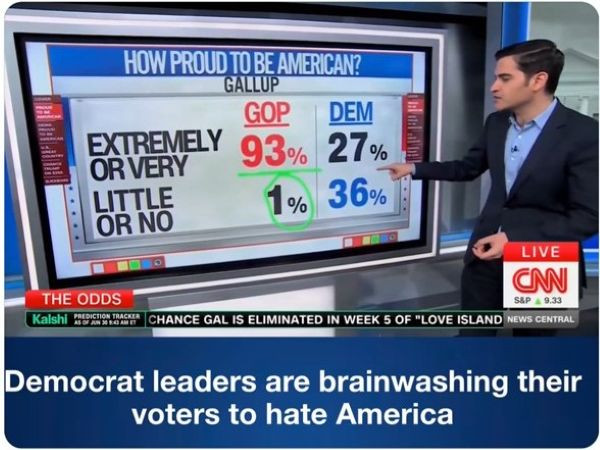
A recent NBC News survey found that 62% of 2024 Trump voters say they are extremely proud to be Americans, compared with just 12% of Kamala Harris voters. Among Republicans, 93% are extremely or very proud. Among Democrats, that number sits at just 27%.
Overall, Republicans' pride in country has held steady regardless of the political moment, averaging 90% since 2001, according to a 2025 Gallup survey. Democrats also started close to 90% in 2001, but have been sliding since then (with some precipitous drops during the Trump years). As of last year, the number stood at 36%, compared with 92% of Republicans, reported USA Today.
In our view there’s a self-perpetuating aspect to this anti-American feeling among Democrats, and it starts in childhood.
A decade-old study from researchers at Harvard University found that the July 4th holiday commemorating the announcement of the Declaration of Independence may still be serving its intended purpose – promoting patriotism.
The problem is it only seems to work on Republicans.
According to the study by Andreas Madestam and David Yanagizawa-Drott, "There is no evidence of an increased likelihood of identifying as a Democrat, indicating that Fourth of July shifts preferences to the Right rather than increasing political polarization."
The three key findings of those attending July 4th celebrations:
- When done before the age of 18, it increases the likelihood of a youth identifying as a Republican by at least 2 percent.
- Celebrating Independence Day raises the likelihood that parade watchers will vote for a Republican candidate by 4 percent.
- Celebrating the 4th of July boosts the likelihood a reveler will vote by about 1 percent and increases the chances they'll make a political contribution by 3 percent.
- What's more, the impact isn't fleeting. "Surprisingly, the estimates show that the impact on political preferences is permanent, with no evidence of the effects depreciating as individuals become older," said the Harvard report.
It is worth noting that many of the grievances the Founders outlined in the Declaration of Independence had to do with taxes and big government, so perhaps it is understandable that the sentiments commemorated on July 4th don’t resonate with liberals and Democrats as much as with conservatives and Republicans.
However, love of country should not be conditional. With America's 250th birthday upon us, the lack of patriotism among Democrats is alarming. And while the county’s political elite, particularly Democratic Party leaders, have made no secret of their personal distaste for Donald Trump, transferring that distaste – even hatred – for the sitting president to the country itself goes far beyond anything we have seen in the past.
Those who are confused or surprised by the rise of the Democratic Socialist movement within the Democratic Party should not be. As the Harvard study suggests, it started in the childhood homes of the first generation of Americans to be reared by parents who hate their country and is merely being carried to its logical conclusion by this cadre of rising young Communists who are taking over the Democratic Party.
George Rasley is editor of Richard Viguerie's ConservativeHQ.com. A veteran of over 300 political campaigns, he served as a staff member or advance representative for some of America’s most recognized conservative political figures, including Ronald Reagan, Sarah Palin and Jack Kemp. A member of American MENSA, he served on the House and Senate staff and on the staff of Vice President Dan Quayle. Rasley is a graduate of Hanover College and studied international affairs at Oxford University's Worcester College.