
Is it possible for these three propositions to all be true at the same time? Hyperscale data centers are essential for national security, hyperscale data centers are the employment opportunities of the future, and the community benefits of a hyperscale data center outweigh their burdens on local infrastructure, water supplies, power grids and other resources essential to a community’s quality of life.
The first one is the easiest one to prove true: Yes, winning or at least keeping ahead in the data center race, and the accompanying artificial intelligence race, are indeed essential to our present and future national security.
And, as is often the case, that is because our enemies – in this case the Communist Chinese – are weaponizing the technology against us at a frightening pace.
As the researchers at the University of Virginia’s National Security Data and Policy Institute explained in a 2025 paper, artificial intelligence is at the core of the Chinese Communist Party’s (CPC) vision for national security and technological self-reliance. Over the course of decades, Chinese leaders have developed layers of national policy that align government agencies, private companies, the military, and academia on the development and implementation of this emerging technology. China’s AI ecosystem is rapidly developing technological breakthroughs that expand its global influence—and the political control of the CPC. Today, China’s centrally planned AI strategy has made it a peer competitor with the US, whose less regulated AI ecosystem is mostly led by private tech companies.
These activities have huge ramifications for America’s national security, and the results are already being seen on the battlefield. In April 2026, for instance, the Iranian regime used weapons systems powered by Chinese AI made with stolen U.S. technology to attack American warfighters (Cadell et al., 2026). Although China has a long history of illegitimate technology competition, its escalatory methods in the AI race may represent a new high-water mark for the CCP’s recklessness. The geopolitical importance of AI could draw even more egregious practices from the regime. The U.S. needs to act quickly and decisively to counter current and future threats from Red China’s all domain unrestricted warfare against us.
The proposition that is often used to sell the siting of hyperscale data centers to skeptical communities is that they will bring employment, especially high paying tech jobs, may not be so easy to prove to be true.
As our friend Stephen Moore explained in a recent op-ed for FOX News, the AI buildout is the largest infrastructure project in our history — bigger in real dollars than the railroads, rural electrification, or the interstate highways.
Construction of a single campus puts more than a thousand tradesmen to work for years at a time. And, as Steve noted, these are careers in the skilled trades: electricians, pipefitters, welders, HVAC technicians. No four-year degree, no student debt. In Iowa, seven hundred apprentices will be trained in Cedar Rapids by 2030.
Brittany Kaiser, CEO of AI infrastructure company Alpha Compute, told Fox News Digital that data centers require workers not only to build the facilities and energy infrastructure, but also to install equipment, monitor operations, perform maintenance and support future expansion.
"These are projects that can provide hundreds or thousands of jobs over many, many years," Kaiser said. "It's not a quick construction project."
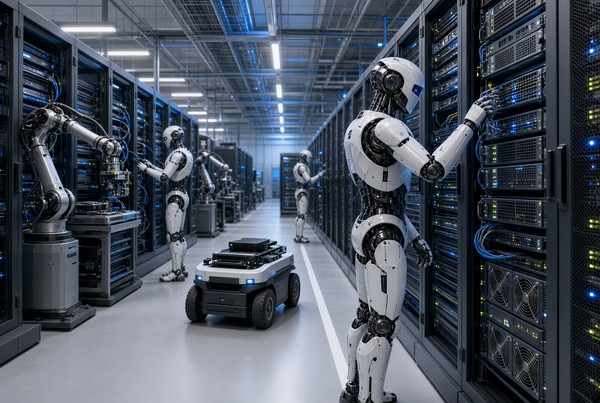
Unfortunately, Ms. Kaiser’s optimistic prediction of the long-term employment opportunities data centers may provide is being undercut by the data center developers themselves, who are – you guessed it – working on the technology to replace human workers with AI powered robots to maintain their data centers.
Mark Zuckerberg’s Meta, the parent company of Facebook, is testing robots that can plug in cables, reset servers, and handle other tasks inside its data centers, according to several current and former workers familiar with the projects. The ongoing effort, which has not been previously reported, may eventually allow Meta to operate its rapidly expanding data center footprint with fewer humans, keeping labor costs in check as its spending on AI infrastructure soars.
One Meta data center worker interviewed for an article in Wired Magazine estimates that if it’s successful, the bot could replace up to 80 percent of some people’s workloads. “We thought those of us performing the physical tasks were safe for a while, but not anymore,” says the worker. “It’s coming for us all, unfortunately.”
Finally, how legitimate are the concerns about the demands hyperscale data centers put on the resources and infrastructure of a host community?
There’s no doubt hyperscale data center development can have benefits for a host community. When Google learned that some Council Bluffs, Iowa students had laptops but no internet at home, it extended its own wireless network to serve them for free. The company has put millions into local schools and nonprofits and funded the city's free public Wi-Fi. It also committed to replenishing 120 percent of the water it consumes, starting with a $1.3 million Missouri River Basin conservation project.
As Steve Moore noted in the article cited above, Google's presence generated $2.7 billion in economic activity for Iowa last year, a huge boost to the economy of a small state.
However, hyperscale data centers are also competing with other businesses and consumers for the resources that are needed to build and operate them – and their requirements are truly massive.
So, it is also true that hyperscale data centers require massive amounts of electricity, water, land, and specialized equipment, placing unprecedented strain on local utility grids and natural resources.
An MIT study found that U.S. data centers consumed more than 4% of the country’s total electricity in 2023, and by 2030 that fraction could raise to 9%. A single hyperscale data center can consume as much electricity as 50,000 homes.
A single hyperscale facility typically draws over 100 megawatts (MW)—comparable to the energy use of 80,000 to 100,000 homes—with emerging AI campuses pushing into the gigawatt (GW) scale. High-performance AI server racks demand 40 to 120 kilowatts each, a steep jump from the historical 5 to 10 kilowatts per rack.
Shortages of high-voltage transformers, localized substations, and transmission lines are already creating major supply chain bottlenecks in the electric utility industry.
Cooling thousands of dense processors requires millions of gallons of water per day via evaporative towers or liquid cooling systems, with U.S. consumption projected to rise significantly.
According to analysis by McKinsey, this surging consumption requires extensive grid expansions and careful navigation of local water scarcity. Consumer Reports notes on that these immense loads are actively influencing regional electric utility rates and availability.
What’s more, multi-building campuses often span hundreds or over 1,000 acres, competing directly with rural and agricultural zones, dwarfing the small towns that serve farmers and rural residents and negatively impacting their quality of life with noise and air pollution.
So, do the benefits of a hyperscale data center outweigh its burdens on the host community?
The leaders of Council Bluffs, Iowa have apparently concluded that they do, while one state over, the citizens of Festus, Missouri, unhappy with the city council’s approval of a $6 billion data center, struck back at the polls, ousting all four incumbent council members running for reelection.
So, are our three propositions all true?
We count the first, that hyperscale data centers are essential to national security as undoubtedly true. The second, that hyperscale data centers are the employment engines of the future as true for the moment, but unproven for the longer term, and the final proposition, that the benefits of a hyperscale data center outweigh the burdens, as something only the citizens of the host community can decide, meaning that local control of the siting decision is the key determinant of citizen satisfaction with the benefit vs. burden decision.