
In one of his must-read emails David Lane, founder of the American Renewal Project, observed that in the ancient world, the city gate was not merely the entrance to the city. It was the place where commerce was conducted, politics discussed, judgments rendered, legal matters settled, disputes heard, bargains struck, and the civic life of the community governed.
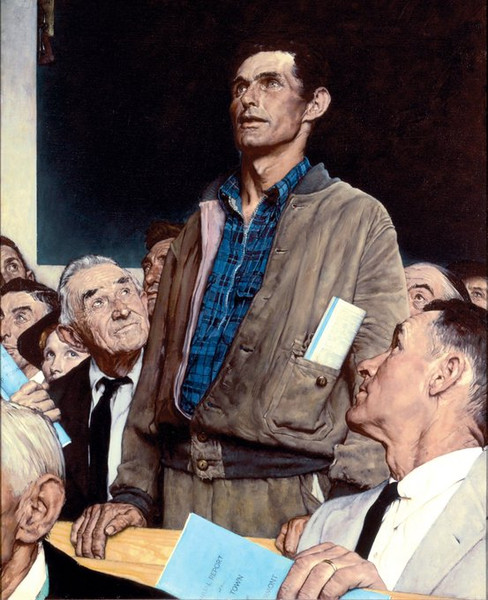
It was the central place of public life - the public square, and with religious freedom as we have known it on the ballot, the American Church must “embrace its role in the public square."
Mr. Lane further suggested that:
William McKane [1921-2004], the Scottish Biblical scholar, noted that Biblical Wisdom does not recoil from the rough-and-tumble of the marketplace, amid all its busyness, noise, bargaining, politics, and disputes. Wisdom does not wait for a quiet room. She goes to the gate, where life is being decided, and lifts her voice among men who are busy, distracted, ambitious, and preoccupied; in the very places where life, money, power, politics, and public order are being negotiated.
Wisdom does not enter the gate with a reserved platform, a respectful crowd, or a guaranteed hearing, McKane adds. She speaks in the rough-and-tumble of public life, where men may ignore her, mock her, resent her, or simply be too busy with money, politics, disputes, and pleasure to pay much attention. Wisdom is not esoteric or academic, Michael V. Fox notes; she plunges into the hurry and rush of everyday life to reach men and women where they are.
Our pastor ran for the California Assembly in 2014. As we mentioned last week, during that campaign, he spoke in 150 homes - ‘coffees’ - across the district, meeting with people who would never darken the door of a church.
Much of the Church and its activity today appears to be housed in the sanctuary, waiting for the world to come to it. Yet the contemporary city gate has taken new forms: the precinct, the school board, the courtroom, the ballot box, the legislature, and the digital platforms where public opinion is shaped - X, YouTube, Facebook, Instagram, TikTok, Google, podcasts, and the algorithm.
These are the places where tens of millions of Americans now congregate daily to see, hear, believe, argue, mock, learn, and deliberate.
It is difficult not to recognize that secularism is already seated there, and that her Biblical genre - Folly - has no intention of remaining private, harmless, or hidden. Folly now sways culture and competes for ideological supremacy over the levers of economic, political, cultural, educational, professional, and recreational power in America.
The issue today is not whether the Church will be political. The issue is whether the Church will be Biblical. Let us ask it out loud: Where is the Church? Christian withdrawal from civic life over the last 100 years is not Biblical piety; it is the abandonment of the very ground where Wisdom must be rooted.
Never limited to the confines of the sanctuary, Solomon’s wisdom was rooted in the places where power, money, justice, education, commerce, and public order were negotiated. It was Solomon who noted that Folly “sits at the door of her house, on a chair at the city heights” [Proverbs 9:14]. Michael V. Fox translates: “Like Wisdom, Folly seeks a public venue and appears in much the same places as Wisdom. They are often in proximity, proposing alternative choices in many circumstances.”
America’s pastors find themselves at a remarkable moment in history. The 2026 election cycle presents targeted congressional districts where the margin between outcomes is thinner than most people can imagine, and where organized, Biblically grounded civic engagement at the precinct level can prove decisive.
The question is whether Wisdom will return to the gate, or whether secularism, in the Biblical genre of Folly, will continue to sit there largely unchallenged.
Let’s not forget that:
• In the 2020 election cycle, 37% of Americans who attend church regularly did not vote.
• Religious freedom as we have known it in America is on the ballot. The hour requires more than concern, more than conversation, and more than complaint. It requires pastors and pews to take responsibility.
This is why every pastor should establish a trusted Faith Action Leader: one dedicated volunteer who gathers the names, phone numbers, and addresses of church members and regular attendees, then cross-references that list to determine who is registered to vote and who is not.
The Faith Action Leader can then help provide Biblically grounded issue education and voter guides, making sure the congregation understands what is at stake. But the most important responsibility is follow-through: lovingly and lawfully tracking those individuals until they have actually voted.
A simple QR code in the weekly church bulletin can make this practical. The parishioner scans the code, enters his or her name, address, phone number, and other necessary information, and indicates whether help is needed with voter registration.
From there, the Faith Action Leader team can assist in completing the required voter registration paperwork for the local board of elections, obtain the parishioner’s signature where required, and ensure that the completed form is lawfully delivered to the appropriate election office.
This is not complicated. It is stewardship. Every church has a bulletin. Every phone has a camera. Every congregation has men and women who need to be encouraged, equipped, registered, informed, and turned out.
The church should pray together as a congregation and place the QR code in the bulletin each week so parishioners can register, engage, volunteer, and take their place at the gate.
Wisdom, after a long absence, is required again at the gate. Folly is already seated there. Secularism and Folly have sat there largely unchallenged across the 20th and 21st centuries. The question before us is whether Christ’s ekklesia will show up.
Thankfully, Gideons and Rahabs are now entering America’s public square, concluded Mr. Lane.
Mr. Lane is right, as CHQ and our chairman, Richard A. Viguerie, have, for decades, been urging Christians to get out of the pews and on to the campaign trail.
What does this mean in practical terms?
Mr. Lane suggested in an interview with The Christian Post, and we agree, that it means galvanizing Christians to register to vote.
According to a recent study from Turning Point USA first reported by Breitbart, more than 4.5 million Republican voters in several battleground states are "disengaged" from the political process, which is a sufficient number to swing the presidential election in 2024.
Lane said many Evangelicals are similarly disengaged, and ARP is doing what they can to change that.
"I think that if Evangelicals move, we win big," Lane said regarding the country's political future. "It's estimated that 65 to 80 million Evangelicals have not registered to vote, which means they've never voted. Half of those don't vote in a presidential year like 2024, which means you get 25 percent voting."
"In an off-year election — the next year is 2026 — half of those don't vote, so you get 12% to 15% of Christians voting," he said. "We did this to ourselves. The culture is nothing but a public manifestation of the religion covering America, which is godless secularism."
One example of how this works was the North Carolina Renewal Project voter registration effort, the goal of which was to mobilize 6,000 churches in the state to register all eligible unregistered voters in their pews on three different Sundays, which they dubbed "Citizen Sundays."
"If righteousness exalts a nation, it logically follows that those living in rebellion against God, rejecting His ultimate scriptural instructions for meaning, purpose, and identity, cannot be trusted with the cultural levers of power and control," Lane wrote in an email to pastors in North Carolina regarding the initiative.
"Two distinct religions are vying for control over the public square in America — Christianity and secularism. The immutable former and the ever-changing latter cannot coexist; one will ultimately go down as a consequence of the rise of the other," Mr. Lane concluded.
We urge all CHQ readers and friends to share this important information widely. Forward this message to your family, friends, neighbors, church and civic club mailing lists and encourage them to act upon it.